Venezuela Invasion
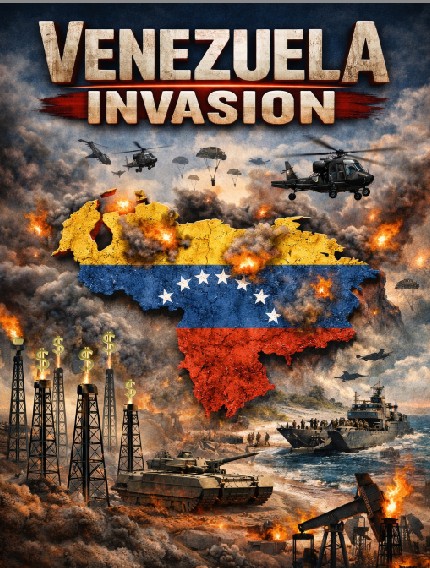
On January 3, 2026, President Trump ordered the US military to invade Venezuela, arrest President Nicolas Maduro and his wife Cilia Flores, and bring them to the US to face charges alleging that Maduro, his wife and son, and their accomplices engaged in a cocaine-trafficking conspiracy and partnered with cartels designated as terrorist groups.
The US invasion force included 150 American planes, drones and helicopters. They bombed radar and air-defense sites and dropped off the commandos at Venezuela’s most fortified military base.
KEY QUESTIONS:
- Who will the US support to run Venezuela?
- The current Maduro government to ensure stability and the ease the takeover of oil resources
- Support the Maduro opposition and elected President for free elections to restore democracy, but risk instability
- Will the US military be involved in maintaining law and order?
- Who will invest in rebuilding the oil infrastructure?
- How long will it take to revitalize their oil infrastructure?
- Will Venezuela re-nationalize the oil after the infrastructure is rebuilt?
IN THIS REPORT:
- A look at Venezuela
- Venezuela & Oil
- Venezuela & Politics
- Justification for Invasion (Operation Absolute Resolve)
- Possible Outcomes
- Contact Congress, let your voice be heard
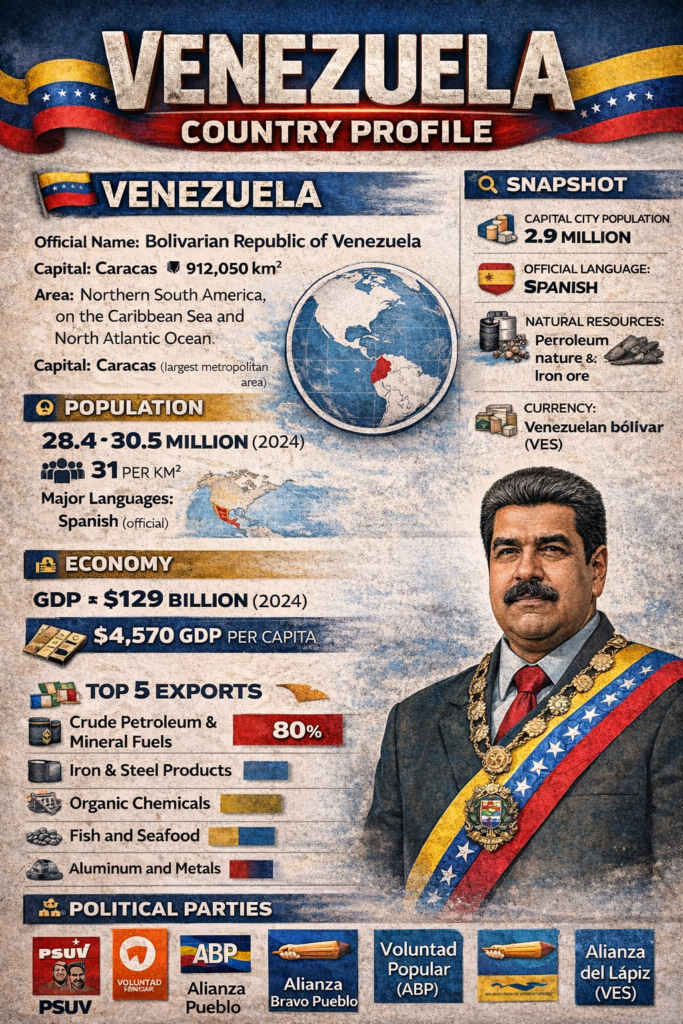
A look at Venezuela
Venezuela & Oil
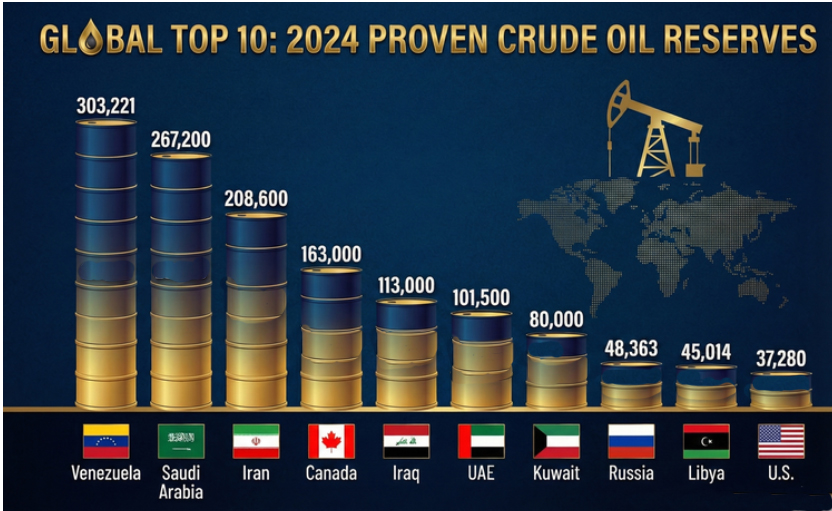
It has been reported that Venezuela holds the world’s largest crude oil reserves.
-
Venezuela’s reserves are huge on paper, but actual production capacity has been very low compared with historic potential — often much less than 1 million barrels per day, a fraction of what the country could produce if infrastructure and investment were robust.
-
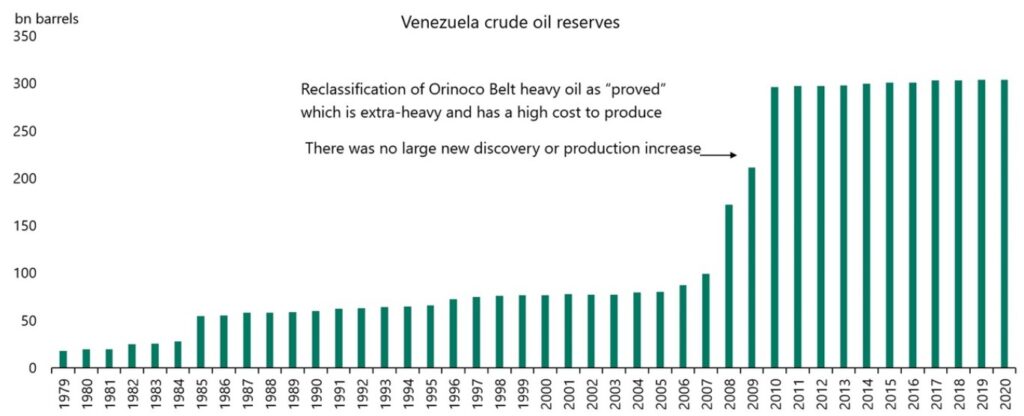
The reliability of the reserve estimate is tied to technological conditions and economic viability as currently defined. If oil prices fall or infrastructure remains degraded, some of the “proven” reserves might not be practically recoverable without significant investment.
- Venezuela reclassified a significant amount of its existing crude oil as “proven” in the early 2000s after Chávez ordered all foreign oil companies to convert their projects into majority state-owned joint ventures, which tripled the country’s crude oil inventory.
Oil Industry History
Venezuela’s transformation into a global oil power began in the 1910s and 1920s with the discovery of vast petroleum reserves. Foreign investment, led by American and European companies including predecessors of Chevron, Shell, and Exxon, rapidly developed these fields. Under military strongmen like Juan Vicente Gómez, the Venezuelan state offered generous concessions in exchange for royalties and taxes. By the 1940s, Venezuela had become a major global exporter, with U.S. oil companies investing over $5 billion in the industry.
Fifty years ago, on January 1, 1976, President Carlos Andrés Pérez officially nationalized Venezuela’s oil industry, creating Petróleos de Venezuela S.A. (PDVSA). This nationalization was less a radical break than a continuation of existing relationships on new terms. PDVSA quickly signed service and technology agreements with the very companies it had expropriated, perpetuating the business philosophy and operational practices of the multinationals that had built Venezuela’s modern oil industry.
The election of Hugo Chávez in 1998 marked a fundamental shift in oil policy. Twenty-five years ago, in 2001, he enacted the new Hydrocarbons Law, which marked a turning point in public sentiment. In 2002, Rafael Ramírez, the energy minister, explicitly politicized PDVSA employment, telling workers they must support Chávez or lose their jobs, declaring that ‘PDVSA is red from top to bottom.’
Between 2006-2007, during the presidency of George W. Bush, Chávez ordered all foreign oil companies operating in the Orinoco Belt to convert their projects into majority state-owned joint ventures with PDVSA holding at least 60 percent control. ExxonMobil and ConocoPhillips refused these terms, leading to the seizure of their assets in 2007. Companies like Chevron that accepted renegotiation stayed on under less favorable conditions. This period of expropriations, combined with chronic underinvestment and political management, began PDVSA’s long decline from Latin America’s largest company to a shadow of its former self.
Venezuela & Politics
The Maduro Regime (2013-2026)
When Hugo Chávez died in 2013, Vice President Nicolás Maduro assumed power. Unlike his charismatic predecessor, Maduro presided over Venezuela’s transformation into a failing state. The combination of falling oil prices in 2014, decades of mismanagement, and Maduro’s continuation of Chávez’s policies triggered economic collapse. Venezuela experienced hyperinflation reaching 700 percent above 2014 levels, and by 2016, oil production had fallen to its lowest point in 23 years.
As the economic crisis deepened, Maduro consolidated authoritarian control through political repression, censorship, and electoral manipulation. His 2018 reelection was widely condemned as unfair and undemocratic by international observers. Nearly sixty countries, including the United States, subsequently recognized opposition figure Juan Guaidó, head of the National Assembly, as Venezuela’s interim leader, though this recognition ultimately failed to dislodge Maduro from power.
The Humanitarian and Migration Crisis
Venezuela’s collapse created one of the world’s worst humanitarian crises. Over seven million Venezuelans fled the country, with Colombia hosting the largest diaspora. The exodus placed enormous strain on neighboring countries and became a central concern for regional security. Inside Venezuela, widespread shortages of food and medicine, combined with the collapse of public services, created desperate conditions for those who remained.
The Rise of María Corina Machado and Opposition Politics
In this context of crisis, opposition leader María Corina Machado emerged as a prominent voice for democratic transition. Her advocacy for peaceful change and criticism of the Maduro regime earned her international recognition, culminating in the 2025 Nobel Peace Prize. However, Machado faced constant threats from the Maduro government, and her political consultant and activist allies were targeted in violent attacks.
Another key opposition figure, Edmundo González Urrutia, was successfully extracted from Venezuela by Spain as he faced threats from the Maduro regime. His son-in-law remained a political prisoner in Venezuela, complicating potential plans for his return.
Venezuela’s vice president, Delcy Rodríguez, has taken over as acting leader in the wake of a U.S. raid that deposed President Nicolás Maduro over the weekend. She collaborates closely with her brother, Jorge Rodriguez, who leads the national assembly.
Justification for Invasion (Operation Absolute Resolve)
The 2025 National Security Strategy and the ‘Trump Corollary’
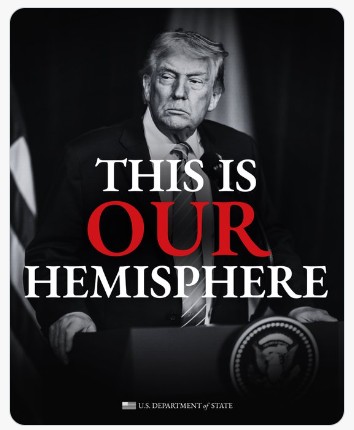
The Trump administration’s November 2025 National Security Strategy provides essential context for understanding Operation Absolute Resolve. This document represents a fundamental departure from previous U.S. strategic frameworks and explicitly prioritizes Western Hemisphere security over other global commitments.
Core Principles and Divergence from Past Strategies
Trump’s 2025 National Security Strategy explicitly rejects the post-Cold War expansion of America’s ‘national interest’ definition and emphasizes that economics are ‘the ultimate stakes’.
The strategy emphasizes four core objectives in the hemisphere:
- Combating drug trafficking and transnational criminal organizations,
- Preventing hostile foreign influence (particularly from China, Russia, and Iran),
- Ensuring access to critical resources and supply chains, and
- Maintaining regional stability to prevent migration crises.
Implications for Military Action
The National Security Strategy’s emphasis on the Western Hemisphere provided both a strategic rationale and an operational framework for intervention in Venezuela. Its treatment of drug trafficking as a national security threat requiring military response, combined with the designation of drug cartels as terrorist organizations, created legal pathways for military force.
International Criticism of the Strategy
The National Security Strategy drew sharp criticism from analysts and European allies. Brookings Institution scholars described it as marking ‘an ideological and substantive shift’ that could lead to ‘a far lonelier, weaker, more fractured future’ for America. The strategy’s harsh criticism of European allies, accusing them of ‘civilizational erasure’ through immigration and declining birthrate, has created unprecedented tension in transatlantic relations.
Council on Foreign Relations experts noted that the strategy’s threat-oriented vision of the hemisphere raised troubling questions about how the U.S. would respond to democratic governments that opposed American preferences, particularly given the administration’s use of tariffs and election interference to pressure compliance.
Venezuela and Drugs
While Venezuela plays a role in the transshipment of cocaine, multiple law enforcement sources indicate it is not among the primary direct suppliers of cocaine reaching the United States. Most cocaine entering the U.S. originates in Colombia and travels through Mexico. Experts outside Venezuelan political narratives have noted that Venezuela’s geographic position east of Colombia’s Pacific coast limits its direct utility as a principal sea route for U.S.-bound shipments.
In this broader context, Venezuela’s role is intertwined with larger regional trafficking patterns: it functions as a link in distribution chains that incorporate Colombian production and Mexican transit infrastructure; however, it does not dominate the trafficking routes feeding the U.S. market in the same way that Mexico and Central American corridors do.
Data from international monitoring bodies like the United Nations Office on Drugs and Crime (UNODC) confirms that Venezuela is not a major producer of synthetic opioids such as fentanyl which is the drug category most associated with U.S. overdose deaths, and its role in cocaine transit to the U.S. appears marginal compared with Mexico’s dominant position in organizing distribution once the drugs reach North America.
SIDE NOTE: In 2025, President Trump pardoned Former Honduran president Juan Orlando Hernández, who was convicted of running his country as a vast “narco-state” that helped to move at least 400 tons of cocaine into the United States. He is one of more than 100 people accused of drug-related crimes whom Trump has pardoned.
Possible Outcomes of the U.S. Invasion
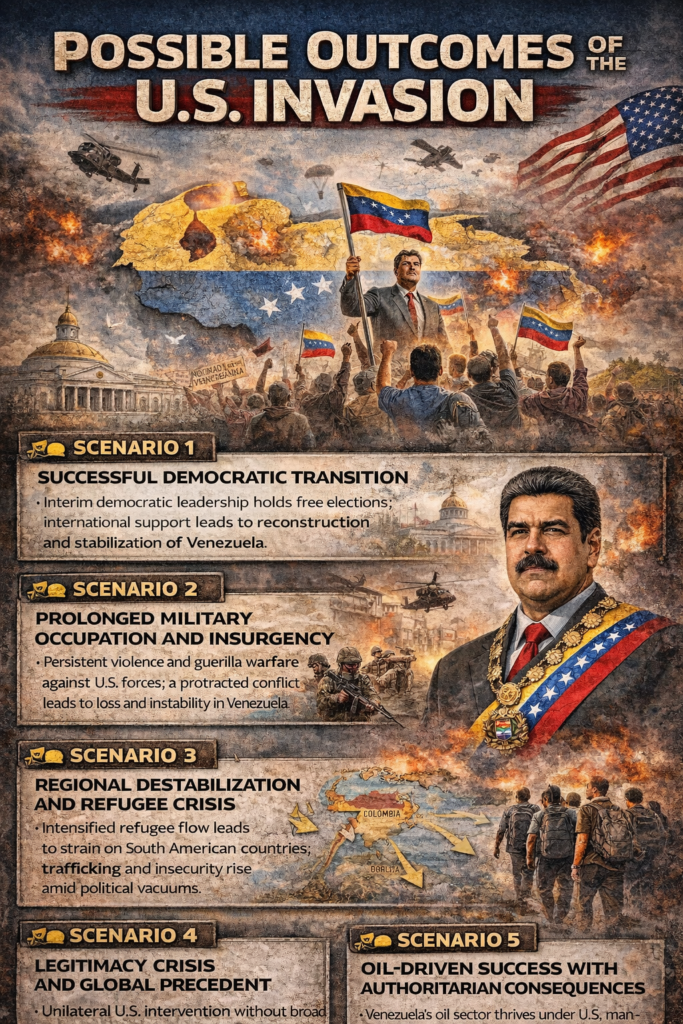
Multiple scenarios could unfold, each with profound implications for Venezuela, the Western Hemisphere, and U.S. global standing.
Scenario 1: Successful Democratic Transition
In the best-case scenario, the removal of Maduro catalyzes a genuine democratic transition. María Corina Machado or Edmundo González Urrutia, with U.S. backing and Spanish diplomatic support, could assume leadership and begin rebuilding Venezuelan institutions. This would require the Venezuelan military, currently commanded by Defense Minister Vladimir Padrino López, to accept the transition rather than resist it.
For this scenario to succeed, several conditions must align.
First, the Venezuelan military and security forces, who have been central to maintaining the Bolivarian regime since 1999, would need to abandon their loyalty to the system that has enriched them.
Second, the opposition would need to quickly establish legitimacy and begin addressing the humanitarian crisis and economic collapse.
Third, international actors beyond the United States – particularly Latin American neighbors – would need to support rather than condemn the transition.
Fourth, U.S. oil companies would need to successfully revitalize PDVSA’s operations and increase production to benefit the Venezuelan people, not just American interests.
President Trump announced that U.S. oil companies would ‘take charge’ of Venezuela’s oil operations, with revenues used to support Venezuela and reimburse the United States for intervention costs. If managed transparently with genuine Venezuelan oversight, this arrangement could provide the capital and expertise needed to restore production.
Scenario 2: Prolonged Military Occupation and Insurgency
A darker possibility is that Operation Absolute Resolve becomes the opening phase of a protracted conflict. Despite Vice President Delcy Rodríguez’s statement that she does not plan to assume the presidency, Maduro loyalists could refuse to accept his removal as legitimate. The four million-strong Bolivarian Militia, armed civilians and uniformed militia members loyal to the Bolivarian Revolution, could wage an insurgency against U.S. forces and any successor government.
Military analysts had previously warned that invading Venezuela would require over 100,000 U.S. troops to secure the country and deal with Venezuela’s destroyed infrastructure, armed militias, and local drug cartels. The October 2025 assessment that U.S. forces in the Caribbean were insufficient for invasion by a factor of 5 to 20 suggests the operation may have been launched with inadequate resources for stabilization. If Trump’s stated willingness to deploy ‘boots on the ground’ leads to a major troop commitment, the United States could find itself in another costly and open-ended occupation.
Shannon K. O’Neil of the Council on Foreign Relations warned in 2018 that military intervention ‘would be a disaster,’ noting that American troops would ‘have to deal with Venezuela’s destroyed infrastructure, armed militias, local drug cartels, and the blame from international observers if they were unable to rebuild the nation.’ These warnings now appear prescient. Moreover, Maduro’s allies, including Cuba, Russia, China, Iran, and Nicaragua, have provided diplomatic and potentially material support that could sustain resistance to U.S.-backed governance.
Scenario 3: Regional Destabilization and Refugee Crisis
Military intervention risks exacerbating rather than resolving Venezuela’s humanitarian crisis. Colombian President Gustavo Petro immediately deployed security forces along the border to prepare for a potential refugee influx, recognizing that conflict could drive additional millions from Venezuela. Brazil’s President Luiz Inácio Lula da Silva condemned the strikes as crossing ‘an unacceptable line’ and setting a ‘dangerous precedent,’ reflecting widespread Latin American opposition to U.S. military action.
The intervention has created deep divisions within the hemisphere. While some governments welcomed Maduro’s removal, many view it as a violation of sovereignty and international law.
Cuba’s dependency on Venezuelan oil means Havana faces potentially catastrophic economic consequences if oil supplies are disrupted, potentially destabilizing the Cuban government. Mexico and other left-leaning Latin American governments could align in opposition to U.S. hegemony, fracturing hemispheric cooperation on trade, migration, and security issues.
Scenario 4: Legitimacy Crisis and Global Precedent
Multiple observers have drawn parallels to the 2003 invasion of Iraq and the 1989 invasion of Panama, noting similar justifications and contested legitimacy. United Nations Secretary-General António Guterres stated the action sets a ‘dangerous precedent’ in international law, while The Guardian writer Simon Tisdall described it as ‘not so very different from’ Russia’s invasion of Ukraine.
Most troublingly, the operation could be cited by other powers to justify future military actions. Tisdall warned it could justify a Chinese invasion of Taiwan, given China’s long-standing claims. Russia has used similar rhetoric about fighting drug trafficking and protecting Russian-speakers to justify operations in neighboring countries. By explicitly rejecting multilateral legitimacy and acting unilaterally, the United States has eroded the normative constraints that previously limited such behavior.
The legal questions surrounding the operation remain unresolved. Congressional leaders, including Secretary of State Marco Rubio, confirmed that Congress received no prior warning, with Rubio calling the operation ‘too sensitive to share.’ This circumvention of congressional war powers authority and apparent lack of legal justification under international law raises fundamental questions about executive power and the rule of law.
Scenario 5: Oil-Driven Success with Authoritarian Consequences
A final possibility combines elements of the above scenarios in ways that could be judged successful by some metrics while deeply troubling by others. If U.S. and international oil companies successfully restore Venezuelan production using the country’s vast reserves, the world’s largest at 304 billion barrels, this could generate enormous revenues. These revenues could fund humanitarian relief, infrastructure reconstruction, and debt repayment while enriching American companies and filling U.S. government coffers as Trump promised.
Stephen Miller’s claim that Venezuelan oil ‘belongs’ to the United States, while legally baseless under the principle of Permanent Sovereignty over Natural Resources, reflects an underlying assumption that might shape post-intervention governance. If the United States maintains effective control over oil revenues and political decision-making while installing pliant Venezuelan leaders, this would represent less a democratic transition than a change in imperial management.
The United States may prioritize compliant governance over genuine democratic legitimacy. María Corina Machado’s observation that ‘Venezuela has already been invaded’ by foreign actors and criminal organizations operating with regime consent could be turned on its head if U.S. occupation similarly subordinates Venezuelan sovereignty to American interests.
Take action, Contact Congress
Related Committees With Partial Foreign Affairs Oversight
While not exclusively foreign-policy committees, the following have significant roles:
House Armed Services Committee (HASC)
Senate Armed Services Committee (SASC)
-
Military operations abroad
-
Defense policy and overseas troop deployments
House Permanent Select Committee on Intelligence (HPSCI)
Senate Select Committee on Intelligence (SSCI)
-
Intelligence activities related to foreign governments and threats
House Appropriations Committee
Senate Appropriations Committee
-
Funding for foreign aid, diplomacy, and international security programs