Ice Arrests
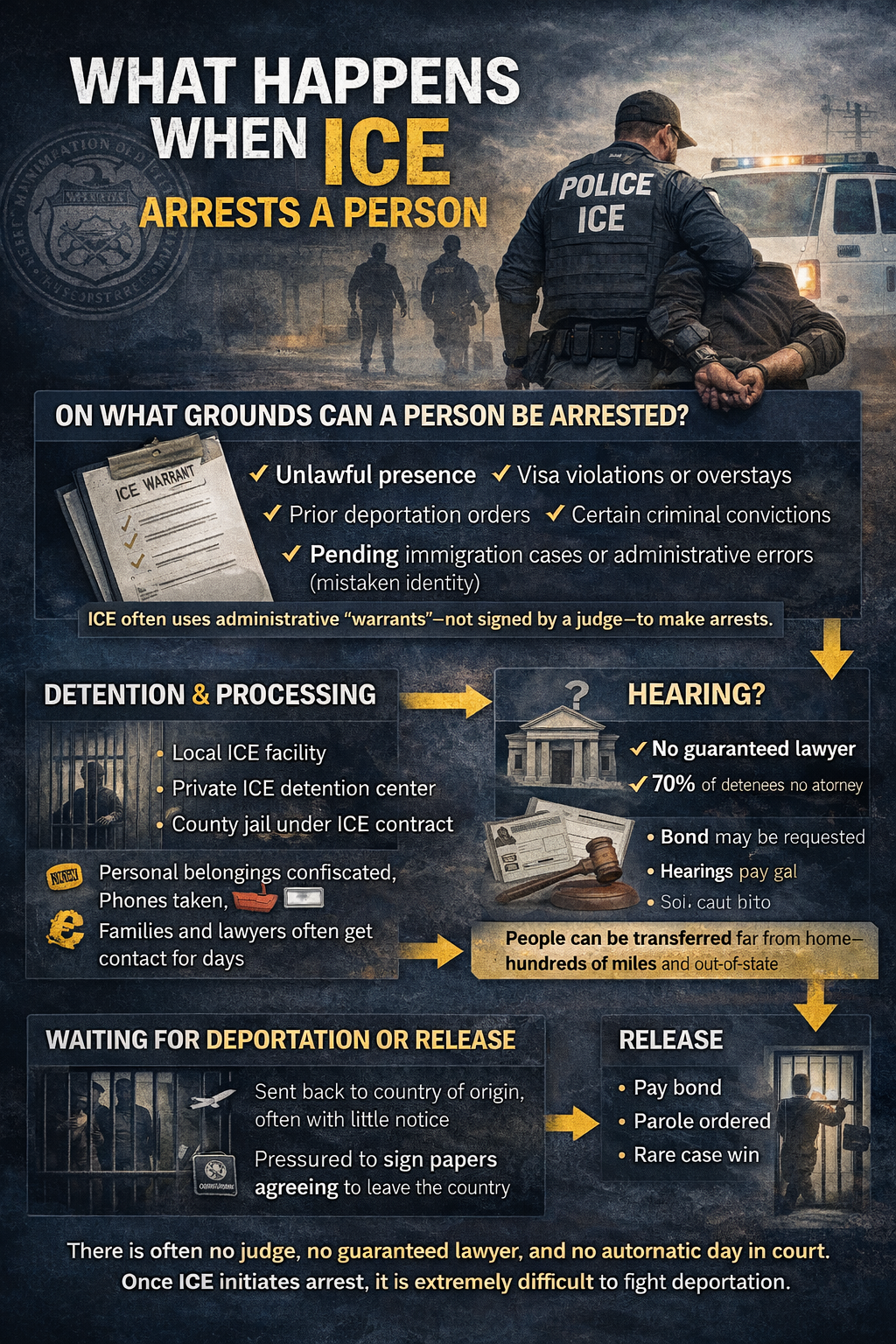
What Happens When ICE Arrests a Person
When Immigration and Customs Enforcement (ICE) arrests someone, there is often no judge present. No jury. Sometimes, not even a warrant signed by a court. What follows is a bureaucratic process that can move with stunning speed—and devastating consequences.
This is how it works.
1) On What Grounds Can ICE Arrest Someone?
ICE arrests are civil immigration arrests, not criminal arrests, yet they often look and feel the same.
Legal Grounds for Arrest
ICE may arrest a person if an agent believes they are “removable” under the Immigration and Nationality Act (INA). Common grounds include:
- Unlawful presence (entering without inspection or overstaying a visa)
- Visa violations (working without authorization, violating status terms)
- Prior removal orders (even decades old)
- Certain criminal convictions (after the criminal sentence is complete)
- Pending immigration proceedings
- Administrative errors (mistaken identity, database errors)
Critically:
-
ICE agents often rely on administrative warrants (Form I-200 or I-205) signed by ICE officials, not judges.
-
Administrative warrants do not authorize entry into a home without consent, yet arrests inside residences still occur through pressure, deception, or misunderstanding of rights.
In practice, ICE agents frequently arrest people who have no criminal convictions, are long-term residents, or are in the middle of legal immigration processes.
2) Where Is the Person Taken After Arrest?
After arrest, the individual is placed into ICE custody, often immediately disappearing from their family.
Initial Processing
The person is typically taken to:
- A local ICE field office, or
- A short-term holding facility, sometimes a county jail under ICE contract
During this phase:
- Personal belongings are confiscated
- Phones are taken
- Access to attorneys is often delayed or denied for hours or days
Transfer to Detention
Within days, or sometimes hours, the person may be transferred to:
- A dedicated ICE detention center
- A privately run facility (e.g., GEO Group, CoreCivic)
- A county jail housing ICE detainees
Transfers can occur across state lines, hundreds or thousands of miles from the person’s home, attorney, or children.
This geographic dislocation is not incidental, it routinely undermines access to legal counsel and family support, weakening a person’s ability to fight their case.
3) Do They Get a Hearing?
Eventually or maybe. But not immediately, and not always in a meaningful way.
Immigration Court Reality
Immigration court is:
- A civil court
- Part of the Department of Justice, not the judiciary
- Judges are not independent in the way Article III judges are
Key facts:
- There is no right to a government-appointed attorney
- Over 70% of detained immigrants go unrepresented
- Hearings often occur by video, sometimes from remote detention centers
Bond Hearings
Some detainees may request a bond hearing, but:
- Many are statutorily barred from bond
- Others wait weeks or months for a hearing
- Bond amounts can be prohibitively high ($5,000–$25,000+)
Certain people, such as those with old criminal convictions or prior removal orders, may be detained without bond entirely, regardless of family ties or rehabilitation.
4) What Happens Before Deportation or Release?
This is the most opaque and consequential phase.
While Detained
Detainees may:
- File for asylum, cancellation of removal, or other relief
- Await hearings that are repeatedly postponed due to court backlogs
- Be pressured to sign voluntary departure papers
- Experience prolonged detention lasting months or years
Conditions in detention frequently include:
- Limited medical care
- Solitary confinement (sometimes labeled “protective custody”)
- Restricted visitation
- Inadequate mental health services
Deaths in ICE custody are linked to medical neglect and have been repeatedly documented.
Deportation
If a judge orders removal, or if the person is deported under expedited removal or reinstatement procedures:
- ICE coordinates travel documents with foreign governments
- Deportation can occur with little notice
- Families may receive no warning before a loved one is put on a plane
People are deported to:
- Countries they may not have lived in since childhood
- Places where they face violence, persecution, or homelessness
- Nations with little infrastructure to receive them
Release
Release may occur through:
- Bond payment
- Parole or supervision
- Court-ordered release
But even after release:
- Individuals remain under ICE surveillance
- Missed check-ins can trigger re-arrest
- Years of uncertainty follow
The Larger Truth
An ICE arrest is not a single event; it is the opening move in a bureaucratic process designed for speed, not fairness.
There is no Miranda warning.
No guaranteed lawyer.
No automatic day in court.
What determines whether someone stays in the U.S. is often not the strength of their case, but whether they can navigate a system built to exhaust them.
And once ICE initiates that process, the balance of power shifts decisively, and often irreversibly, away from the person in custody.