Trump’s Domestic Terrorism Ruse
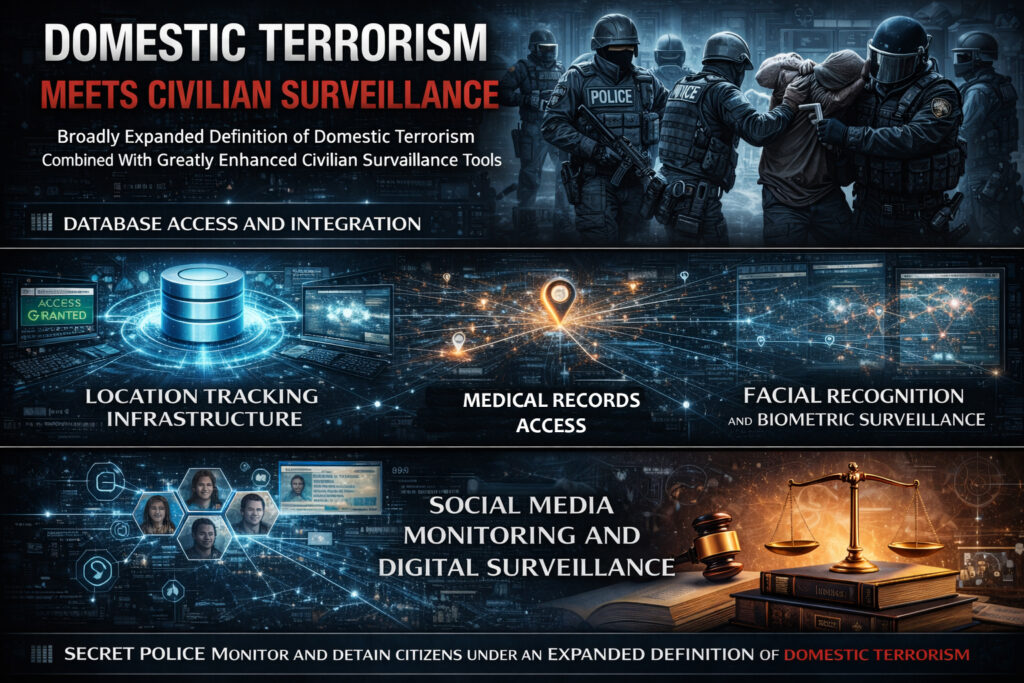
Trump has broadly expanded the definition of a Domestic Terrorist and layered it with a program of greatly expanded citizen surveillance.
TOP LINE:
Expanded Definition of Terrorism – Prosecuting beliefs rather than just actions.
Trump’s National Security Presidential Memorandum 7 (NSPM-7) represents a fundamental departure from previous domestic terrorism frameworks, transforming what was once a narrow, conduct-based definition into an expansive ideology-based enforcement regime.
Where the Patriot Act‘s 18 U.S.C. § 2331(5) focused on specific dangerous acts intended to intimidate or coerce, NSPM-7 redefines domestic terrorism through the lens of political belief, targeting what it characterizes as “anti-fascist” ideology and extending law enforcement authority to investigate not just violent acts, but the “recurrent motivations” and “ideological” foundations behind protected political speech.
Coupled with greatly enhanced citizen surveillance tools and techniques
In April 2025, ICE awarded Palantir a 30-million-dollar contract to develop ImmigrationOS, a next-generation enforcement tool. This contract is part of more than 900 million dollars in federal contracts Palantir has received since the current administration took office.
Palantir’s systems pull data from across government databases, including passport records, Social Security files, IRS tax data, and license plate reader information. It also uses facial recognition software and healthcare records. This system functions as a data integration tool, linking databases that were never intended to be connected.
Here is an in-depth look at Palantir’s surveillance capabilities
Take action, contact Congress
Committees with Jurisdiction:
- Senate Judiciary Committee – Primary jurisdiction over:
- DOJ operations and domestic law enforcement
- FBI and Joint Terrorism Task Forces
- Civil liberties and constitutional concerns
- FARA violations
- Senate Homeland Security and Governmental Affairs Committee – Jurisdiction over:
- DHS operations
- National security policy coordination
- Interagency coordination
- Senate Intelligence Committee – Jurisdiction over:
- Intelligence activities and Director of National Intelligence
- Intelligence gathering related to domestic threats
- National security intelligence operations
- Senate Finance Committee – Jurisdiction over:
- IRS activities and tax-exempt organizations
- Treasury Department financial enforcement
- Tax policy matters
- House Judiciary Committee – Primary jurisdiction over:
- DOJ operations and prosecutions
- FBI activities
- Civil liberties concerns
- Federal criminal law enforcement
- House Homeland Security Committee – Jurisdiction over:
- DHS operations
- Domestic terrorism policy
- Grant programs to state/local law enforcement
- House Intelligence Committee – Jurisdiction over:
- Intelligence community activities
- Intelligence sharing and coordination
Background Details
On September 25, 2025, President Donald Trump issued National Security Presidential Memorandum 7 (NSPM-7), titled “Countering Domestic Terrorism and Organized Political Violence.”
This memorandum represents a fundamental departure from previous domestic terrorism frameworks, transforming what was once a narrow, conduct-based definition into an expansive ideology-based enforcement regime.
Where the Patriot Act’s 18 U.S.C. § 2331(5) focused on specific dangerous acts intended to intimidate or coerce, NSPM-7 redefines domestic terrorism through the lens of political belief, targeting what it characterizes as “anti-fascist” ideology and extending law enforcement authority to investigate not just violent acts, but the “recurrent motivations” and “ideological” foundations behind protected political speech.
NSPM-7 threatens core constitutional freedoms by:
(1) criminalizing political viewpoints rather than violent conduct;
(2) authorizing pre-emptive investigation of Americans based on their beliefs about capitalism, religion, and social justice;
(3) directing law enforcement to trace “funding sources” and “organized structures” of political movements; and
(4) establishing a framework that could ensnare journalists, activists, educators, and nonprofit organizations in terrorism investigations.
The memorandum’s language echoes the most concerning aspects of Cold War-era McCarthyism while deploying post-9/11 surveillance infrastructure against domestic political movements.
Why this matters
NSPM-7’s Ideological Transformation
Section 1 of the memorandum declares that there are “common recurrent motivations and indicia uniting this pattern of violent and terroristic activities under the umbrella of self-described ‘anti-fascism.'” It then proceeds to list ideological markers:
“anti-Americanism, anti-capitalism, and anti-Christianity;
support for the overthrow of the United States Government;
extremism on migration, race, and gender; and
hostility towards those who hold traditional American views on family, religion, and morality.”
This language transforms political viewpoints into investigative triggers. Under this framework, Americans who critique capitalism, advocate for immigration reform, question traditional gender roles, or express skepticism about certain religious doctrines can be flagged as potential domestic terrorists based on their “recurrent motivations” rather than any dangerous conduct.
The memorandum explicitly directs law enforcement to identify “behaviors, fact patterns, recurrent motivations, or other indicia common to organizations and entities that coordinate these acts.”
The constitutional danger is immediately apparent. The First Amendment protects “anti-American” speech, socialist economic advocacy, atheism and religious criticism, and certainly political positions on immigration, racial justice, and gender equality. These are core political controversies in American democracy. By identifying opposition to “traditional American views” as a terrorism indicator, NSPM-7 effectively criminalizes one side of fundamental democratic debates.
The Expansion of Investigative Authority and Pre-Crime Surveillance
A. Investigating “Networks, Entities, and Organizations”
Section 2 of NSPM-7 directs the Joint Terrorism Task Forces (JTTFs) to “investigate potential Federal crimes relating to acts of recruiting or radicalizing persons” for political violence or conspiracy against rights. More alarmingly, it mandates investigation of “institutional and individual funders, and officers and employees of organizations, that are responsible for, sponsor, or otherwise aid and abet the principal actors” engaged in such conduct.
This language creates a dragnet for civil society organizations. Consider a hypothetical environmental nonprofit that organizes protests against immigration detention facilities. Under NSPM-7, if any individual associated with those protests commits an act of vandalism or trespass, crimes that the memorandum explicitly lists as terrorism priorities, federal investigators can trace backwards through the organization’s funding sources, examine its officers and employees, and investigate whether the nonprofit “aided and abetted” terrorism through its protected organizing activities.
The memorandum’s directive to investigate “non-governmental organizations and American citizens residing abroad or with close ties to foreign governments” engaged in potential Foreign Agents Registration Act violations further expands the scope. Civil rights organizations that receive foundation grants, immigrant rights groups with international connections, or even academic institutions with foreign donors could find themselves subjected to terrorism investigations based on their advocacy work.
B. Treasury Department and Financial Surveillance Powers
Section 2(i) directs the Treasury Secretary to “make available all resources, to the maximum extent permitted by law, to identify and disrupt financial networks that fund domestic terrorism.” This includes deploying investigative tools to “trace illicit funding streams” and providing guidance for financial institutions to file Suspicious Activity Reports on “indicia of illicit funding streams.”
The implications for financial privacy are staggering. Banks and credit unions will be instructed to flag transactions associated with organizations or individuals exhibiting the “ideological markers” identified in the memorandum. Donations to social justice organizations, payments to activist groups, or transfers to nonprofits focused on racial equity, immigration rights, or economic justice could trigger Suspicious Activity Reports that feed into terrorism databases.
Section 2(j) extends this surveillance to tax-exempt organizations, directing the IRS Commissioner to investigate whether any nonprofits are “directly or indirectly financing political violence or domestic terrorism.” Combined with the ideological framework, this creates a mechanism to strip tax-exempt status from organizations that advocate for positions associated with “anti-capitalism” or other disfavored viewpoints, even absent any connection to violent conduct.
C. Mandatory Interrogation Requirements
Section 2(k) requires all federal law enforcement agencies to “question and interrogate” individuals engaged in “political violence or lawlessness” about “the entity or individual organizing such actions and any related financial sponsorship” before plea agreements. This provision transforms minor criminal defendants into intelligence sources against political movements.
Consider the practical application: A college student arrested for trespassing during a protest against ICE detention policies can be denied a plea agreement unless they provide information about who organized the protest, which student groups participated, and how it was funded. The government effectively coerces cooperation in building terrorism cases against protected advocacy organizations as a condition of resolving minor criminal charges.
The Expansion of Criminal Liability Beyond Violence
A. Redefining Low-Level Offenses as Terrorism
Section 2(h) directs the Attorney General to issue guidance ensuring that “domestic terrorism priorities include politically motivated terrorist acts such as organized doxing campaigns, swatting, rioting, looting, trespass, assault, destruction of property, threats of violence, and civil disorder.”
This list conflates genuine terrorism (assassination attempts) with routine criminal offenses (trespass) and constitutionally protected activities that may involve minor infractions (civil disorder). A march that blocks traffic without a permit could constitute “civil disorder.” Protesters who enter a government building’s public lobby after hours commit “trespass.” Under NSPM-7, these acts become predicate offenses for terrorism investigations if they’re deemed “politically motivated”, a determination made based on the ideological framework established in Section 1.
The inclusion of “organized doxing campaigns” is particularly concerning for press freedom. Investigative journalists who publish information about public officials, including their connections, financial relationships, or residential addresses for contact purposes, could face terrorism charges if that information is subsequently used by others to harass those officials. The chilling effect on journalism is immediate and severe.
B. Conspiracy Charges and RICO Prosecutions
Section 2(k) explicitly lists conspiracy statutes among prioritized charges: 18 U.S.C. 241 (conspiracy against rights), 18 U.S.C. 371 (conspiracy to commit offense), and the Racketeer Influenced and Corrupt Organizations Act (RICO). These statutes allow the prosecution of individuals who never personally committed violent acts but are connected to an organization where violence occurred.
RICO, originally designed to combat organized crime syndicates, requires proving a pattern of racketeering activity by an enterprise. Under NSPM-7, a social movement organization that conducts protests (some of which involve minor property damage or trespass) can be prosecuted as a RICO enterprise. Officers, donors, and members can face racketeering charges, which carry penalties of up to 20 years imprisonment, for their association with protected advocacy work.
This is precisely what civil liberties organizations warned against during the Patriot Act debates: the application of organized crime frameworks to political movements. The difference is that post-9/11 domestic terrorism policy at least maintained the pretense of distinguishing criminal conduct from political advocacy. NSPM-7 abandons that pretense entirely by identifying ideological positions as terrorism indicators.
Historical Parallels and Constitutional Violations
A. Echoes of McCarthyism and COINTELPRO
The parallels between NSPM-7 and Cold War-era suppression of political dissent are unmistakable. During the 1950s, the House Un-American Activities Committee and Senator Joseph McCarthy targeted Americans based on “anti-American” ideology, communist sympathies, and association with left-wing organizations. The FBI’s COINTELPRO operations infiltrated civil rights groups, peace organizations, and socialist political parties, not because they committed crimes, but because their ideologies threatened the status quo.
Those programs were ultimately discredited and condemned as constitutional violations. The Church Committee investigations of the 1970s revealed systematic abuse of surveillance powers against Martin Luther King Jr., anti-war activists, and civil rights leaders. Congress enacted reforms specifically to prevent ideology-based targeting of Americans.
NSPM-7 resurrects that discredited approach with modern surveillance infrastructure. Where McCarthy had congressional hearings and FBI infiltrators, this administration deploys Joint Terrorism Task Forces, financial surveillance networks, and RICO prosecutions. The technological sophistication has increased, but the fundamental violation of civil liberties remains identical: investigating and prosecuting Americans for their political beliefs.
B. First Amendment Violations: Speech and Association
The First Amendment protects not merely speech but association. In NAACP v. Alabama (1958), the Supreme Court recognized that compelled disclosure of membership lists violates freedom of association by exposing members to retaliation and chilling participation in advocacy organizations. In Brandenburg v. Ohio (1969), the Court held that even advocacy of illegal action is protected unless it’s directed to inciting imminent lawless action and likely to produce such action.
NSPM-7 violates both principles. By directing investigation of “funding sources” and “organizational structures” of groups whose members hold disfavored ideologies, it forces disclosure of associational ties. By identifying “recruiting or radicalizing persons” as a predicate for terrorism charges, it criminalizes advocacy, the very act of persuading others to adopt political positions, regardless of whether such advocacy incites imminent lawless action.
The memorandum’s description of political movements that “portray foundational American principles… as ‘fascist’ to justify and encourage acts of violent revolution” explicitly targets political rhetoric and framing. This is viewpoint discrimination in its purest form: the government declaring that certain characterizations of American society are evidence of terrorism.
C. Fourth Amendment Violations: Searches and Surveillance
The Fourth Amendment requires particularized suspicion before the government can search private information. The Supreme Court has extended this protection to financial records (United States v. Miller, though weakly), communications metadata (Carpenter v. United States), and organizational affiliations.
NSPM-7 authorizes mass surveillance based on ideological profiling rather than individualized suspicion. The directive to financial institutions to flag transactions based on “indicia” associated with terrorism, where those indicia include political beliefs about capitalism and immigration, enables suspicionless surveillance of millions of Americans’ financial lives. This is equivalent to authorizing wiretaps on everyone who attends a particular church or subscribes to a particular magazine.
The Existential Threat to American Democracy
A. The Chilling Effect on Political Participation
The most profound threat posed by NSPM-7 may be its chilling effect on democratic participation. When the government declares that criticism of capitalism, advocacy for immigration reform, or support for racial justice are indicators of domestic terrorism, rational citizens will self-censor. Donors will stop funding civil rights organizations. Activists will abandon advocacy work. Students will avoid political engagement. Professors will avoid teaching controversial subjects.
This self-censorship operates invisibly but devastatingly. We won’t see terrorism prosecutions of every environmental activist or immigrant rights advocate; the government doesn’t need to prosecute everyone to achieve its goal. The mere existence of this framework, the knowledge that one’s political beliefs might trigger terrorism investigations, is sufficient to suppress dissent.
Research on surveillance and political participation confirms this dynamic. Studies following the Snowden revelations showed measurable decreases in Americans’ willingness to express controversial political views online and to participate in protest movements. NSPM-7 extends that chilling effect from digital surveillance to the physical world of organizing, fundraising, and advocacy.
B. The Danger of Selective Enforcement
NSPM-7’s ideological framework guarantees selective enforcement. The memorandum identifies left-wing political positions (anti-capitalism, immigration advocacy, racial justice) as terrorism indicators while conspicuously omitting right-wing ideologies. This asymmetry is not accidental; it reflects a deliberate choice to weaponize counterterrorism infrastructure against one side of the political spectrum.
The memorandum cites the alleged Charlie Kirk assassination as a precipitating event and references anti-ICE protests and “criminal justice riots.” Yet it makes no mention of the January 6, 2021 Capitol attack, the 2017 Charlottesville violence, or the long history of right-wing domestic terrorism that law enforcement agencies have identified as the most persistent lethal threat to Americans. This selective framing reveals the policy’s true purpose: not combating terrorism generally, but suppressing specific political movements.
Selective enforcement corrupts the rule of law. When prosecutors can choose whether to apply terrorism statutes based on the target’s political ideology, law becomes an instrument of political control rather than neutral justice. This is precisely what the Framers feared when they drafted the First Amendment: the government using its powers to silence opposition and entrench incumbent power.
C. International Implications and Authoritarian Precedent
The United States has long criticized authoritarian regimes for using terrorism designations to suppress political opposition. China’s targeting of Uyghur advocacy groups, Russia’s prosecution of opposition activists as terrorists, and Egypt’s designation of the Muslim Brotherhood are examples of how terrorism frameworks can be weaponized against dissent.
NSPM-7 undermines America’s moral authority to condemn such practices. How can the United States credibly criticize China for designating ethnic minority organizations as terrorist groups when it investigates civil rights organizations as terrorism networks? How can it challenge Russia’s prosecution of anti-war activists when it treats anti-ICE protesters as domestic terrorists?
Moreover, NSPM-7 provides a template for authoritarian regimes to justify their own repression. When the world’s oldest constitutional democracy treats political ideology as evidence of terrorism, other countries will cite this precedent to defend their own suppression of dissent. The damage to global human rights norms is incalculable.
Conclusion: A Crossroads for American Liberty
NSPM-7 represents a watershed moment in American civil liberties. It is not hyperbole to describe it as one of the most significant threats to constitutional freedom in modern American history. By redefining domestic terrorism from conduct-based criminal activity to ideology-based political opposition, it transforms counterterrorism infrastructure into a mechanism for suppressing dissent.
The memorandum’s departure from the Patriot Act framework is stark and deliberate. Where previous policy focused on preventing violent acts, NSPM-7 targets political beliefs. Where the FBI distinguished “violent extremism” from protected advocacy, NSPM-7 identifies advocacy itself, the act of “recruiting or radicalizing”, as terrorism. Where previous administrations at least paid lip service to civil liberties constraints, NSPM-7 openly embraces ideological profiling as its organizing principle.
The practical consequences are dire. Environmental organizations advocating against fossil fuel infrastructure will face terrorism investigations. Immigrant rights groups organizing protests will see their leaders prosecuted under RICO. Student activists demonstrating for racial justice will be interrogated as terrorism suspects. Journalists publishing information about government officials will risk terrorism charges for “organized doxing.” Donors supporting civil liberties organizations will have their transactions flagged as suspicious.
But the greatest danger lies in what NSPM-7 represents: a government willing to abandon constitutional constraints when facing political opposition. The specific targeting of “anti-capitalist” and “anti-Christian” viewpoints reveals contempt for the pluralism and ideological diversity that define American democracy. The description of criticism of law enforcement and border control as justification for “violent revolution” demonstrates a willingness to reframe legitimate policy debates as existential threats.
History teaches that governments rarely surrender extraordinary powers once seized. The Alien and Sedition Acts of 1798, the Palmer Raids of 1920, the internment of Japanese Americans during World War II, and COINTELPRO all demonstrate how national security rationales can justify unconscionable violations of civil liberties. Each was eventually repudiated, but only after tremendous harm to American democracy.
Americans now face a choice. We can accept the normalization of political surveillance and ideology-based prosecution, allowing NSPM-7 to transform the landscape of democratic participation. Or we can resist, through litigation, legislation, public education, and political mobilization, to reclaim the constitutional principles this memorandum abandons.
The stakes could not be higher. What began in the trauma of September 11 as an effort to prevent foreign terrorist attacks on American soil has culminated in a framework for investigating American citizens based on their political beliefs. NSPM-7 proves what civil libertarians warned about for decades: that counterterrorism powers, once established, inevitably migrate from foreign threats to domestic opposition.
If this memorandum stands, the America that emerges will be fundamentally different from the one we inherited. It will be a nation where criticism of government policy invites terrorism investigations, where association with advocacy organizations risks RICO prosecution, where financial support for civil rights groups generates suspicious activity reports, and where political participation carries the taint of potential treason.
This is not the America the Framers envisioned when they drafted the First Amendment. It is not the America that generations of activists fought and died to preserve. It is, instead, a police state masquerading as democracy, a government that maintains the forms of freedom while destroying its substance.
The question now is whether Americans will recognize NSPM-7 for what it is: not a measured response to genuine security threats, but a fundamental assault on the constitutional order. Our answer to that question will determine whether the United States remains a beacon of liberty or becomes another example of democracy’s fragility in the face of authoritarian ambition.