Free and Fair Elections
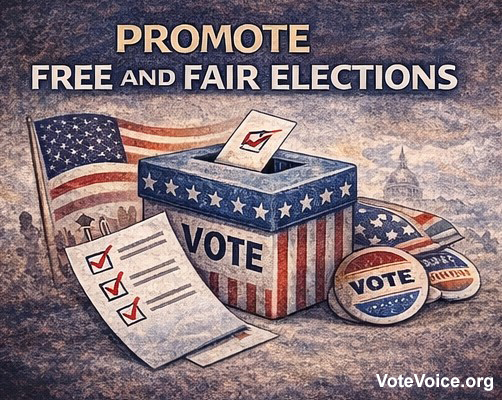
Core Ideas:
First, no-excuse vote-by-mail and a minimum 14-day early voting window in every state. Not just a few states. Every state. Imagine being able to vote when it works for YOUR schedule, not when the government tells you to show up.
Second, making Election Day a federal holiday or moving elections to weekends. Think about it: we get holidays for shopping and barbecues, but not for the most fundamental act of citizenship? That changes.
Third, standardized ID requirements nationwide. One clear, fair standard that ensures access while protecting election integrity. No more patchwork of confusing state laws that disproportionately affect certain communities.
Fourth, increase the transparency of campaign financing. The Supreme Court has ruled that campaign contributions are a form of free speech, so voters need to know whose voice is being heard.
Introduction:
The foundation of democracy isn’t just about who wins or loses, but about whether everyone gets a fair shot at making their voice heard.
Right now, across America, millions of eligible voters face barriers that shouldn’t exist. Gerrymandered districts where the elected select their voters and not the reverse. Dark money is flooding our elections from anonymous sources. Outdated voting systems are vulnerable to failure. But here’s the thing: none of this is inevitable.
Here is a comprehensive blueprint for what truly free and fair elections should look like in 21st century America. And today, we’re breaking down exactly what that means for you, for your community, and for the future of American democracy.
Below is Project RAD’s plan for Free and Fair Elections
📘Expand Voter Access
🎯 Objective:
Ensure every eligible American can vote without obstacles.
✅ Key Actions:
Automatic Voter Registration (AVR): Register eligible voters automatically through government agencies (e.g., DMV, Social Security).
Same-Day Registration: Allow voters to register or update their registration on Election Day.
Vote-by-Mail & Early Voting: Require all states to offer no-excuse vote-by-mail and a minimum 14-day early voting window.
National Voting Holiday: Make Election Day a federal holiday or shift it to weekends.
Standardized ID Requirements: Create a uniform federal standard that ensures access while protecting against discrimination.
📘 End Gerrymandering
🎯 Objective:
Ensure fair representation by eliminating partisan map drawing.
✅ Key Actions:
Independent Redistricting Commissions: Mandate all states to use nonpartisan, citizen-led commissions to draw district maps.
Federal Redistricting Standards: Enforce national criteria for fairness, compactness, and preservation of communities of interest.
Algorithmic Audits: Use statistical and algorithmic tools to detect and reject gerrymandered maps.
Public Participation: Require public input and transparency throughout the map-drawing process.
📘 Increase Transparency in Campaign Financing
🎯 Objective:
Expose dark money and ensure voters know who is funding elections.
✅ Key Actions:
Real-Time Donor Disclosure: Require immediate reporting of all political contributions above $200.
Ban Anonymous Donations: End the use of shell companies and crypto to anonymously fund campaigns.
Digital Ad Transparency: Regulate online political ads by requiring full disclosure of funders and targeting methods.
Reform the FEC: Rebuild the Federal Election Commission with nonpartisan leadership and real enforcement power.
📘 Strengthen Election Security and Integrity
🎯 Objective:
Protect the vote from fraud, interference, and technical failure.
✅ Key Actions:
Paper Ballot Requirement: All voting systems must produce verifiable paper trails.
Risk-Limiting Audits: Conduct post-election audits in every state to verify outcomes.
Modernize Infrastructure: Invest in cybersecurity for all voting systems, especially in rural and underfunded areas.
Election Worker Protections: Create legal safeguards for poll workers against threats or intimidation.
Secure Chain of Custody: Implement standardized tracking for all ballots and voting machines.
📘 Promote Civic Trust and Accountability
🎯 Objective:
Educate, engage, and hold all election actors accountable.
✅ Key Actions:
National Civics Education Program: Reinforce voting literacy in schools with an age-appropriate, nonpartisan curriculum.
Voting Rights Restoration: Ensure people who have served felony sentences can regain voting rights.
Disinformation Monitoring: Establish a nonpartisan body to track and flag election disinformation.
Public Election Funding Option: Allow candidates to opt into clean campaign financing to reduce reliance on major donors.
Election Oversight Commission: Form an independent federal agency to monitor and enforce fair election standards nationwide.
TAKE ACTION – Contact Congress
(How to contact Congress) click here
Congressional Committees That Oversee Federal Elections
Committee on Rules and Administration
- Primary jurisdiction: Federal elections, FEC, and election technology.
- Oversees the administration of Senate elections and broader election law.
Committee on the Judiciary
- Has jurisdiction over constitutional issues, voting rights, and federal law enforcement aspects of elections.
Committee on Homeland Security and Governmental Affairs
- Addresses election infrastructure security, cyber threats, and coordination with the Department of Homeland Security (DHS) on protecting election systems.
Committee on House Administration
- Subcommittee on Elections
- Primary jurisdiction: Federal election laws, campaign finance, the Federal Election Commission (FEC), voting systems, and election technology.
- Plays a central role in legislation and oversight related to the integrity and administration of federal elections.
Committee on Oversight and Accountability
- Can conduct investigations into election-related issues, including allegations of fraud or misconduct.
- Has broad oversight jurisdiction over federal programs and agencies.
Committee on the Judiciary
- Handles legislation and oversight relating to constitutional voting rights and federal election law enforcement.
- Addresses issues like the Voting Rights Act, election interference, and voter suppression.