ICE Revealed

Five Key Points
- ICE has an aggressive quote system that rewards quantity over the quality of arrests.
- The ICE detention budget has been dramatically expanded and exceeds that of the federal prison system
- Once arrested by ICE, a detainee loses many legal protections
- Foreign countries are not dumping their criminals and mentally ill people into the US.
- Most unauthorized immigrants in the US have been vetted and overstayed their visas.
Prelude:
The justification for the dramatic increase in ICE and border control funding is based on the claim that the US has “open borders” and foreign countries are “dumping their criminals and mentally unstable people” into the US.
This is blatantly false
Here are a few facts:
Immigrants in the US.
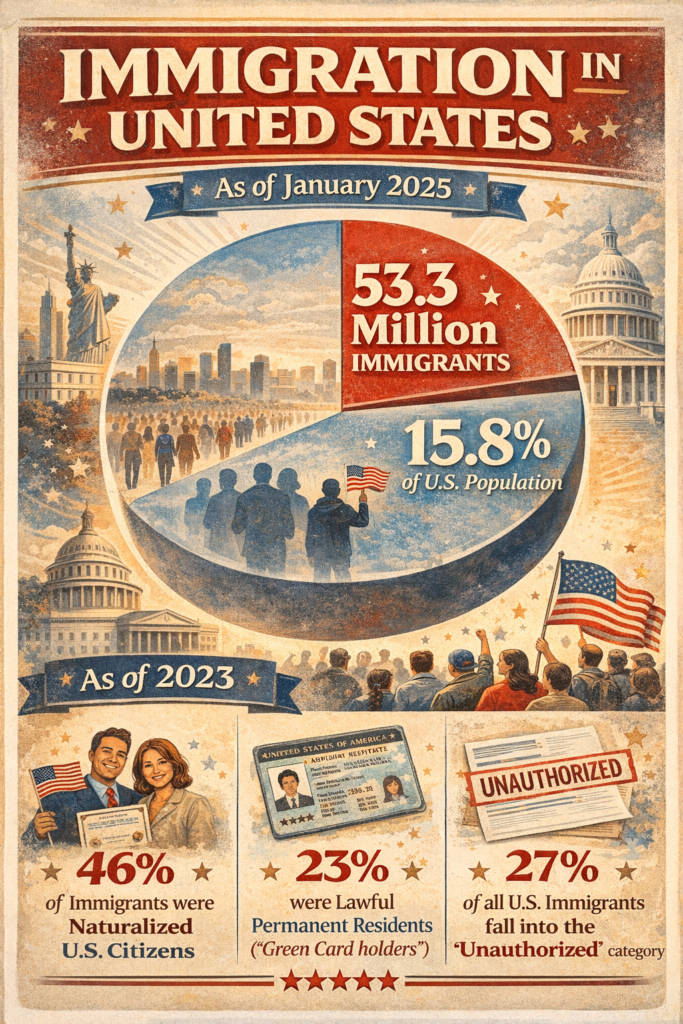
The vast majority of the 53 million immigrants are in the US legally. About half are naturalized citizens, and another 23% are Permanent Residents (legal green cards).
Of the remaining 27% are classified as unauthorized, and half of those have some form of protected status. As a result, less than 15% are classified as deportable.
Of the unauthorized immigrants, most (about 2/3) entered the country legally but overstayed their visas. Building a wall does not address these people.
75% of unauthorized immigrants have been living in the US for at least 15 years, most working, raising families, paying taxes, without receiving many of the benefits and obeying the criminal laws.
The impression that most unauthorized immigrants sneak into the US or are dumped by foreign countries is fundamentally incorrect.
CLICK HERE for a closer look at unauthorized immigrants
What is ICE?
Immigration and Customs Enforcement (ICE) operates as a federal law enforcement agency under the U.S. Department of Homeland Security. The agency was created in 2003 as part of the Homeland Security Act. ICE reports directly to the Secretary of Homeland Security.
The agency consists of two primary operational components:
Enforcement and Removal Operations (ERO) manages the identification, arrest, detention, and removal of individuals in violation of immigration laws. ERO operates detention facilities nationwide and coordinates deportations.
Homeland Security Investigations (HSI) conducts criminal investigations into transnational crimes, including human trafficking, drug smuggling, financial crimes, cybercrime, and customs violations. HSI special agents have the authority to enforce more than 400 federal statutes.
ICE training
Deportation Officer Training
ERO deportation officers attend the Basic Immigration Enforcement Training Program. Multiple sources report that the deportation officer training has been shortened substantially. Recent job postings and reports describe the program as approximately 47 to 50 days, or roughly six to eight weeks. Some reporting suggests training may have been reduced to as little as six weeks during hiring surges.
The story of ICE under Trump
Daily Arrest Quotas Imposed
In January 2025, the Trump administration directed ICE officials to increase arrests from a few hundred per day to at least 1,200 to 1,500 daily. By late May 2025, this quota was raised to 3,000 arrests per day. White House Deputy Chief of Staff Stephen Miller stated on CNN that these quotas are a floor, not a ceiling.
The quota translates to approximately 75 arrests per day for each of ICE field offices. Data shows that while arrests surged immediately after the quotas were implemented, ICE has struggled to consistently meet the 3,000-per-day target. Between January 20 and October 15, 2025, ICE averaged 821 arrests per day according to government data, though DHS claims the figure is closer to 1,800 when including arrests by other agencies assisting ICE.
Few Arrestees have Criminal Convictions
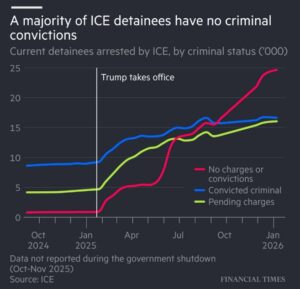
Data from the Immigration Research Initiative shows that most people ICE arrests currently do not have criminal convictions. The Cato Institute reported that 65 percent of people taken by ICE had no convictions, and 93 percent had no violent convictions. This represents a shift from the stated policy of prioritizing the worst of the worst.
The administration has encouraged collateral arrests, where agents apprehend undocumented people who happen to be with someone on a target list, such as people in the same household. This practice helps inflate arrest numbers but raises questions about whether enforcement is driven by public safety concerns or quota requirements.
What happens when ICE arrests someone?
Key Points
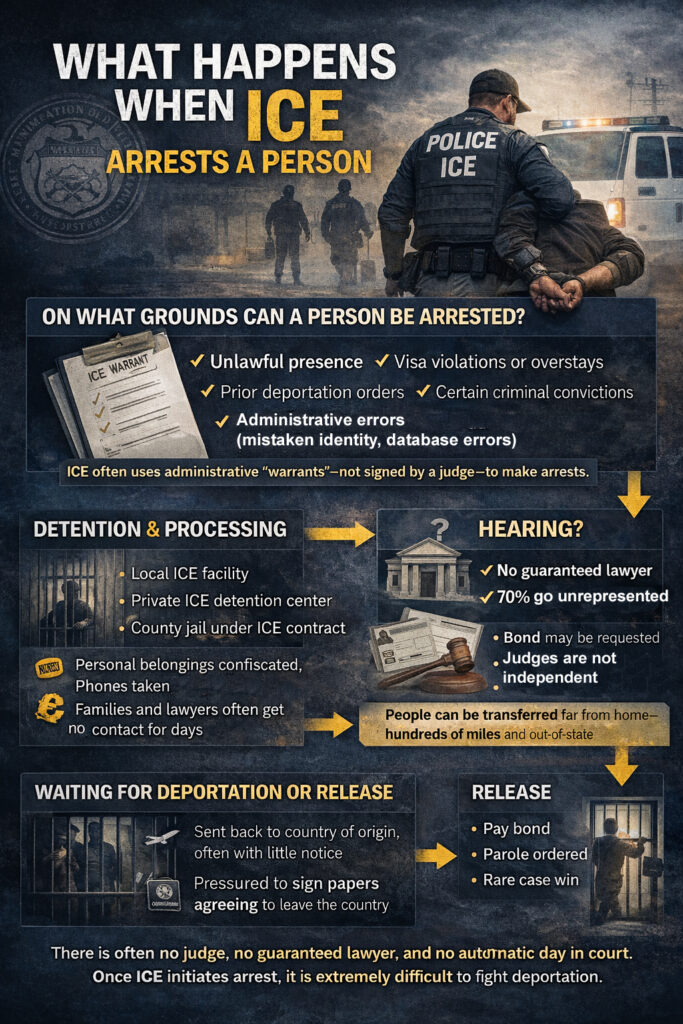
ICE may arrest a person if an agent believes they are “removable” under the Immigration and Nationality Act (INA).
ICE agents often rely on administrative warrants (Form I-200 or I-205) signed by ICE officials, not judges. ICE agents frequently arrest people who have no criminal convictions, are long-term residents, or are in the middle of legal immigration processes. These detainees often immediately disappear from their families.
During this phase, Personal belongings are confiscated, Phones are taken, and access to attorneys is often delayed or denied for hours or days
Transfer to Detention
Within days or hours, the person may be transferred to:
A dedicated ICE detention center, A privately run facility (e.g., GEO Group, CoreCivic) or a county jail housing ICE detainees. Transfers can occur across state lines, hundreds or thousands of miles from the person’s home, attorney, or children. This geographic dislocation routinely undermines access to legal counsel and family support, weakening a person’s ability to fight their case.
Deportation
If a judge orders removal, or if the person is deported under expedited removal or reinstatement procedures. Families may receive no warning before a loved one is put on a plane.
Let’s look at the numbers
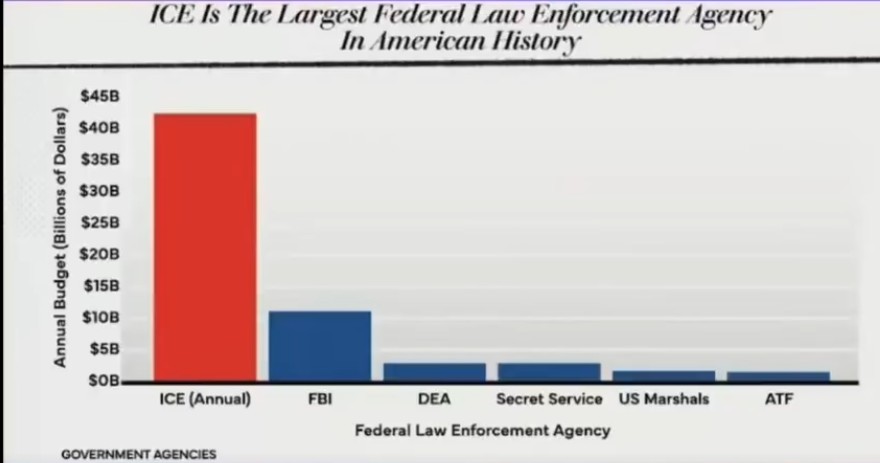
In the last twelve months, the American immigration detention system has undergone the largest expansion in our nation’s history. The same companies that bankrolled the president’s campaign are now making billions from that expansion.
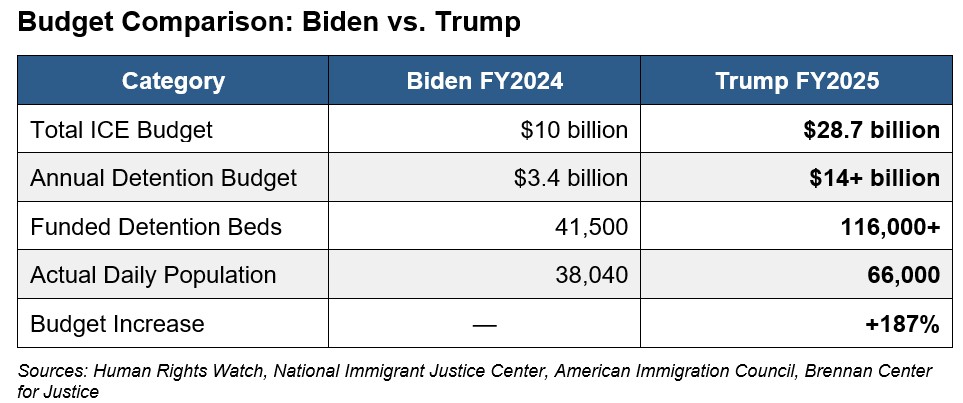
When Donald Trump took office in January 2025, ICE’s budget was $10 billion. Ten months later, after signing something they called the “One Big Beautiful Bill Act”, that budget exploded to 28.7 billion dollars.
That’s a 187% increase. Nearly TRIPLE the funding. In less than a year.
Where did that money go? Into detention beds. January 2025: 40,000 people locked up in immigration detention. December 2025: 66,000 people. They wanted 100,000 by now. They’re building toward 135,000.
To put that in perspective, the entire federal prison system, housing murderers, terrorists, and organized crime bosses, holds 155,000 people. And ICE’s detention budget now EXCEEDS the budget for the entire federal prison system.
We’re spending more to detain people than we spend on actual convicted criminals.
Where is the money going?
Who’s making money from all this?

CoreCivic and GEO Group. Private prison companies. They run about 90% of ICE detention facilities.
During the 2024 campaign, these two companies donated $2.78 million to Trump’s campaign and inaugural fund. GEO Group alone gave nearly two million. CoreCivic: over $800,000.
And what did they get for their investment?
In less than a year, they collectively received over $800 million in new federal contracts.
Their stock prices? Up 73% for GEO Group. Up 56% for CoreCivic. Their second quarter revenues more than DOUBLED compared to 2024.
Our current Attorney General, Pam Bondi, the nation’s top law enforcement officer, earned $390,000 lobbying for GEO Group before taking office. She lobbied for them. Now she oversees the policies that enrich them.
Ten out of thirteen GEO Group lobbyists in 2024 were former government officials. People who used to work for ICE or the Department of Justice. They left, went through the revolving door, and now they’re lobbying their former colleagues.
Julie Wood: ran ICE from 2006 to 2008. Now? On GEO Group’s board.
Daniel Bible: was an executive at ICE until days before the 2024 election. Where is he now? Executive Vice President at GEO Group.
This is the textbook definition of corruption. Former government officials are making policies that benefit their future employers. Then walking through the revolving door to collect their paychecks.
And we wonder why detention keeps expanding? The money flows to people who have every incentive to keep the cages full.
Here’s what they’ve built: a deportation-industrial complex.
The Brennan Center for Justice calls it that explicitly. Why? Because this system isn’t designed for justice. It’s designed to produce deportations. And profits.
They’ve awarded contracts using emergency “letter contracts” to bypass competitive bidding. One contract expert called it “giving private companies the keys to the treasury.”
They’ve allocated $45 billion over four years just for detention expansion. $46.6 billion for border wall construction, triple what was spent during Trump’s first term. $10 billion in a “slush fund” with minimal oversight.
And every dollar that flows through this system enriches someone. Transportation companies. Electronic monitoring firms. State governments. County jails. Private airlines are conducting deportation flights.
Everyone gets a piece. Everyone except the people locked inside
The Worst of the Worst?
Trump tells you they’re going after “the worst of the worst.” Dangerous criminals. Gang members. People who threaten public safety.
That’s a lie.
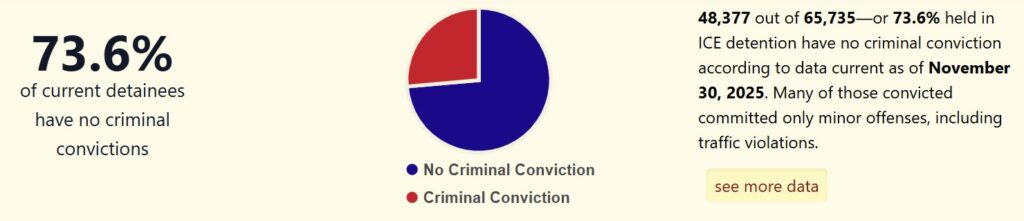
Arrests of people with NO criminal record surged by 2,450% in Trump’s first year.
By September, the detention population included over 16,000 people with no criminal record, 15,000 with prior convictions, and 14,000 with pending charges.
For the first time in modern history, non-criminals outnumber criminals in ICE detention.
Let’s put a human face on it.
On January 7, 2026, ICE agents shot and killed Renée Good in Minneapolis during enforcement operations. She was exercising her First Amendment right to protest.
On January 24, 2026, ICE agent(s) shot and killed Alex Pretti in Minneapolis AFTER they removed a legal gun from him.
A 10-year-old girl with BRAIN CANCER. A U.S. citizen. Deported with her family while traveling to an emergency medical appointment.
A 24-year-old Russian pro-democracy activist who WON his asylum case, a judge reviewed 900 pages of evidence and granted him protection, and he’s STILL in detention.
A Virginia music teacher with valid legal status who fled to Spain because he was afraid of being detained despite having done nothing wrong.
Multiple U.S. citizens have been detained and deported. People born in California. Born in Arizona. Born in this country. Detained anyway because of how they looked or where they lived or what language they spoke
This isn’t law enforcement. This is racial profiling with a federal badge.
Constitutional Crisis
Federal courts have found that ICE operations in Los Angeles relied on racial profiling, targeting people because they looked Latino, spoke Spanish, or appeared to work low-wage jobs.
The Supreme Court allowed it to continue.
Justice Sonia Sotomayor, joined by Justices Kagan and Jackson, dissented. Let me read you what she wrote:
“We should not have to live in a country where the Government can seize anyone who looks Latino, speaks Spanish, and appears to work a low-wage job.”
But that’s exactly the country we’re living in now.
Wrapping this up.
Your government is spending $28.7 billion of your tax dollars to detain people who are overwhelmingly not criminals. To lock them in facilities run by private companies that donated millions to elect the president. To hold them in conditions so bad that people are dying at three times the rate they died under the previous administration.
If we allow this to continue, if we look away while human beings die in detention, while constitutional rights are trampled, while private companies profit from human suffering, then we have to accept that this IS who we are.
The evidence is clear. The money trail is documented. The body count is rising.
The question isn’t what’s happening anymore. We know what’s happening.
The question is: What are we going to do about it?
A call to action: contact Congress


1. House Committee on the Judiciary
Jurisdiction:
- Immigration law and policy
- Immigration enforcement authorities
- Civil liberties and constitutional protections
Key Subcommittee:
Oversight Role:
- ICE enforcement practices
- Detention authority and due process
- Deportation procedures
- Use of force, unlawful detention, and racial profiling
- Statutory authority governing ICE operations
Why it matters:
This is the primary policy and legal oversight committee for ICE. Most immigration statutes ICE relies on fall under the Judiciary’s jurisdiction.
2. House Committee on Homeland Security
Jurisdiction:
- Department of Homeland Security (DHS)
- Border security and interior enforcement
- DHS operational readiness
Key Subcommittee:
Oversight Role:
- ICE operational tactics
- Coordination between ICE, CBP, and local law enforcement
- ICE staffing, training, and mission execution
Why it matters:
ICE is a DHS component agency. This committee focuses on how ICE operates, not just what authority it has.
3. House Committee on Appropriations
Jurisdiction:
-
Federal funding and budget allocations
Key Subcommittee:
Oversight Role:
- ICE budget size and structure
- Detention bed funding
- Contracting with private detention operators
- Funding conditions and reporting requirements
Why it matters:
Appropriations decisions often shape ICE behavior more than statutes, especially detention capacity and enforcement tempo.
4. House Committee on Oversight and Accountability
Jurisdiction:
- Government misconduct
- Waste, fraud, abuse
Oversight Role:
- Investigations into ICE abuses
- Improper detentions (including U.S. citizens)
- Misuse of surveillance tools
- Contracting irregularities
Why it matters:
This committee conducts high-profile investigations and subpoenas ICE and DHS leadership.

5. Senate Committee on the Judiciary
Jurisdiction:
- Immigration law
- Due process and civil rights
Key Subcommittee:
Oversight Role:
- ICE enforcement authority
- Detention legality
- Deportation law and asylum processes
Why it matters:
Senate Judiciary mirrors House Judiciary but plays a key role in confirmations and shaping national immigration law.
6. Senate Committee on Homeland Security and Governmental Affairs (HSGAC)
Jurisdiction:
- DHS oversight
- Federal agency performance
Oversight Role:
- ICE operational effectiveness
- Internal DHS controls
- Enforcement strategy and coordination
Why it matters:
This committee oversees DHS as a whole, including ICE management failures or misconduct.
7. Senate Committee on Appropriations
Key Subcommittee:
Oversight Role:
- ICE funding levels
- Detention bed mandates
- Enforcement resource expansion
Why it matters:
Controls ICE’s financial lifeblood, including detention expansion and staffing surges.