The Immigration Crisis
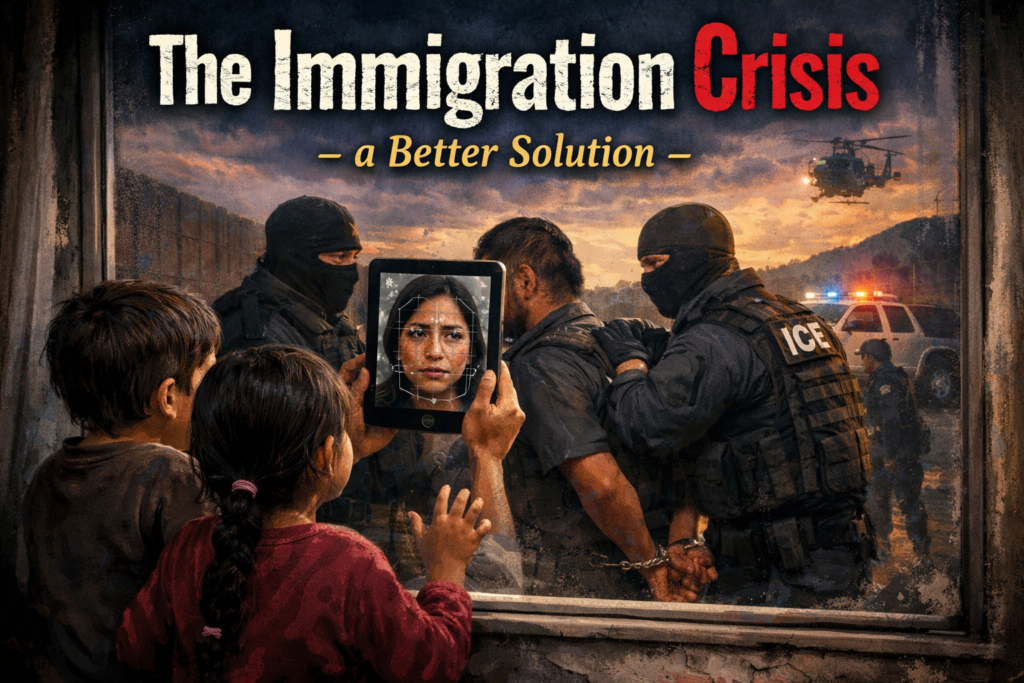
Every day in America, families are being torn apart.
Children are watching parents led away in handcuffs.
Workers who have spent decades building lives, paying taxes, and contributing to their communities are being hunted down by masked federal agents under a system powered by Artificial Intelligence driven surveillance, license plate readers, and cell phone tracking , all funded by $170 billion of your tax dollars.
This is not the story of dangerous criminals being brought to justice.
This is the story of 14 million people, most of whom have lived here for over a decade, caught in the crossfire of a government that chose fear over solutions, spectacle over governance, and cruelty over compassion.
Meanwhile Congress is debating if Trumps federal agents should be identifiable just like our armed forces and police officers.

That is the wrong question.
The real question is –
How should Congress tackle our national Immigration problem?
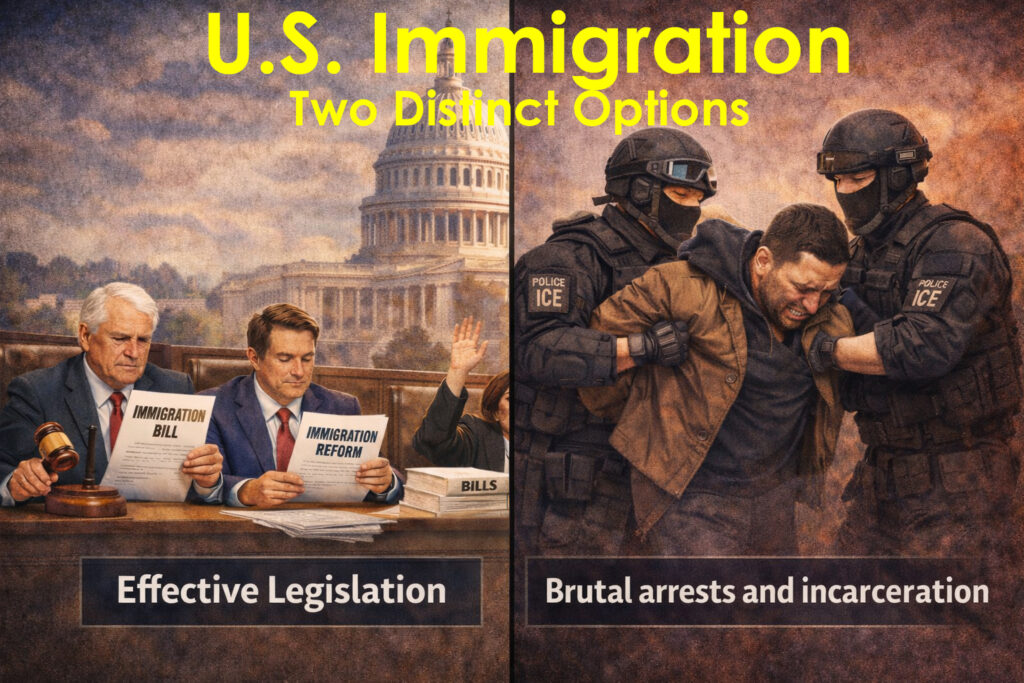
President Trump and the Republicans who controlled Congress had two options
- Put the work in and craft a long-term solution through effective legislation
- Create and fund a brutal army of masked Federal agents who terrorize the immigrant community to arrest and deport millions
Their choice is obvious
KEY FACTS:
- There are about 52 million immigrants in the US.
- Immigrants provide significant economic benefits to the US economy
- Only about 25% are unauthorized
- 8 out of 10 of those unauthorized immigrants have lived in the US since 2010.
- Unauthorized immigrants commit significantly fewer crimes than the general US population.
- The US immigration system needs significant reform
- Your voice can help support reform
This page will provide reliable information on this topic, suggest some solutions to address current immigration system flaws, and identify members of Congress who have jurisdiction over this issue.
TOP LINE:

President Trump and the Republican Congress have dramatically changed the US immigration system, particularly in the area of forced deportations.
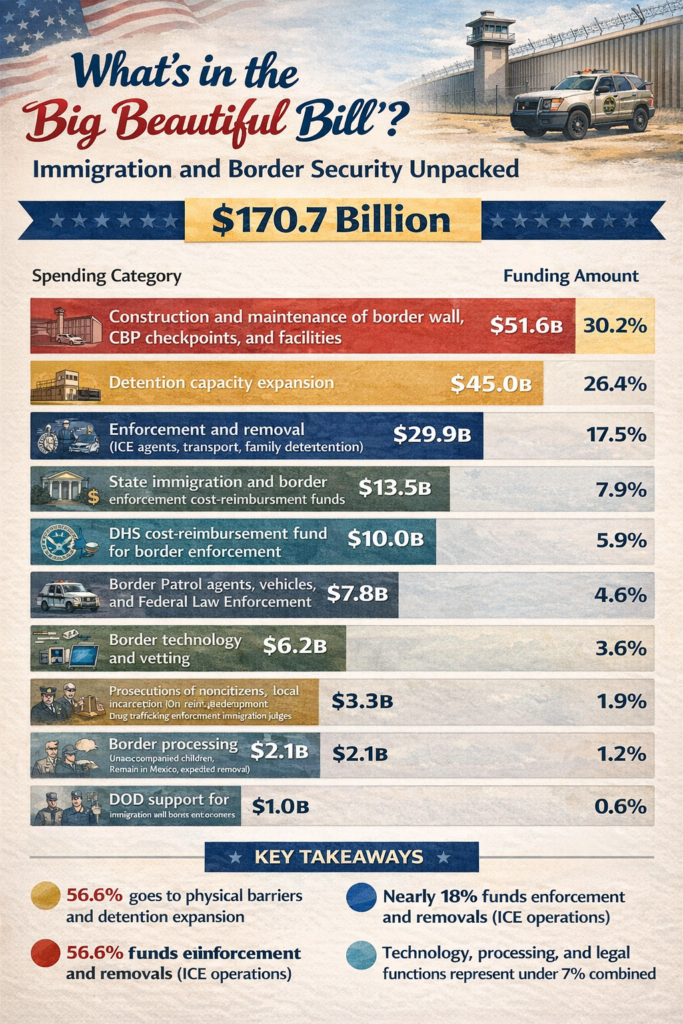
When combined with the $65 billion allocated to Customs and Border Protection and additional homeland security funds, total immigration enforcement spending reaches approximately $170 billion. This is equal to over twice the annual budget of the cancelled USAID.
In 2025, Congress passed legislation allocating $75 billion to ICE through fiscal year 2029. This staggering increase transforms the agency’s annual operating budget from approximately $10 billion to a projected $30 billion in FY 2026.
On May 20, 2025, White House Deputy Chief of Staff Stephen Miller convened a closed-door meeting with senior ICE officials at DHS headquarters and demanded one million deportations in Trump’s first year, requiring ICE to triple its arrest efforts to 3,000 per day.
The latest federal budget funds the hiring of at least 10,000 new ICE officers. This makes ICE larger than the FBI, DEA, and ATF combined.
In comparison, previous US administrations had focused immigration efforts on enforcement, prioritizing border management over interior removals, and directing ICE to concentrate on individuals with serious criminal convictions and recent border crossings.
The Biden administration deported 271,000 people in FY 2024, a 10-year high that exceeded Trump’s first-term peak.
During that same period, ICE’s annual budget hovered around $8-10 billion, with deportations averaging 68,000 annually from the interior of the United States.
Let’s take a look at
- An Overview of US Immigration
-
Why Immigration Reform is Important
-
The Economic and Social Benefits of Immigration to the United States
-
Top Concerns Regarding Current US Immigration Policy
-
Solutions
-
Solutions for Asylum System Reform
-
Solutions for Border Security and Management
-
Solutions for Legal Immigration Pathways and Visa Reform
-
Solutions for the Undocumented Population and Enforcement
-
Solutions for Congressional Action and Long-Term Reform
-
-
Who to contact in Congress regarding this issue
TOP LINE:
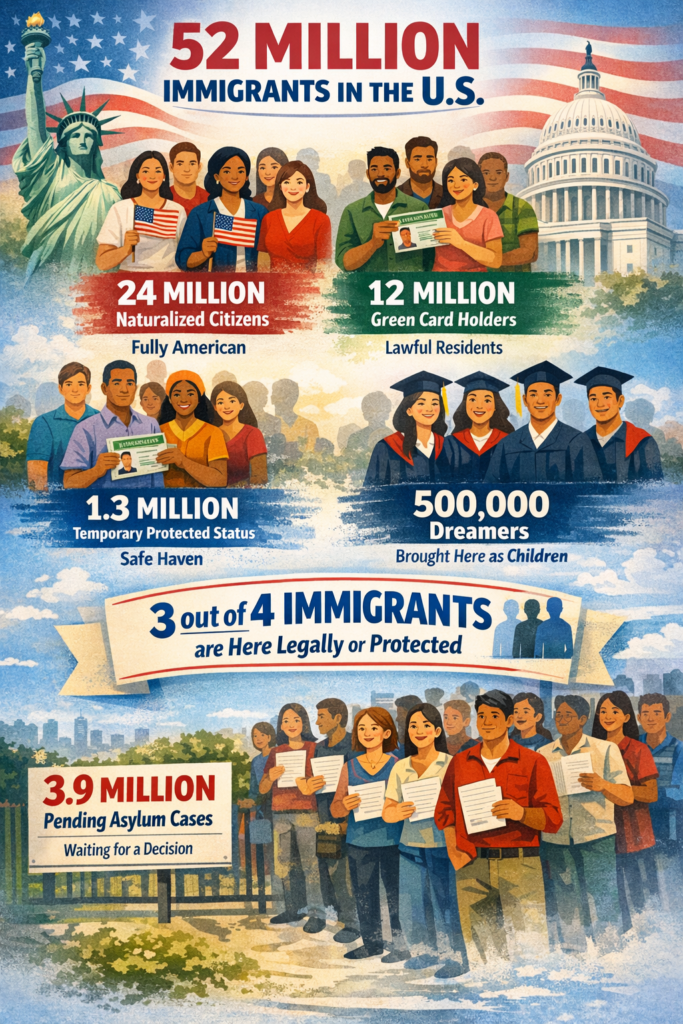
Of all the US immigrants
24 million are naturalized citizens
12 million are legal residents (Green Card Holders)
1.3 million have temporary protected status
500,000 are DACA recipients “the Dreamers”
almost 4 million are in the US asylum program awaiting a decision
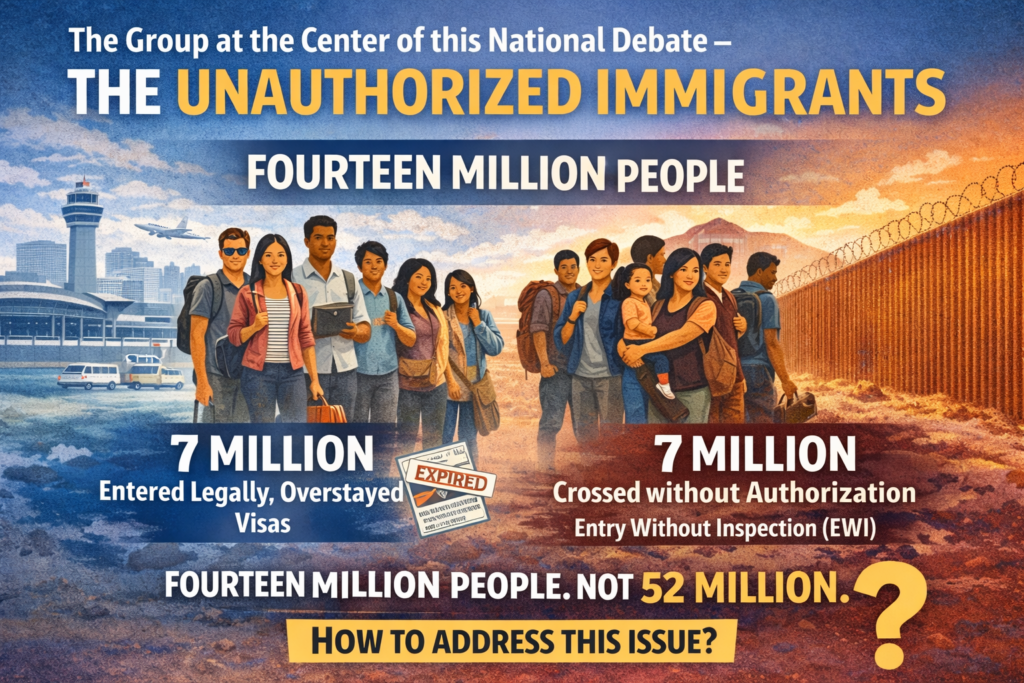
The remainder are the Unauthorized Immigrants we hear so much about
among that group (the other 25%)
7 million were vetted for a visitor visa but overstayed its terms
7 million Entered illegally – EWI /Entry Without Inspection.
Of this group, the unauthorized immigrants, 8 out of 10 have lived in the US since 2010.
SOURCE: https://www.pewresearch.org/short-reads/2025/08/21/key-findings-about-us-immigrants/
How many immigrants are unauthorized?
Do unauthorized immigrants commit more crimes?
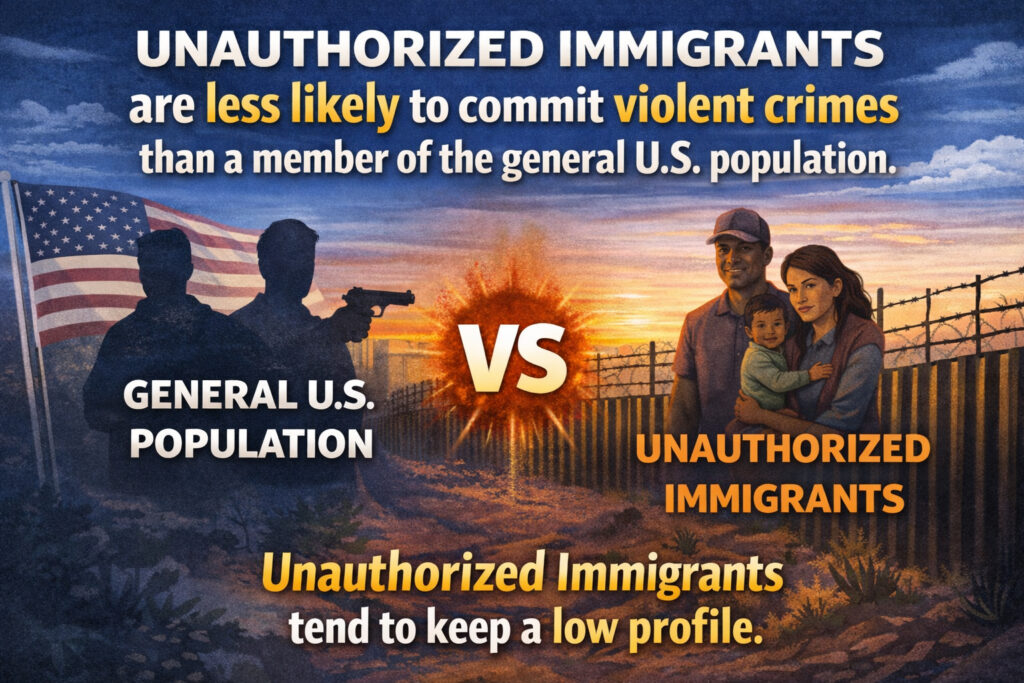
One of the most rigorous comparative datasets comes from the Texas Department of Public Safety, which uniquely tracks arrests by immigration status.
Texas DPS Study (2012–2018)
A peer-reviewed study published in the Proceedings of the National Academy of Sciences analyzed more than 1.8 million arrests by immigration status. Key findings:
-
Unauthorized immigrants had substantially lower crime rates than U.S.-born citizens and legal immigrants across a range of felony offenses.
-
Relative arrest likelihood:
-
Unauthorized immigrants were over 2 times less likely to be arrested for violent crimes than U.S.-born citizens
-
They were 2.5 times less likely to commit drug crimes.
-
And over 4 times less likely to commit property crimes.
-
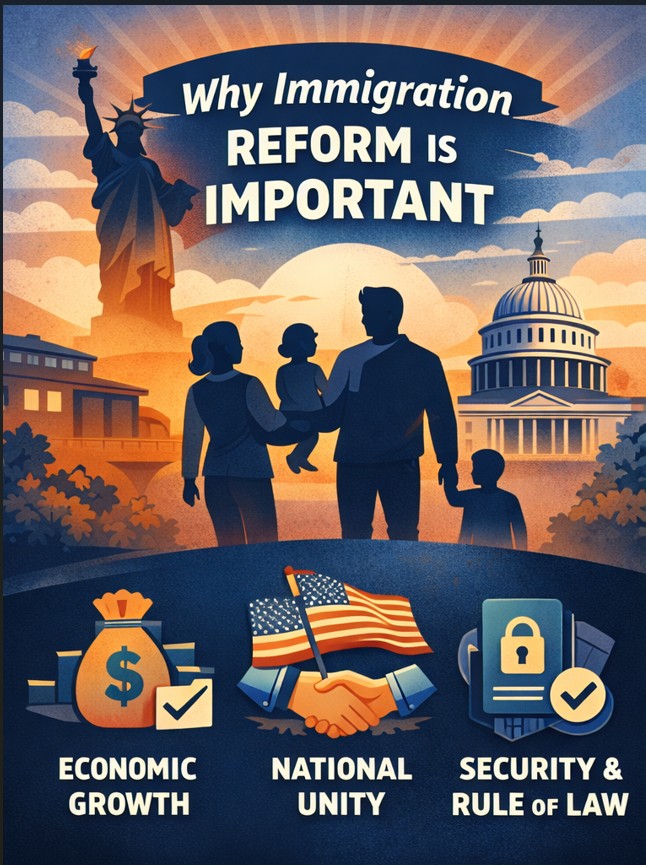
Why Immigration Reform is Important:
The United States has been a nation of immigrants throughout its history, and immigration has been a source of national strength.
Immigration reform requires balancing competing values: security and openness, sovereignty and humanitarian obligation, economic needs and social cohesion, enforcement and compassion. Comprehensive legislation addressing all aspects of the system simultaneously can create a functional immigration system that serves American interests while respecting human dignity.
A reformed immigration system would provide the United States with significant advantages: economic growth from an expanded labor force and entrepreneurship, fiscal benefits from increased tax revenues, demographic vitality from a younger workforce, innovation from global talent, enhanced security through better screening and documentation, humanitarian protection for legitimate refugees, and restored rule of law through functioning processes.
Achieving reform requires political courage, willingness to compromise, focus on evidence rather than rhetoric, and commitment to both enforcing laws and changing laws that no longer work.
Our National Motto – E. Pluribus Unum – Out of Many, One

It is not a slogan. It is a promise.
A sensible immigration policy makes that promise real. It makes this country stronger, not more divided.
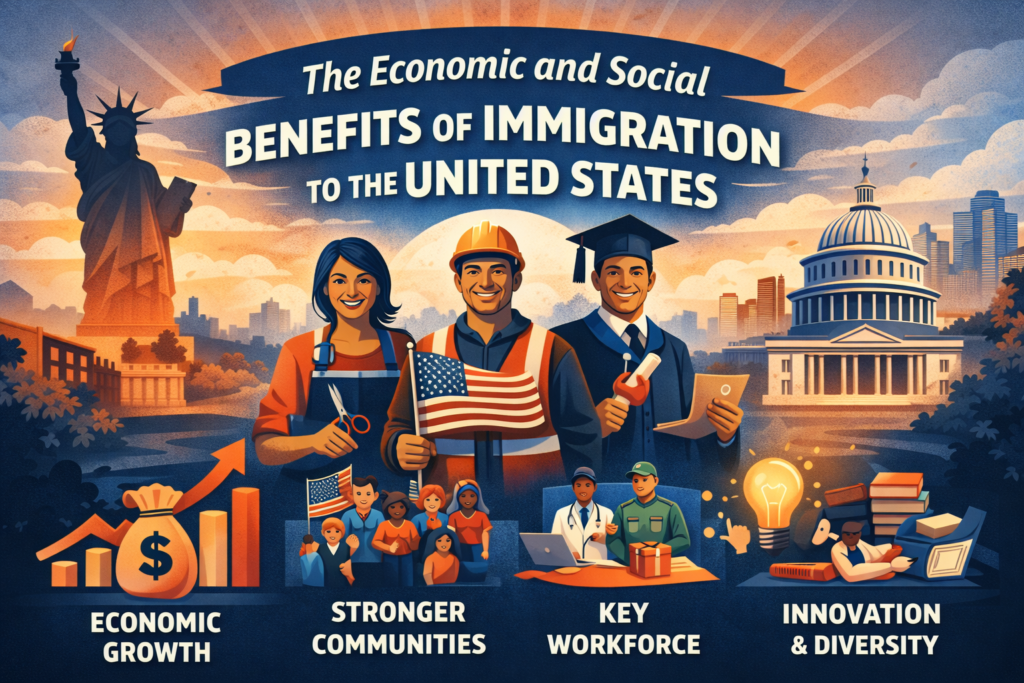
The Economic and Social Benefits of Immigration to the United States
Executive Summary
Current research and economic data demonstrate that immigration continues to deliver substantial benefits to the United States across multiple dimensions, including economic growth, fiscal contributions, labor market dynamics, innovation, and demographic vitality.
-
Economic Growth and GDP Contributions
Immigration significantly drives economic expansion in the United States. According to the Congressional Budget Office, the immigration surge between 2021 and 2026 is projected to boost gross domestic product by $8.9 trillion over the 2024-2034 period. In 2023 alone, immigrants generated approximately $1.7 trillion in economic activity, representing a substantial portion of total national output.
Immigrants expand the labor force, increase consumer spending, and create businesses at rates higher than native-born Americans. Research from the Hamilton Project indicates that higher immigration contributed approximately 0.1 percentage points to GDP growth annually in 2022, 2023, and 2024.
-
Labor Force Contributions and Job Creation
Rather than displacing American workers, immigrants expand the overall job market. Between 2000 and 2022, foreign-born workers accounted for nearly three-quarters of all growth in the prime-age civilian labor force. As of 2023, foreign-born workers comprised 18.6 percent of the labor force, with a participation rate of 66.6 percent, nearly five percentage points higher than the native-born population.
-
Fiscal Contributions and Government Revenues
Immigrants make substantial contributions to federal, state, and local tax systems. In 2022, immigrants paid $382.9 billion in federal taxes and $196.3 billion in state and local taxes. Even undocumented immigrants contribute significantly, paying $59.4 billion in federal taxes and $13.6 billion in state and local taxes in 2022, despite being ineligible for most federal benefits.
The immigration surge is projected to lower federal deficits by $900 billion over the 2024-2034 period. The CBO estimates that increased immigration will boost federal revenues by amounts that grow over time, reaching $167 billion (2.2 percent of total revenues) in 2034.
Immigrants pay into Social Security and Medicare through payroll taxes, programs for which they are ineligible to receive benefits. Undocumented immigrants alone contributed $25.7 billion to Social Security and $6.4 billion to Medicare in 2022,
-
Innovation and Entrepreneurship
Immigrants play a disproportionate role in American innovation. Despite comprising only 16 percent of the inventor workforce between 1990 and 2016, immigrants produced roughly 23 percent of all patents during that period.
Forty-six percent of Fortune 500 companies in 2024, including Apple, Amazon, and Google, were founded by immigrants or their children. Immigrants start businesses across all sectors, from small local enterprises to large-scale technology companies, creating jobs and driving economic dynamism.
-
Addressing Demographic Challenges
As the U.S. population ages and the native-born population of prime working age remains relatively flat, immigration becomes increasingly important for maintaining economic vitality.
The labor force in 2033 will be larger by 5.2 million people, mostly because of higher net immigration, according to CBO estimates. Without immigration, the United States would face severe labor shortages that could constrain economic growth and strain social safety nets.
-
Sector-Specific Contributions
Immigrants are particularly vital in several key industries. In healthcare, food production and agriculture, construction, hospitality, and emerging fields like semiconductors and artificial intelligence, immigrants fill essential positions that would otherwise remain vacant. The foreign-born workforce is especially concentrated in service occupations, construction, and transportation sectors, where labor demand consistently exceeds supply.
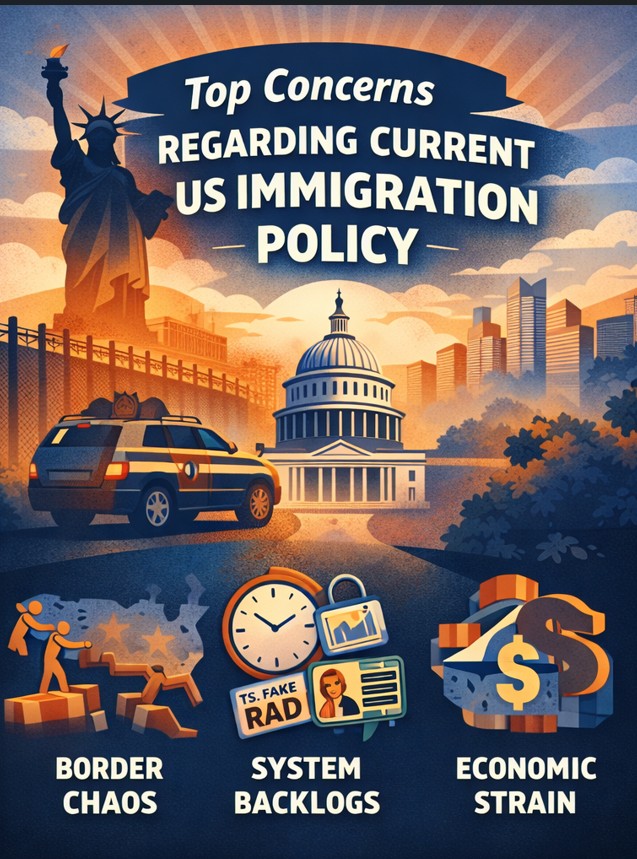
Top Concerns Regarding Current US Immigration Policy
-
System Dysfunction and Lack of Control
Public opinion polls reveal that while Americans remain broadly pro-immigration, there is significant anxiety about border security and the government’s ability to make decisions about who enters the country.
-
Overwhelming Court Backlog and Processing Delays
As of January 2025, more than 3.9 million removal cases are pending before immigration courts, an all-time high, with average wait times for initial asylum hearings reaching approximately four years.
-
Border Security and Unauthorized Entry
Despite Border Patrol staffing remaining roughly flat over the past four years, border encounters increased by 250 percent during the same period, creating an untenable ratio of agents to encounters.
Customs and Border Protection lacks sufficient personnel at ports of entry, and technology for detecting contraband (particularly fentanyl) needs modernization. The asylum system has been overwhelmed by applications, many from individuals fleeing violence and instability in their home countries.
-
Asylum System Misuse and Legitimate Protection Concerns
On one hand, legitimate refugees fleeing persecution need protection; this is a legal and moral obligation under international and domestic law. On the other hand, the asylum system has been used by some as a means to circumvent regular immigration channels, with human smuggling networks exploiting the system’s delays and vulnerabilities.
The screening standards and adjudication processes have not kept pace with application volumes.
-
State and Local Resource Strain
While immigration generates net fiscal benefits at the federal level, state and local governments often bear disproportionate costs. Immigrants tend to cost local governments more than they pay in taxes, primarily due to education and healthcare expenses. States and cities receiving large numbers of migrants have faced significant pressure on housing, schools, social services, and infrastructure without commensurate federal support.
-
Legal Immigration Pathway Inadequacies
Visa caps and per-country limits create decades-long wait times for family reunification and employment-based immigration from certain countries. For low-skilled workers, legal pathways are extremely limited despite clear labor market demand.
The H-1B program for skilled workers, while valuable, faces criticisms from multiple directions. Some argue it displaces American workers and is misused by outsourcing firms, while others contend that the cap of 85,000 visas annually is far too low to meet the economy’s needs for specialized talent.
-
Enforcement Concerns
Immigration enforcement has become highly politicized.
The debate over enforcement priorities reflects fundamental disagreements about how resources should be allocated. Should enforcement focus on criminals and security threats, or pursue a broader mandate? Should long-term residents without legal status who are otherwise law-abiding face deportation?
-
Political Polarization and Reform Gridlock
Congress has failed to enact comprehensive immigration reform for decades. The failure of the 2024 bipartisan border security agreement, which received support from the Border Patrol Union, business groups, and municipal leaders, exemplifies this dysfunction. Without congressional action, the fundamental structural problems in the immigration system remain unresolved.
-
Misinformation and Public Understanding
False claims about immigrants draining resources, committing crimes at higher rates than native-born Americans, or taking jobs from citizens persist despite contrary evidence. The politicization of immigration has made evidence-based policy making difficult, with rhetoric often overwhelming data.
Solutions for Immigration Reform
- Solutions for Border Security and Management
- Solutions for Asylum System Reform
- Solutions for Legal Immigration Pathways and Visa Reform
- Solutions for the Undocumented Population and Enforcement
- Solutions for Congressional Action and Long-Term Reform
📘 Strong Border Security and Management
🎯 Objective: Ensure a secure, functional border that upholds U.S. laws and values.
✅ Key Actions:
Modernizing Border Infrastructure and Technology
-
Enhanced Detection Technology:
Install cutting-edge inspection systems at all ports of entry to detect contraband, particularly fentanyl and other drugs. The bipartisan 2024 Senate proposal called for 100 new inspection machines at Southwest border ports. This should be expanded to all ports of entry and regularly updated as technology advances.
-
Surveillance and Monitoring Systems:
Deploy advanced sensor technology, aerial surveillance (including drones), and integrated monitoring systems along the border between ports of entry.
-
Smart Border Infrastructure:
Rather than focusing solely on physical walls, invest in comprehensive infrastructure, including access roads, lighting, secure processing facilities, and communications systems. Border security requires an integrated approach combining physical barriers where appropriate, technology, and personnel.
Increasing Personnel and Improving Working Conditions
-
Border Patrol Expansion:
Increase Border Patrol staffing to at least 22,000 agents, with additional support staff, as recommended by multiple border security frameworks. The current staffing level has not kept pace with increased encounters.
-
CBP Officers at Ports of Entry:
Significantly increase the number of Customs and Border Protection officers at ports of entry. These officers facilitate legitimate trade and travel while interdicting contraband and conducting security screening.
-
Competitive Compensation:
Border Patrol agents and CBP officers face challenging working conditions, often in remote locations with limited amenities. Competitive salaries, benefits, housing assistance, and career development opportunities are essential for the recruitment and retention of qualified personnel.
-
Training and Professional Development:
Provide comprehensive training on humanitarian processing, de-escalation techniques, cultural competency, and legal requirements. Well-trained officers are more effective, make better decisions under pressure, and face fewer complaints and misconduct allegations.
Creating Orderly Processing Systems
-
CBP One Expansion:
Restore and improve the CBP One mobile application system that allows migrants to schedule appointments at ports of entry rather than crossing illegally between ports. The system should have sufficient appointment slots to meet demand, be accessible in multiple languages, and function reliably. This channel’s migration through legal processes, where individuals can be screened, documented, and processed systematically.
This system was cancelled by Trump on the first day of his second administration.
-
Regional Processing Centers:
Establish processing centers at key locations along the border with adequate facilities for humane holding, medical screening, background checks, and initial asylum screening. Current facilities are often overcrowded and inadequate for their purpose.
-
Humanitarian Standards:
Ensure that all border facilities meet basic humanitarian standards for sanitation, nutrition, medical care, and protection of vulnerable populations, including children.
Managing Surges and Emergency Authorities
-
Flexible Capacity:
Develop surge capacity protocols that allow rapid scaling of personnel, facilities, and processing when encounters spike. This includes mobilizing resources from other DHS components, deploying temporary facilities, and implementing streamlined procedures during high-volume periods.
-
Emergency Authority with Guardrails:
Implement emergency authority similar to that proposed in the 2024 Senate bill, allowing the government to impose additional restrictions when encounters exceed sustainable levels (e.g., a seven-day average above 5,000 encounters).
-
Coordinated Inter-agency Response:
Border management requires coordination across multiple agencies, including DHS, DOJ, HHS, State Department, and local governments. Establish clear protocols, shared data systems, and joint operations centers to ensure seamless coordination during normal operations and surges.
Addressing Root Causes and Regional Cooperation
-
Foreign Assistance:
Invest in economic development, security, governance, and humanitarian assistance in countries generating large outflows of migrants. While this is a long-term strategy, addressing poverty, violence, corruption, and instability in Central America, Venezuela, Haiti, and other source countries reduces migration pressure.
-
Regional Migration Management:
Collaborate with Mexico, Central American countries, and international organizations to develop a regional approach to managing migration. This includes capacity building for asylum systems in other countries, burden-sharing arrangements, and coordination on smuggling interdiction.
-
Safe Mobility Offices:
Expand safe mobility offices throughout the region where individuals can apply for refugee resettlement, family reunification, or labor migration programs.
Combating Smuggling and Trafficking Organizations
-
Transnational Criminal Organization Targeting:
Intensify law enforcement efforts against smuggling and trafficking networks that exploit migrants and facilitate illegal entry. This requires intelligence gathering, international cooperation, financial sanctions, and prosecution of smuggling kingpins.
-
Information Campaigns:
Conduct public information campaigns in source countries explaining the dangers of irregular migration, the reality that most asylum claims will be denied if not based on valid grounds, and available legal pathways.
Balancing Security with Trade and Travel
-
Trusted Traveler Programs:
Expand programs like Global Entry, SENTRI, and NEXUS that allow pre-screened, low-risk travelers to cross borders quickly.
-
Infrastructure for Commerce:
Ensure that enhanced security measures do not unduly delay legitimate trade. The US-Mexico border sees over $600 billion in annual trade. Dedicated commercial lanes, pre-inspection programs, and streamlined customs procedures ensure that commerce flows while maintaining security.
📘 Asylum System Reform
🎯 Objective: Create a clear and workable system of asylum reform.
✅ Key Actions:
Expanding Adjudication Capacity
The single most critical reform for the asylum system is dramatically expanding adjudication capacity to match the volume of applications. With over 2.8 million pending asylum cases across USCIS and immigration courts combined, the current system cannot deliver timely decisions regardless of other reforms.
Specific Actions:
-
Increase Asylum Officers:
USCIS requires an immediate and substantial increase in asylum officers. The 2024 bipartisan Senate proposal called for hiring an additional 4,300 asylum officers. This expansion should be implemented with sufficient funding to ensure rapid hiring, comprehensive training, and retention of qualified personnel.
-
Expand Immigration Judge Corps:
Immigration courts need a minimum of 800 to 1,000 immigration judges to address the backlog and handle new cases. Funding should support not only judges but also their necessary support staff, courtroom technology, and facilities.
-
Streamline Administrative Processes:
Implement electronic filing systems, digital case management, and improved communication systems to reduce administrative delays. Many cases are slowed by paperwork requirements and outdated filing procedures that could be modernized with current technology.
-
Performance Standards:
Establish realistic but ambitious targets for case completion without compromising thoroughness or fairness. Immigration judges should not be pressured to meet quotas that compromise due process.
-
Implementing Rapid Asylum Processing at the Border
Current asylum law allows individuals to apply for protection, but the process takes years, during which applicants remain in the United States. A reformed system should decide most cases within weeks or months, not years.
-
Asylum Officer Initial Adjudication:
Expand the authority of trained USCIS asylum officers to make final decisions on asylum applications filed at or near the border, as authorized in the 2022 asylum officer rule. These officers have expertise in asylum law and can conduct thorough but efficient interviews and adjudications.
-
Higher Initial Screening Standard:
Implement a “reasonable possibility” standard for initial credible fear screenings (higher than the current “significant possibility” standard) to ensure that only individuals with viable asylum claims proceed to full adjudication.
-
Expedited Timelines:
Establish aggressive but achievable timelines for asylum adjudication. Applications should receive initial decisions within 90 days of filing, with appeals processed within an additional 60 days.
-
Detention Alternatives:
For individuals awaiting asylum adjudication, implement robust alternatives to detention, including electronic monitoring, regular check-ins, case management services, and community-based supervision. These alternatives are more humane and cost-effective than detention while ensuring appearance at hearings.
Addressing Asylum Misuse While Protecting Legitimate Refugees
-
Clear Grounds for Asylum:
Asylum law defines specific grounds for protection, persecution based on race, religion, nationality, political opinion, or membership in a particular social group. Adjudications should consistently apply these standards without expanding asylum to cover generalized violence, economic hardship, or conditions not meeting the legal definition of persecution.
-
Safe Third Country Agreements:
Negotiate agreements with countries in the Americas to allow asylum applications to be processed in the first safe country reached, reducing secondary migration to the US border.
-
In-Country Processing:
Establish refugee processing centers in countries of origin or transit, allowing individuals to apply for protection without making dangerous journeys to the US border. This approach was used successfully in Central America and should be expanded significantly. Individuals with approved applications can then travel legally to the United States.
Providing Legal Representation and Information
-
Right to Counsel in Asylum Cases:
While not required by law, providing legal representation dramatically improves the fairness and efficiency of asylum proceedings. Studies show that represented individuals are more likely to appear for hearings and have their cases adjudicated the first time correctly.
-
Legal Information Programs:
Expand programs that provide asylum seekers with information about their rights, responsibilities, and the application process. Many applicants lack a basic understanding of legal procedures, which contributes to missed hearings and procedural errors.
Prioritizing Cases and Managing the Backlog
-
Priority Dockets:
Implement tiered priorities for case adjudication. Cases involving national security concerns, serious criminality, or recent arrivals should be expedited. Conversely, cases involving long-term residents with equities in the United States (family ties, employment, community roots) can be deferred until the backlog decreases, focusing limited resources on the highest priorities.
-
Active Case Management:
Immigration courts should actively manage their dockets, identifying cases that can be resolved quickly through stipulations, administrative closure of non-prosecutable cases, or consolidation of family cases.
Integrating Technology and Data Systems
-
Unified Case Management System:
Develop an integrated system that tracks cases across agencies (CBP, USCIS, EOIR, ICE) to reduce duplication, prevent cases from falling through cracks, and provide transparency for applicants about their case status.
-
Virtual Hearings:
Expand the use of video conferencing for immigration court proceedings, particularly for detained individuals or those in remote locations.
📘 Legal Immigration Pathways and Visa Reform
🎯 Objective: Make immigration policy work for national prosperity and global leadership.
✅ Key Actions:
Expanding Employment-Based Immigration
-
Increase H-1B Cap:
The current cap of 85,000 H-1B visas annually (65,000 regular cap plus 20,000 for advanced degree holders from US institutions) has not increased since 2004, despite tremendous growth in the technology sector and other industries requiring specialized skills. The cap should be increased to at least 150,000 to 200,000 annually and indexed to economic indicators like unemployment rates and labor demand.
-
Remove Country Caps:
The per-country limits on employment-based green cards create absurd situations where highly skilled workers from countries like India and China face decades-long waits while slots from other countries go unused.
-
Streamline Green Card Process:
The current Labor Certification (PERM) process is outdated and easily manipulated. Reform it to require genuine good-faith recruitment of US workers with appropriate salaries and qualifications, but without the current system’s loopholes that allow companies to design job descriptions to exclude qualified Americans. Simultaneously, strengthen enforcement against employers who abuse the system while making the process more efficient for those using it legitimately.
-
Create Pathways for Essential Workers:
Establish new visa categories for workers in industries facing persistent labor shortages, including healthcare (nurses, home health aides, medical technicians), hospitality, food service, and other essential sectors. These visas should have reasonable wage requirements, worker protections, and potential pathways to permanent residence.
Reforming H-1B and Protecting Workers
-
Wage-Based Allocation:
Modify H-1B allocation to prioritize positions offering higher wages rather than relying solely on a random lottery. This ensures that the program attracts truly specialized, highly skilled workers rather than being used for entry-level positions.
-
Enhanced Worker Protections:
Strengthen protections for H-1B workers to prevent exploitation. Allow H-1B holders to change employers more easily without losing status, require companies to pay H-1B workers the higher of the prevailing wage, the median wage for the occupation, or what similarly qualified US workers earn.
-
Prevent Outsourcing Abuse:
Implement reforms that prevent staffing and outsourcing companies from using H-1B visas to replace American workers. Cap the percentage of a company’s workforce that can be H-1B holders (e.g., 50 percent), prohibit H-1B filings for positions where US workers were laid off within the previous 180 days, and require companies to post positions publicly before filing H-1B petitions.
-
Expedited Processing for Previous Holders:
Allow expedited processing for renewal of H-1B status for workers who have previously held the status and have demonstrated compliance.
Expanding Opportunities for STEM Graduates
-
STEM Degree Pathway:
Create an immigration pathway specifically for foreign students who graduate from US universities with advanced degrees in science, technology, engineering, and mathematics. These individuals have been educated in US institutions, understand American culture and business practices, and possess skills essential for economic competitiveness. Allow them to work for a period (e.g., six years) with a streamlined green card process.
-
Documented Dreamers:
Provide permanent solutions for children of temporary visa holders who have grown up in the United States but face deportation when they turn 21. These young adults, often called “Documented Dreamers“, were raised as Americans but face expulsion to countries they may have left as infants.
Agricultural Worker Programs
-
H-2A Modernization:
The H-2A temporary agricultural worker program requires significant reform. Streamline the application process to reduce bureaucratic delays, allow year-round use (not just seasonal), and create pathways for experienced agricultural workers to obtain permanent residence.
-
Earned Legalization for Agricultural Workers:
Recognize that millions of undocumented immigrants currently work in agriculture, where labor shortages are severe. Provide a pathway for these experienced workers to earn legal status through continued agricultural employment, payment of fines, tax compliance, and background checks.
Healthcare Workforce Programs
-
Conrad 30 Permanent Authorization:
Make the Conrad 30 waiver program permanent and expand it beyond the current 30-physician-per-state limit. This program allows foreign physicians who trained in the United States on J-1 visas to remain in the country if they practice for three years in medically underserved areas. Given the severe physician shortage in rural and underserved communities, this program should be expanded substantially.
-
Nursing and Allied Health Visas:
Create dedicated immigration pathways for nurses, physical therapists, mental health professionals, and other healthcare workers. The aging US population will require dramatically increased healthcare services, and immigration can help fill critical gaps while the nation expands training capacity.
Family Reunification Improvements
-
Reduce Visa Backlogs:
Family-based immigration faces multi-year and sometimes multi-decade backlogs, particularly for siblings of US citizens and adult children of permanent residents. Increase annual visa allocations for these categories and eliminate per-country caps that create disproportionate delays for nationals of certain countries.
-
Keep Families Together:
Implement policies that prevent family separation during the immigration process. Allow spouses and minor children of temporary visa holders to receive work authorization and independent legal status so they are not entirely dependent on the primary visa holder. Create opportunities for long-term undocumented residents with US citizen family members to regularize their status without leaving the country.
Startup and Entrepreneurship Visas
-
International Entrepreneur Parole:
Expand and formalize programs allowing foreign entrepreneurs who attract significant US investment, create jobs, or develop innovative technologies to establish businesses in the United States. Current options are limited and uncertain.
-
Streamline Investment Visas:
Simplify EB-5 immigrant investor programs, which have been plagued by fraud and abuse but could be valuable tools for attracting capital investment. Require investments in job-creating enterprises rather than passive real estate projects, strengthen oversight, and ensure that investments benefit economically distressed areas.
Increasing Transparency and Reducing Processing Times
-
Agency Resource Alignment:
USCIS historically funded operations primarily through application fees, creating perverse incentives to increase fees while slowing processing. Provide adequate appropriations to USCIS to expand capacity, hire additional officers, and modernize systems. Processing times for most applications should not exceed six months.
-
Digital Systems:
Implement comprehensive online systems for application filing, status tracking, document submission, and communication. A unified digital platform would improve transparency, reduce errors, and speed processing.
-
Predictability for Applicants:
Provide realistic timeframes for processing and regularly update applicants on their case status. Clear information about processing times, case status, and next steps would significantly improve the experience for legitimate applicants.
📘 Unauthorized Immigrant Population and Enforcement
🎯 Objective: Integrate unauthorized immigrants who contribute to the economy and society, especially Dreamers and long-term residents.
✅ Key Actions:
Earned Legalization Programs
-
Long-Term Resident Pathway:
Establish an earned legalization program for unauthorized immigrants who have resided in the United States for an extended period (e.g., ten years or more), have not committed serious crimes, and can demonstrate positive contributions to their communities. Requirements should include payment of back taxes, fines, English language proficiency, civic knowledge, and background checks.
-
DACA Permanence:
Provide a permanent solution and pathway to citizenship for “Dreamers“, individuals brought to the United States as children who have grown up as Americans. These young adults have attended American schools, speak English as their primary language, and often have no meaningful connection to their countries of birth. Many have DACA (Deferred Action for Childhood Arrivals) protection, but this executive action could be terminated at any time.
-
Essential Worker Protections:
Create legal pathways for unauthorized workers in essential industries, including healthcare, food production, construction, and transportation. Allow them to earn legal status through continued employment, payment of taxes, and compliance with requirements.
Prioritized Enforcement
-
Focus on Serious Threats:
Immigration enforcement resources should prioritize individuals who pose genuine national security or public safety threats, those convicted of serious crimes, gang members, and those on terrorist watchlists.
-
Alternatives to Mass Deportation:
Mass deportation would be extraordinarily costly (potentially exceeding $150 billion), logistically impractical, and economically devastating. The Peterson Institute estimates that removing 8.3 million unauthorized workers would significantly reduce GDP, cause labor shortages across multiple sectors, increase prices for consumers, and separate millions of mixed-status families. Enforcement should be smart and targeted, not indiscriminate.
-
Coordination with Local Law Enforcement:
Federal immigration enforcement should coordinate with state and local police only on cases involving serious criminality. Requiring local police to enforce immigration law erodes community trust, making immigrant communities reluctant to report crimes or cooperate with police. This makes everyone less safe. Local jurisdictions should be allowed to set priorities that align with public safety needs.
-
Humane Detention Standards:
When detention is necessary, facilities should meet rigorous humanitarian standards. Private detention centers should be subject to robust oversight, regular inspections, and accountability for violations. Alternatives to detention, including supervised release, electronic monitoring, and case management, should be used for individuals who do not pose a flight risk or safety threat.
Worksite Enforcement Reform
-
Mandatory E-Verify:
Implement mandatory E-Verify nationwide, requiring all employers to verify work authorization for new hires. This system enables employers to quickly verify employment eligibility while safeguarding workers against document fraud.
-
Employer Accountability:
Shift the enforcement focus to employers who knowingly hire unauthorized workers to gain a competitive advantage through lower wages and poor working conditions. Increase penalties for employers who violate labor laws, including significant fines, debarment from government contracts, and criminal prosecution for systematic violations.
-
Worker Protections:
Ensure that all workers, regardless of immigration status, can report labor violations, wage theft, unsafe working conditions, and discrimination without fear of deportation. When workers can enforce their rights, it levels the playing field for law-abiding employers and reduces the economic incentive to hire unauthorized workers at below-market wages.
Due Process and Legal Representation
-
Right to Legal Representation:
While immigration proceedings are civil rather than criminal, the consequences, including permanent banishment from the United States and separation from family, are severe. Provide legal representation to individuals in removal proceedings, particularly unaccompanied children, individuals with mental disabilities, and those facing complex legal issues.
-
Fair Hearing Procedures:
Ensure that all individuals in removal proceedings receive notice of hearings, access to evidence against them, opportunity to present evidence and witnesses, and decisions based on law rather than political pressure. Immigration judges should be independent and insulated from political interference.
-
Bond Hearings:
Individuals in immigration detention who do not pose a flight risk or safety threat should receive bond hearings before immigration judges. Prolonged detention without individualized determination violates due process principles and is unnecessarily punitive for people who have not been convicted of crimes.
Addressing Mixed-Status Families
-
Provisional Unauthorized Presence Waivers:
Expand provisional waivers that allow unauthorized immigrants with US citizen or permanent resident family members to apply for waivers of inadmissibility while remaining in the United States. Current law requires many individuals to leave the country for consular processing, triggering bars to reentry.
-
Deferred Action for Family Unity:
Create deferred action programs for undocumented parents, spouses, or children of US citizens or permanent residents who have been in the country for extended periods. These programs acknowledge family relationships and allow individuals to remain with their families while pursuing legal status.
Data-Driven Enforcement
-
Transparency and Accountability:
Publish detailed data on enforcement actions, including demographics of those removed, criminal history, length of residence, family ties, and outcomes.
-
Impact Assessment:
Conduct economic and social impact assessments before implementing large-scale enforcement operations. Understand the consequences for families, communities, industries, and tax revenues.
-
Civil Rights Protections:
Strengthen safeguards against racial profiling and discrimination in enforcement. All enforcement actions should be based on individualized suspicion rather than ethnicity, language, or appearance. Regular audits and robust complaint mechanisms should identify and address discriminatory practices.
📘 Solutions for Congressional Action and Long-Term Reform
🎯 Objective: Congress should address immigration reform as a comprehensive package, rather than piecemeal.
NOTE: In 2025, the Dignity Act of 2025 (H.R. 4393), a bipartisan effort to address many of these immigration issues, was introduced in the U.S. House of Representatives. It was reportedly killed for political reasons.
Below is an independent assessment of how to address our broken immigration system.
✅ Key Actions:
Comprehensive Legislative Package
-
Bipartisan Framework:
Congress must enact comprehensive immigration reform that addresses all aspects of the system simultaneously. Piecemeal approaches have failed repeatedly because each faction can block elements they oppose, while no one gets what they need. A comprehensive bill should include border security enhancements, asylum system reforms, expansion of legal immigration, and earned legalization, creating something for everyone and necessitating difficult compromises.
-
Regular Review and Updates:
Immigration law should not remain static for decades. Establish mechanisms for regular review of visa caps, country limits, and program requirements based on economic conditions, demographic trends, and labor market needs. Immigration policy should adapt to changing circumstances rather than remaining frozen in outdated frameworks.
-
Depoliticization:
Remove immigration from the cycle of partisan warfare by creating durable bipartisan solutions. This requires leadership from both parties willing to prioritize national interest over electoral advantage.
Building Immigration System Capacity
-
USCIS Funding and Modernization:
Provide adequate appropriations to USCIS to hire personnel, upgrade technology, and improve customer service. The current system relies heavily on application fees, creating incentives to increase fees rather than improve service. Appropriations should fund the expansion of the asylum officer corps, fraud detection, field offices, and modernization of case management systems.
-
Immigration Court Independence:
Consider removing immigration courts from the Department of Justice and establishing an independent immigration court system similar to other specialized federal courts. This would insulate judges from political pressure and improve perceptions of fairness.
-
Technology Investment:
Develop modern, integrated systems for case tracking, document management, bio-metric collection, and inter-agency communication. Current systems are fragmented, outdated, and inefficient. A unified digital immigration system would improve security, reduce fraud, and dramatically speed processing.
-
Training and Professional Development:
Invest in comprehensive training for all personnel involved in immigration processing and enforcement. This includes cultural competency, trauma-informed approaches, legal updates, and ethical standards.
Regional and International Cooperation
-
Multilateral Migration Management:
Work with international partners, particularly in the Americas, to develop coordinated approaches to migration. This includes burden-sharing for refugee protection, coordinated enforcement against smuggling networks, development assistance to reduce migration pressure, and harmonization of asylum standards.
-
Safe Third Country Expansion:
Negotiate agreements allowing asylum applications to be processed in safe third countries, reducing secondary migration and border crossings. However, these agreements must include adequate safeguards ensuring that individuals are not returned to danger and have access to fair asylum procedures.
-
Foreign Assistance Targeting:
Increase foreign assistance to address the root causes of migration, including violence, poverty, corruption, and climate change impacts. Programs should focus on economic development, job creation, governance reform, security sector reform, and humanitarian assistance.
-
Labor Mobility Partnerships:
Develop bilateral agreements with countries that send large numbers of migrants, creating legal pathways for workers to fill labor market needs in the United States while sending remittances home.
Economic Integration and Social Cohesion
-
Immigrant Integration Programs:
Invest in programs that help immigrants learn English, understand American civic values, access education and workforce training, and navigate systems. Well-integrated immigrants are more productive, earn higher incomes, pay more taxes, and contribute more fully to communities.
-
Refugee Resettlement Expansion:
Increase the annual refugee admissions ceiling and provide adequate funding for resettlement services. The United States has historically been a global leader in refugee protection, and this role should be maintained. Resettlement should include initial support services, housing assistance, employment services, and community integration programs.
-
Paths to Citizenship:
Ensure that all legal permanent residents can naturalize as citizens after meeting reasonable requirements. Citizenship provides full participation in American democracy and strengthens national unity. Reduce naturalization fees that create barriers for low-income immigrants, and provide language and civics instruction to help immigrants prepare for naturalization.
Addressing Future Challenges
- Demographic Planning
The United States faces an aging population and declining birth rates among the native-born. Immigration is essential for maintaining workforce size, supporting social safety net programs like Social Security and Medicare, and ensuring economic dynamism. Immigration policy should be designed with these demographic realities in mind.
-
Economic Competitiveness:
Global talent competition is intensifying. Countries including Canada, Australia, and many European nations have immigration systems designed to attract skilled workers, entrepreneurs, and investors.
Public Education and Communication
-
Fact-Based Public Discourse:
Combat misinformation about immigration through public education campaigns based on data and research. Government agencies, research institutions, media, and community organizations should work to provide accurate information.
-
Highlighting Success Stories:
Share stories of immigrant contributions to communities, businesses, innovation, and American culture. Humanizing immigration debates helps build support for sensible policies and counters dehumanizing rhetoric.
-
Transparent Communication:
Government officials should communicate honestly about immigration challenges and trade-offs rather than pretending simple solutions exist. Building public trust requires acknowledging difficulties while explaining why reform is necessary and how proposed solutions would work.
Contingency Planning
-
Surge Response Protocols:
Develop detailed protocols for responding to migration surges, including deployment of additional personnel, activation of temporary facilities, streamlined processing procedures, and coordination with local governments and humanitarian organizations.
-
Economic Impact Mitigation:
For communities receiving large numbers of immigrants, provide federal assistance to support infrastructure, schools, healthcare facilities, and social services. Ensure that local governments are not left to bear disproportionate costs without federal support.
Implementation and Accountability
-
Phased Implementation:
Major immigration reforms should be implemented in phases with clear timelines, benchmarks, and accountability measures. This allows for adjustments based on experience and prevents overwhelming the system.
-
Performance Metrics:
Establish clear metrics for measuring the success of immigration reforms, including processing times, border apprehension rates, asylum grant rates, backlog reduction, customer satisfaction, and economic impacts.
-
Congressional Oversight:
Congress should conduct regular oversight hearings to review the implementation of immigration reforms, identify problems, and make necessary adjustments.
Contact Congress

House of Representatives
1. House Committee on the Judiciary
-
The primary legislative committee for immigration reform legislation in the House.
-
Its Subcommittee on Immigration Integrity, Security, and Enforcement handles most immigration policy specifics, including naturalization, border security, refugee admissions, and enforcement frameworks.
2. House Committee on Homeland Security
-
Has jurisdiction over immigration enforcement and border security, including oversight of the Department of Homeland Security (DHS) and agencies such as U.S. Customs and Border Protection (CBP), ICE, and USCIS.
3. House Committee on Oversight and Accountability (formerly Oversight and Government Reform)
-
Conducts broader oversight of federal operations, including immigration enforcement and border policies, through relevant subcommittees.
4. House Appropriations Committee
-
Controls funding for federal agencies and programs that implement immigration policy, especially via its Subcommittee on Homeland Security.
Note: Other House committees (e.g., Ways and Means, Foreign Affairs) may occasionally consider immigration–related provisions when they intersect with trade, visas, labor, or international agreements, but they are not primary policy committees for immigration reform.
Senate
1. Senate Committee on the Judiciary
-
The primary Senate committee on immigration reform legislation.
-
Its Subcommittee on Border Security and Immigration focuses on immigration law, citizenship rules, refugee policy, and oversight of federal agencies involved in immigration functions.
2. Senate Committee on Homeland Security and Governmental Affairs (HSGAC)
-
Provides broad oversight of DHS operations, including immigration enforcement components like CBP and ICE. It reviews effectiveness and government operations relating to border security and immigration policy implementation.
3. Senate Appropriations Committee
-
Determines funding levels for immigration and border security enforcement through its Subcommittee on Homeland Security
Context on Roles and Interaction
-
Judiciary Committees (House and Senate) are traditionally the primary legislative authors and gatekeepers for comprehensive immigration reform bills, shaping substantive policy and legal changes.
-
Homeland Security Committees focus on enforcement, border operations, and agency oversight, making them central in debates over border security, detention policy, and enforcement resources.
-
Appropriations Committees do not craft immigration policy directly, but they shape the practical implementation by setting funding levels for immigration agencies and programs.