Palantir Immigrant Surveillance
TOP LINE:
Palantir Technologies has constructed a comprehensive surveillance apparatus that integrates data from across government and private sources to identify, locate, and track immigrants (both legal and unauthorized). For more than a decade, this company has served as the technological backbone of U.S. Immigration and Customs Enforcement operations.
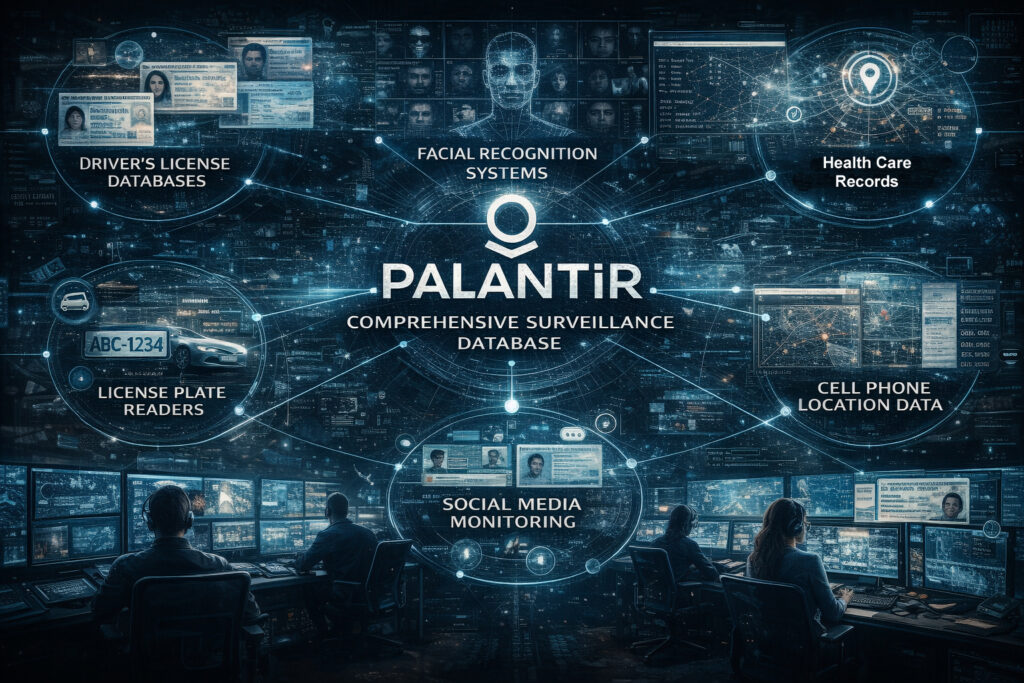
Palantir’s systems function as data integration platforms that merge information from
driver’s license databases,
cell phone location records,
facial recognition systems,
social media monitoring tools, and
even healthcare records.
These capabilities raise profound questions about privacy, civil liberties, and the boundaries of government surveillance in a democratic society.
What distinguishes Palantir’s role is not merely providing software but constructing what one former employee, quoted in multiple news reports, described as extravagant plumbing for data. The company’s platforms integrate information that would otherwise remain siloed across different agencies and databases, creating comprehensive profiles that enable sophisticated pattern analysis and predictive targeting.
The scope of Palantir’s involvement in immigration enforcement likely extends beyond what is currently known to the public.
Palantir’s History with Immigration Surveillance
From FALCON to ImmigrationOS
Palantir’s relationship with ICE began in 2014, when the agency awarded the company a contract worth over 41 million dollars to build and maintain the Investigative Case Management system. According to documents obtained by the Electronic Privacy Information Center through litigation, this system became ICE’s primary data storage and analysis infrastructure.
The FALCON system, documented in EPIC’s Freedom of Information Act requests, consists of multiple modules designed to aggregate and analyze data. Internal ICE documents revealed by investigative journalists show that FALCON was used to track air travel, analyze driver’s license scans, and monitor people’s locations using cell phone records. Until 2022, according to reporting by immigration policy researchers, the FALCON-Roadrunner module enabled real-time location tracking of both enforcement targets and ICE agents during operations.
In April 2025, ICE awarded Palantir a 30 million dollar contract to develop ImmigrationOS, described in contract justification documents as a next-generation enforcement tool. According to The New York Times, which obtained public procurement records, this contract is part of more than 900 million dollars in federal contracts Palantir has received since the current administration took office.
The contract specifications, reviewed by the American Immigration Council, outline three primary functions for ImmigrationOS: streamlining identification and apprehension decisions with priority given to specific categories of immigrants, tracking self-deportations with what the contract terms near real-time visibility, and improving deportation logistics from identification through removal.
The Scale of the Partnership
The depth of Palantir’s integration into immigration enforcement became apparent through multiple reporting sources. The Intercept‘s 2017 investigation described Palantir as providing the engine for deportation operations, while a 2016 investigation by The Verge, based on internal documents, suggested the company’s systems could facilitate screening programs for immigrants.
What distinguishes Palantir’s role is not merely providing software but constructing what one former employee, quoted in multiple news reports, described as extravagant plumbing for data. The company’s platforms integrate information that would otherwise remain siloed across different agencies and databases, creating comprehensive profiles that enable sophisticated pattern analysis and predictive targeting.

Database Access and Integration
The Breadth of Data Sources
According to government documents reviewed by the American Immigration Council, Palantir’s systems pull data from across government databases, including passport records, Social Security files, IRS tax data, and license plate reader information. The Electronic Frontier Foundation’s analysis emphasizes that Palantir functions as a data integration tool, linking databases that were never intended to be connected and which often hold incorrect data.
The Georgetown Law Center on Privacy and Technology’s comprehensive investigation, American Dragnet, documented that ICE has secured access to data from state motor vehicle departments, utility companies, and even educational institutions. The investigation revealed that ICE conducted facial recognition searches of driver’s license databases as early as 2008, with Rhode Island being the first documented case.
The Washington Post’s 2019 investigation, based on documents obtained from Georgetown’s Center on Privacy and Technology, revealed that ICE had conducted facial recognition searches of driver’s license photos in multiple states without obtaining explicit legislative authorization. The revelation prompted congressional concern, with Representative Zoe Lofgren, chair of the House Judiciary Subcommittee on Immigration and Citizenship, describing the practice as a massive, unwarranted intrusion conducted secretly and without legal authorization.
Healthcare Data Integration
In January 2026, investigative outlet 404 Media reported on a Palantir-developed tool called ELITE, Enhanced Leads Identification and Targeting for Enforcement. Based on court testimony from law enforcement agents in Oregon and documents obtained through litigation by 404 Media and the Freedom of the Press Foundation, ELITE integrates data from the Centers for Medicare and Medicaid Services’ database containing information on approximately 80 million Medicaid patients.
According to Fortune magazine‘s reporting on the controversy, ELITE generates what ICE calls leads by accessing Medicaid data to create dossiers on individuals the agency believes may be deportable. The system provides confidence scores regarding individuals’ current addresses and maps potential enforcement targets.
The KFF health policy research organization‘s analysis noted a fundamental problem with using Medicaid data for immigration enforcement: the data available to the Centers for Medicare and Medicaid Services does not distinguish between immigrants who are lawfully present and those who are not. This means the system necessarily sweeps in information about individuals who have legal authorization to be in the United States.

Location Tracking Infrastructure
Cell Phone Location Data
Internal ICE documents, cited by immigration policy researchers, explicitly state that the agency uses Palantir platforms and applications to track people’s locations using cell phone records. This capability represents a significant expansion of surveillance beyond traditional law enforcement methods that would typically require warrants for such intrusive tracking.
The Wall Street Journal‘s 2020 investigation documented that multiple federal agencies, including ICE, purchased access to databases compiled by commercial data brokers that aggregate location information from smartphone applications. These purchases, based on procurement records and contracts, allowed agencies to access information that might otherwise require judicial authorization if obtained directly from telecommunications providers.
Reporting by Vice’s Motherboard in 2021 revealed that ICE, among other agencies, purchased access to commercial databases containing billions of location records harvested from smartphone applications. These databases can be queried to identify individuals who visited specific locations or to construct detailed movement patterns over extended periods.
License Plate Reader Networks
According to the Electronic Frontier Foundation‘s investigations, ICE maintains contracts with multiple automated license plate reader companies. The agency has a six-million-dollar contract through a Thomson Reuters subsidiary to access license plate data from Motorola Solutions. Additionally, EFF documented that ICE persuaded local law enforcement officers to conduct searches on the agency’s behalf through Flock Safety’s extensive network.
Investigative reporting by 404 Media in May 2025 found specific instances where local law enforcement in Illinois searched Flock’s automated license plate reader system and subsequently shared information with ICE. The San Francisco Standard documented that San Francisco police officers permitted out-of-state law enforcement to conduct more than 1.6 million searches of the city’s license plate reader database, with at least 19 searches connected to ICE investigations.
Georgetown Law’s American Dragnet investigation emphasized that Palantir’s role is to integrate this license plate reader data with other information sources, enabling ICE to correlate vehicle movements with other data points to establish patterns of life and predict where targets might be located at specific times.

Facial Recognition and Biometric Surveillance
Driver’s License Database Access
Internal ICE documents confirm that the agency uses Palantir platforms to analyze information from driver’s license scans. The American Immigration Council’s reporting notes that ICE uses Palantir to analyze driver’s licenses, among other data sources, as part of its enforcement operations.
The Georgetown Center’s investigation revealed that ICE has exploited immigrant vulnerability to collect this data. Sixteen states and Washington, D.C. allow undocumented immigrants to apply for driver’s licenses in exchange for providing personal information, including legal names, addresses, and photographs. According to the research, ICE has accessed these very databases to target the individuals who provided information in good faith seeking to comply with traffic laws.
Mobile Facial Recognition Technology
Reporting by 404 Media and subsequent coverage by PBS News and other outlets documented that ICE has deployed a mobile facial recognition application called Mobile Fortify. According to Department of Homeland Security disclosures, this application allows agents to scan people’s faces using their mobile phones and compare the scans against databases containing photographs from multiple government agencies.
The Illinois Attorney General’s lawsuit against DHS, filed in January 2026, alleges that Mobile Fortify has been used in the field more than 100,000 times. KJZZ radio’s interview with 404 Media founder Joseph Cox revealed that the application accesses a gallery of 200 million photos from Customs and Border Protection, the State Department, and images captured when individuals enter or exit the United States.
Videos posted online and incidents observed by Associated Press journalists, document ICE agents scanning people’s faces without requesting consent, and in some cases continuing to scan even after individuals objected. Civil rights experts interviewed by PBS noted that Congress never authorized the use of border facial recognition technology to be turned inward for domestic enforcement purposes.
Integration with Commercial Facial Recognition
Campaign Zero‘s investigation into private surveillance companies documented that ICE is among the largest customers of Clearview AI, a company that has scraped more than 30 billion facial images from internet sources without consent. WIRED magazine‘s reporting on ICE surveillance plans notes that the agency seeks to incorporate technologies from companies, including Clearview AI, among others, to enhance operational capabilities.
KQED’s investigation noted that Clearview AI is used by hundreds of police departments nationwide and is expected to engage in deeper collaboration with ICE. The company has faced criticism for privacy violations and documented inaccuracies, particularly in identifying people with darker skin and women.

Social Media Monitoring and Digital Surveillance
Social Media Monitoring Contracts
WIRED magazine reported in 2025 that ICE is seeking to contract with nearly 30 companies to conduct social media monitoring for gathering intelligence for deportation raids and arrests. The proposal calls for continuous monitoring with defined turnaround times and seeks to incorporate surveillance technologies from multiple companies.
Documents obtained by the Brennan Center for Justice through Freedom of Information Act requests showed that ICE purchased access to commercial social media monitoring tools capable of tracking keywords, hashtags, and locations across multiple platforms simultaneously. These tools enable analysts to create detailed profiles based on social media activity, connections, and movements.
The American Immigration Council reports that Palantir’s platforms combine social media posts with travel records, tax data, and phone extractions into unified investigative files. This integration transforms disparate pieces of information into comprehensive dossiers that can be searched and analyzed as single entities.
Tip Line Integration with Artificial Intelligence
PBS News reported that the Department of Homeland Security disclosed it is using Palantir’s artificial intelligence models to process immigration enforcement tips submitted to its tip line. This represents a shift from manual processing of information to automated analysis of public submissions.
The implications of AI-assisted tip processing are significant. Such systems can rapidly cross-reference submitted information against multiple databases, potentially flagging individuals based on pattern-matching algorithms whose criteria are not publicly disclosed. Civil liberties advocates have raised concerns about the accuracy of such automated systems and the potential for false positives affecting individuals who have legal status.

Legal and Ethical Implications
Conflicts of Interest and Oversight Concerns
The American Immigration Council’s reporting revealed that Stephen Miller, described as the administration’s chief architect of immigration policy, holds a substantial financial stake in Palantir. This relationship raises questions about potential conflicts of interest when a senior government official responsible for immigration policy has financial interests in a company receiving hundreds of millions in government contracts to implement those policies.
KJZZ‘s investigation noted that when DHS or its component agencies deploy new technologies, they are generally required to publish Privacy Impact Assessments describing the technology’s capabilities and potential impacts on civil rights for both non-citizens and American citizens. However, journalists reported they have not yet identified such assessments for either the ImmigrationOS contract or the Mobile Fortify facial recognition application.
Congressional Oversight Gaps
The Georgetown Center’s research documented that ICE’s surveillance initiatives have regularly operated below congressional radar. The agency conducted facial recognition searches of driver’s license databases for over a decade before The Washington Post‘s 2019 investigation brought the practice to public attention. Senior lawmakers with oversight responsibilities expressed shock upon learning of activities that had been occurring for years without their knowledge.
This pattern of operation outside effective oversight has continued. The Electronic Frontier Foundation’s legal director Rachel Levinson-Waldman, quoted by PBS, warned that developing surveillance technologies for immigration enforcement creates infrastructure that could be expanded or wielded against U.S. citizens engaging in entirely lawful or protest activity.
The Surveillance Industry and Democratic Accountability
The Electronic Frontier Foundation’s analysis argues that the surveillance industry represents a key enabler of human rights and civil liberties violations. Their research contends that as long as the surveillance industry exists and generates data, it will remain an irresistible tool for anti-democratic forces.
More than 450 technology workers, including employees from Palantir, Google, and OpenAI, signed a public letter calling on tech CEOs to cancel contracts with ICE, according to Fortune’s reporting. Some Palantir engineers themselves have raised concerns about the ethical implications of designing systems capable of mass surveillance without sufficient oversight, arguing that such systems cross a dangerous line from protecting civil liberties to undermining them.
Conclusion
The evidence reveals a surveillance infrastructure of remarkable scope and sophistication. Palantir’s platforms serve as the connective tissue linking disparate data sources into a unified system for identifying, locating, and tracking individuals. This system integrates information from driver’s license databases, facial recognition systems, cell phone location data, license plate readers, social media monitoring, and even healthcare records.
The company’s role extends beyond merely providing software tools. By creating systems that link databases never intended to be connected, Palantir has constructed an infrastructure that enables surveillance at a scale that would have been difficult to implement through traditional law enforcement methods. The integration of artificial intelligence into these systems amplifies their capabilities, enabling pattern analysis and predictive targeting based on criteria that are not subject to public scrutiny.
What emerges from this is a picture of surveillance creep, where capabilities developed for one purpose become available for others, where data collected for healthcare or transportation safety becomes accessible for immigration enforcement, and where technologies deployed at borders turn inward to monitor activities within the country. The lack of robust oversight mechanisms and the absence of clear legal boundaries create conditions where these systems can expand beyond their stated purposes.
This raises fundamental questions about the appropriate balance between enforcement efficiency and civil liberties, between technological capability and democratic accountability, and between corporate profit and public interest. While Palantir maintains that its systems improve enforcement efficiency and public safety, the concentration of such extensive surveillance power in algorithmic systems operating with minimal public transparency demands careful scrutiny.
This has examined only what has been revealed through government contracts, investigative journalism, litigation, and Freedom of Information Act requests. The complete scope of Palantir’s involvement in immigration enforcement, and the full capabilities of the systems the company has constructed, likely extend beyond what is currently documented in the public record. As these systems continue to evolve and expand, the need for transparency, oversight, and public accountability becomes increasingly urgent.
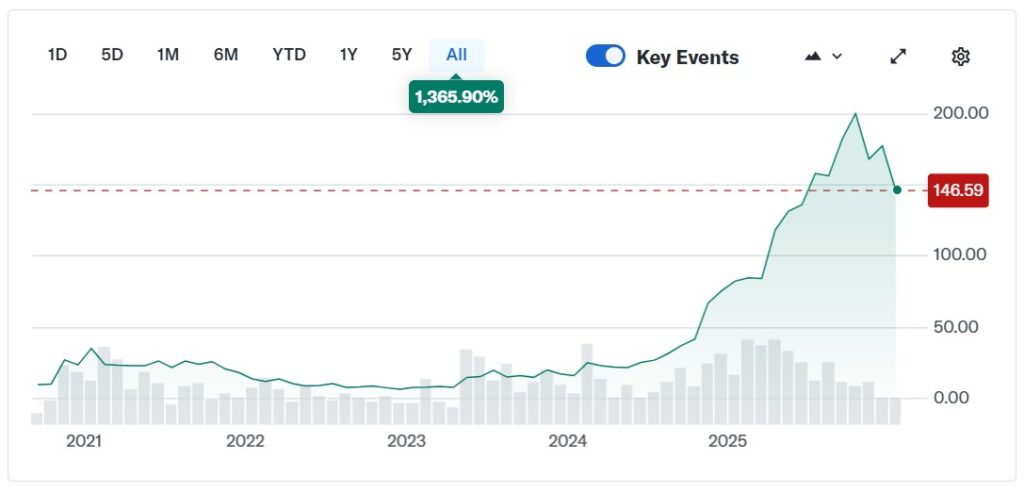
Palantar Stock Price