Trump’s $230 Million DOJ Jackpot
TOP LINE:
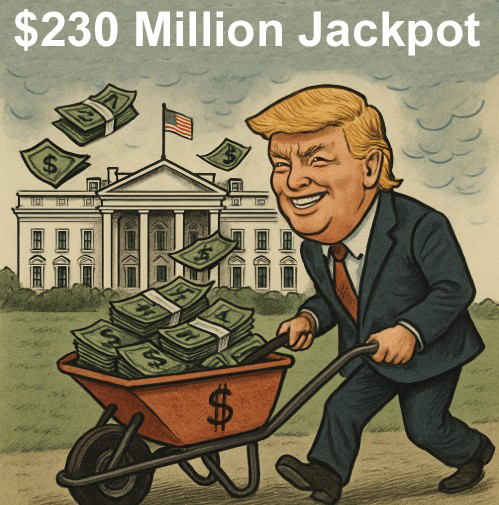
President Donald Trump is demanding that the Department of Justice pay him $230 million in taxpayer money as compensation for investigating him regarding the Russian investigation and Secret Documents cases.
This payout would be approved by his former criminal defense attorneys, now working as senior officials in the Department of Justice
These payments clearly violate the US Constitution’s domestic emoluments clause.
Trump himself acknowledged the absurdity:
“It’s interesting, because I’m the one who makes a decision, right? And you know that decision would have to go across my desk, and it’s awfully strange to make a decision where I’m paying myself.”
Once paid, there is little anyone could do about this
Only pubic outcry could prevent this absurdity.
The Basis for the Claim
According to multiple sources, Trump filed two separate administrative claims against the Department of Justice under the Federal Tort Claims Act: a law that allows people to seek damages when they’re harmed by negligent or wrongful acts of government employees.
Claim One: The Russia Investigation
Filed in late 2023, this claim seeks damages for what Trump alleges were violations of his rights during the FBI and Special Counsel Robert Mueller’s investigation into Russian interference in the 2016 election and potential connections to Trump’s campaign.
Here’s the problem with that claim: The Mueller investigation resulted in 34 indictments, including Trump’s campaign chairman, his deputy campaign chairman, his national security advisor, his personal lawyer, and his longtime political advisor. Seven people pleaded guilty or were convicted. The investigation documented extensive contacts between Trump’s campaign and Russia, and detailed multiple instances where Trump attempted to obstruct the investigation.
Trump is seeking $130 Million for this claim.
Claim Two: The Classified Documents Case
Filed in summer 2024, this claim accuses the FBI of violating Trump’s privacy when agents searched Mar-a-Lago in August 2022 and seized hundreds of classified documents that Trump had taken from the White House after leaving office.
Trump is seeking $100 million for this claim alone, alleging malicious prosecution, invasion of privacy, and reputational damage.
Here’s what actually happened: After months of negotiations, subpoenas, and Trump’s legal team falsely certified that all classified materials had been returned the FBI executed a court-authorized search warrant. They found over 300 classified documents, including documents marked Top Secret and compartmented information related to national security.
A federal grand jury indicted Trump on 40 counts related to willful retention of national defense information, obstruction of justice, and making false statements.
So Trump’s claim is essentially this: “I took classified documents illegally, lied about returning them, obstructed efforts to get them back, got caught, and now I want $100 million because you searched my property with a valid warrant.
The Clear Conflicts of Interest
Who would decide whether to pay Trump this money?
Todd Blanche: Deputy Attorney General
Todd Blanche was Trump’s lead criminal defense attorney in both the classified documents case and the January 6 election interference case. These are the very cases for which Trump now seeks compensation.
Blanche defended Trump through grand jury proceedings, arraignments, pre-trial motions, and was preparing to defend him at trial before Trump was reelected and the cases were dropped.
Blanche now works for Trump as the number-two official at the Justice Department. And he would be one of the officials authorized to approve paying Trump $230 million, for cases Blanche himself defended Trump in.
Stanley Woodward: Associate Attorney General
Stanley Woodward is the number-three official at DOJ. He represented Walt Nauta, Trump’s co-defendant in the classified documents case. Nauta was charged with conspiring with Trump to obstruct justice and hide classified documents. He has deep financial and professional ties to Trump.
Woodward is now in a position to approve a $230 million payment to Trump for the very case in which Woodward represented Trump’s co-conspirator.
Pam Bondi: Attorney General
Attorney General Pam Bondi, who oversees both Blanche and Woodward, has her own Trump connections. She has been a longtime political ally, defended Trump during his first impeachment, and her appointment to AG was widely seen as a reward for loyalty.
So the people who would approve of Trump’s claim are:
- His former defense attorney
- His co-defendant’s attorney (paid by Trump’s PAC)
- His longtime political ally
These Ethics Officials Have Been Fired by Trump
In July 2025, the Trump administration fired Joseph W. Tirrell, the Director of DOJ’s Departmental Ethics Office. He was the person responsible for advising on conflicts of interest, financial disclosures, and recusals for senior political appointees like Blanche, Woodward, and Bondi.
Trump also fired Jeffrey Ragsdale, Director of the Office of Professional Responsibility, which investigates ethical violations by DOJ attorneys.
Trump purged at least a dozen career ethics officials who had worked with the Special Counsel’s office or had oversight responsibilities.
Senate Judiciary Committee Democrats, led by Ranking Member Dick Durbin, sent a letter to Attorney General Bondi highlighting this exact problem:
“As you know, the Trump Administration removed the senior career DOJ ethics officials who would provide this critical guidance and placed their duties in the hands of inexperienced political appointees who are beholden to you for their positions.”
This violates the Constitution
Article II, Section 1, Clause 7 of the United States Constitution contains what’s known as the Domestic Emoluments Clause. Here’s what it says:
“The President shall, at stated Times, receive for his Services, a Compensation, which shall neither be increased nor diminished during the Period for which he shall have been elected, and he shall not receive any other Emolument from the United States, or any of them, during that Period.”
This clause has one purpose: to prevent the President from receiving any payment from the federal government or state governments beyond his fixed salary.
The Domestic Emoluments Clause prohibits exactly what Trump is trying to do: receive money from the United States government beyond his presidential salary.
Legal scholars across the political spectrum agree. Representative Jamie Raskin, Ranking Member of the House Judiciary Committee, along with Ranking Member Robert Garcia of the Oversight Committee, sent a letter to Trump.
They wrote:
“President Trump has described a blatantly illegal and unconstitutional effort to steal $230 million from the American people. As the senior Department of Justice officials who would be responsible for approving that shakedown, you each face a choice: uphold your constitutional oath and refuse this flagrantly illegal demand, or become complicit in perhaps the most brazen violation of the Constitution’s anti-corruption provisions in American history.”
Senate Judiciary Democrats were equally blunt, characterizing the claims as “yet another attempt by President Trump to weaponize his position of power for personal financial gain at the expense of American taxpayers.”
Any Justice Department official who approves this payment would not only be violating the Constitution, they would also be committing crimes themselves.
The House Judiciary Democrats’ letter makes this clear:
“Agreeing to the President’s demands would not only violate that oath, it would also constitute aiding and abetting an unconstitutional and unlawful scheme to use taxpayer funds to enrich the President. Doing so could expose these officials to civil liability, ethics investigations, professional discipline, and potential criminal liability for conspiracy to defraud the United States.”
How would we know if it was paid?
If Trump’s appointees approve this payment, how would the American people even know?
The Judgment Fund
Settlements under the Federal Tort Claims Act are typically paid from something called the Judgment Fund, which is a pot of indefinitely appropriated money that Congress has set aside to pay court judgments and settlements against the United States government. It’s managed by the Treasury Department and contains billions of dollars.
Once a settlement is approved by the Justice Department, the Treasury Department processes the payment automatically. There’s no additional oversight. No vote. No public hearing.
In 2025, the federal Judgment Fund paid out a total of $207 million for all settlements in claims against the Justice Department. Trump is seeking more than that entire amount for himself.
Reporting Requirements
There are some transparency mechanisms, but they’re inadequate:
Under 28 U.S.C. § 530D, the Attorney General must report to Congress any settlement exceeding $2 million within 30 days after the conclusion of each fiscal quarter.
The report must include the date of approval, a detailed statement of the issues and background, and fully executed copies of settlement agreements.
So theoretically, if this settlement were approved, Congress would eventually find out about it, leagally within 30 to 120 days after it happens.
But here’s the problem: That’s just reporting. It’s not approval. It’s not oversight. It’s a notification after the fact. By the time Congress learns about it, the money has already been paid.
Secret Settlements?
If Trump’s lawyers and DOJ officials structured this as an “alternative dispute resolution” process or claimed national security concerns required confidentiality, they could potentially delay public disclosure.
Administrative settlements are often negotiated confidentially. The reporting requirement only kicks in once the settlement is finalized and approved. The negotiation process itself can be opaque.
Legal experts told The Hill that there is “no legal recourse whatsoever” for taxpayers or members of Congress to challenge a settlement once it’s approved. Mounting a legal challenge would be “difficult” because it’s nearly impossible to find a plaintiff with legal standing—a concrete and personal stake in the outcome.
As one legal expert put it:
“They can be heard politically, but legally, there is no process whatsoever for a taxpayer or a representative in Congress to challenge a bona fide settlement.”
Trump could get paid, and there’s almost nothing anyone could do about it.
Is there Congressional Oversight?
Who Makes the Final Decision?
Under Federal Tort Claims Act regulations and the Justice Department’s own manual:
- For settlements up to $25,000: Agency heads can approve
- For settlements between $25,000 and $4 million: The Assistant Attorney General for the Civil Division or the Director of the Torts Branch can recommend, and either the Deputy Attorney General or Associate Attorney General must approve
- For settlements exceeding $4 million: The Associate Attorney General must approve, though typically in consultation with the Deputy Attorney General
For a $230 million settlement, the approval would almost certainly require sign-off from:
- Todd Blanche (Deputy Attorney General), and/or
- Stanley Woodward (Associate Attorney General)
Both men are Trump’s former lawyers.
While Trump claimed he wouldn’t personally sign off, because that would be too obviously corrupt, his political appointees would make the decision. And they serve at his pleasure.
Can Congress Stop This?
Legally, Congress could pass legislation prohibiting the Justice Department from settling claims filed by sitting presidents. They could require Congressional approval for any settlement exceeding a certain threshold to the president. They could defund the Judgment Fund until assurances are provided.
But that would require:
- A bill passing the House
- A bill passing the Senate
- Trump not vetoing it (or Congress overriding his veto with a two-thirds majority)
None of that is going to happen with Republicans in control and Trump in the White House.
So the practical answer is: Congress cannot stop this unless Republicans decide Trump has gone too far. And there’s no evidence that a threshold exists.
So, what happens next?
The most likely scenario is that Trump’s lawyers and DOJ officials quietly negotiate a settlement for some amount less than $230 million, perhaps $50 million, perhaps $100 million, and present it as a “compromise.” They’ll file the required report with Congress 30 days after the fact. Democrats will howl. Republicans will shrug. The payment will be made. And there will be nothing anyone can do about it.
Here’s what this really is: a test.
Trump is testing whether he can openly violate the Constitution and enrich himself using taxpayer dollars, while the officials he appointed facilitate it, and face zero consequences.
If this succeeds and Trump gets paid, it establishes a precedent that presidents can sue their own government, install loyalists to approve those suits, and pay themselves whatever they want.
It means the Emoluments Clause is meaningless. It means presidential conflicts of interest are acceptable. It means self-dealing is the norm.
And it means we no longer have a republic governed by law. We have a kleptocracy governed by whoever has power.
Representative Raskin put it perfectly in his letter to DOJ officials:
“You have an independent obligation to uphold the Constitution. In the face of this outlandish assault from the President of the United States, you have a duty to immediately and publicly announce that the Department will not approve any payments to President Trump based on these administrative claims.”
The answer will tell us everything about whether the rule of law still exists in America.
Make your voice heard
Which Congressional Committees Have Jurisdiction?
Multiple Congressional committees have oversight jurisdiction over this matter:
The Judiciary Committee has jurisdiction over the Department of Justice, the Federal Tort Claims Act, and constitutional issues, including the Emoluments Clause.
Ranking Member Jamie Raskin (D-MD) has led House Judiciary Democrats in demanding that Bondi, Blanche, and Woodward reject Trump’s claims. They’ve launched an investigation and requested all documents and communications related to Trump’s administrative claims, including DOJ’s internal assessments of their legality.
The Oversight Committee has broad jurisdiction over government waste, fraud, and abuse, as well as ethics violations by government officials.
Ranking Member Robert Garcia (D-CA), along with Raskin, sent a letter to Trump demanding he turn over any documents, legal analysis, or communications regarding his plan to “rob American taxpayers.”
Senate Judiciary Committee Democrats, led by Ranking Member Dick Durbin (D-IL), sent a letter to Attorney General Bondi probing Trump’s claims and highlighting the “inescapable conflict of interest” at DOJ.
All Senate Judiciary Democrats signed the letter, characterizing the claims as “yet another attempt by President Trump to weaponize his position of power for personal financial gain.”
The Appropriations Committees have jurisdiction over the Judgment Fund, which is funded through indefinite appropriations. They could theoretically hold hearings on whether the fund should be restructured to require Congressional approval for settlements to current presidents.