Trump’s Greenland Gambit
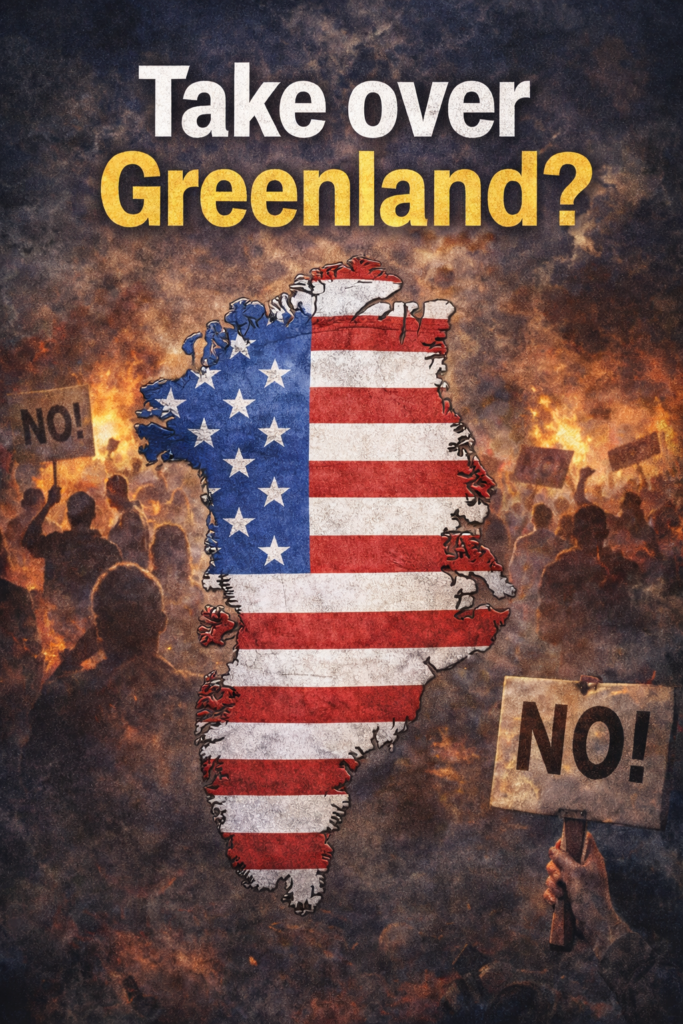
On January 6, 2026, White House Press Secretary Karoline Leavitt stated:
“President Trump has made it well known that acquiring Greenland is a national security priority of the United States, and it’s vital to deter our adversaries in the Arctic region. The President and his team are discussing a range of options to pursue this important foreign policy goal, and of course, utilizing the U.S. Military is always an option at the Commander in Chief’s disposal.”
This came after Trump appointed Louisiana Governor Jeff Landry as special envoy to Greenland with the explicit mission to “make Greenland a part of the US.”
This is not a joke or posturing. Trump is serious.
In response, Denmark has deployed hundreds of additional troops to Greenland, including the Chief of the Royal Danish Army. Eight NATO allies– France, Germany, Italy, Poland, Spain, the United Kingdom, Norway, and Sweden, have sent military reinforcements as part of “Operation Arctic Endurance” specifically to defend Greenland from American aggression.
An invasion of Greenland would be an unambiguous violation of international law. Not a gray area. Not a matter of interpretation. A clear, unequivocal violation.
The cornerstone of post-World War II international law is Article 2(4) of the United Nations Charter, which states:
“All Members shall refrain in their international relations from the threat or use of force against the territorial integrity or political independence of any state, or in any other manner inconsistent with the Purposes of the United Nations.”
This isn’t some obscure provision buried in treaty footnotes. This is THE fundamental principle of modern international law. The International Court of Justice has called it “an important part of the international legal order” and a “cornerstone of the UN Charter.”
The United States, along with every other UN member, pledged to uphold this principle. We ratified the UN Charter. It’s part of U.S. law.
Greenland is part of the Kingdom of Denmark. Denmark is a sovereign state recognized by the United Nations and every country on Earth. Any military action to seize Greenland would be a textbook violation of Denmark’s territorial integrity.
International law professor Marc Jacobsen from the Royal Danish Defence College is unequivocal: A U.S. invasion would constitute “a direct violation of the NATO treaty” and international law.
If the United States invades Greenland, we become exactly what we condemned Russia for when it invaded Ukraine. We become what we fought against in World War II. We become an imperial aggressor using military might to seize territory in direct violation of international law.
End of NATO
EU Defense Commissioner Andrius Kubilius went further: “A US invasion of Greenland would be the end of NATO.”
If NATO collapses, America loses:
- Military bases across Europe, including in the Arctic, that are vital for defense
- Intelligence sharing networks built over 75 years
- The combined military power of 30 democratic nations
- The coalition that helps us compete with China and deter Russia
- Our credibility as a reliable partner anywhere in the world
Here is the truth. We already have what we need in Greenland.
The United States operates Pituffik Space Base (formerly Thule Air Base) in Greenland under a 1951 agreement with Denmark. We have roughly 150 American troops stationed there. The base provides critical early warning radar systems, satellite tracking, and missile defense capabilities.
Denmark has never once denied us access. They’ve been eager partners in Arctic security for over 70 years.
If we want more bases, more troops, more mineral access, Denmark would negotiate. They’re our ally. That’s what allies do.
If the United States can invade allied territory because we claim “national security” justifies it, then every other major power gets the same excuse.
Russia claims national security justifies invading Ukraine. We condemned that. How do we maintain moral authority when we’re doing the same thing?
China claims national security justifies annexing Taiwan. How do we object when we’ve established that powerful nations can seize territory they deem strategically important?
American Foreign Policy
Step back and look at what this crisis reveals about American foreign policy under Trump.
Take a look at the 2025 National Security Strategy
In a nutshell, it articulates a distinctly “America First” national security doctrine that prioritizes core U.S. interests, sovereignty, and economic and military strength over broad commitments to global governance or values-based diplomacy. It also emphasizes a more transactional relationship with allies.
This approach represents a sharp departure from recent NSS documents, such as the Biden administration’s 2022 strategy, which framed U.S. security around democracy promotion, multilateral alliances, and a rules-based international order.
It shifts away from global leadership roles toward regional dominance and domestic resilience. Unlike previous strategies that balanced security with engagement in institutions like NATO and climate-related security agendas, the 2025 NSS treats climate policy and global governance as secondary or counterproductive to U.S. competitive advantage.
What is driving Trump?
After successfully conducting a military operation in Venezuela to capture President Maduro, itself a violation of Venezuelan sovereignty, Trump is emboldened. He believes American military might can achieve any objective without consequences.
He’s threatening Canada with annexation. He’s threatening to seize the Panama Canal. He’s threatening military action against Colombia, Cuba, and Mexico.
And the consequences are already manifesting:
Trump launched a trade war with the European Union, threatening 10-25% tariffs on eight NATO allies until they capitulate on Greenland. This isn’t trade policy. This is economic warfare to force territorial concessions.
EU leaders have responded by stalling approval of the proposed EU-US trade agreement and discussing the use of the EU Anti-Coercion Instrument to target the United States.
The NATO alliance is fractured. Trust between America and Europe is at an all-time low. China and Russia are delighted.
Here’s why you should care:
First, if America can violate international law when convenient, every other country can too. The chaos that is unleashed makes the world far more dangerous for Americans.
Second, if NATO collapses, America faces China and Russia alone. We lose the collective military and economic power of 30 democratic nations. That makes us weaker, not stronger.
Third, if our allies can’t trust us, they stop cooperating. Intelligence sharing ends. Military bases close. Trade agreements dissolve. The network of partnerships that amplifies American power disintegrates.
Fourth, if we normalize territorial conquest, we legitimize every other country’s territorial ambitions. That means more wars, more instability, more global chaos.
Fifth, the precedent we set today determines the world our children inherit. Do we want them growing up in a world where might makes right, where treaties are worthless, where the powerful simply take what they want from the weak?
Sixth, this isn’t just about Greenland. It’s about whether America still believes in the principles we claim to represent. Democracy. Rule of law. Respect for sovereignty. Peaceful resolution of disputes. International cooperation.
Implications
President Trump wants to invade Greenland. Not might. Not could. The White House has explicitly stated that military force is an option they’re considering.
And all of this to seize a territory we already have access to, from an ally eager to cooperate, for reasons that could be achieved through negotiation.
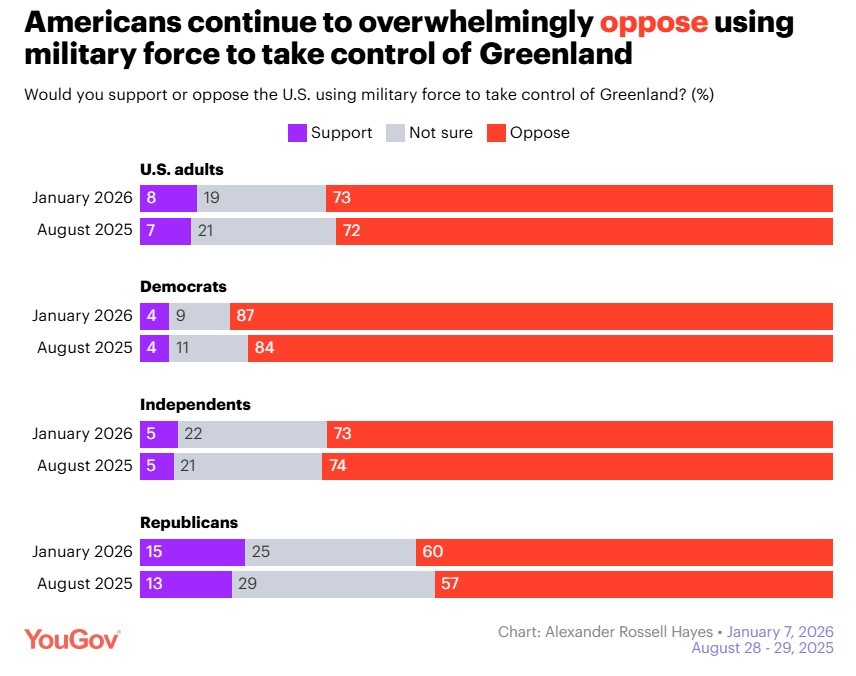
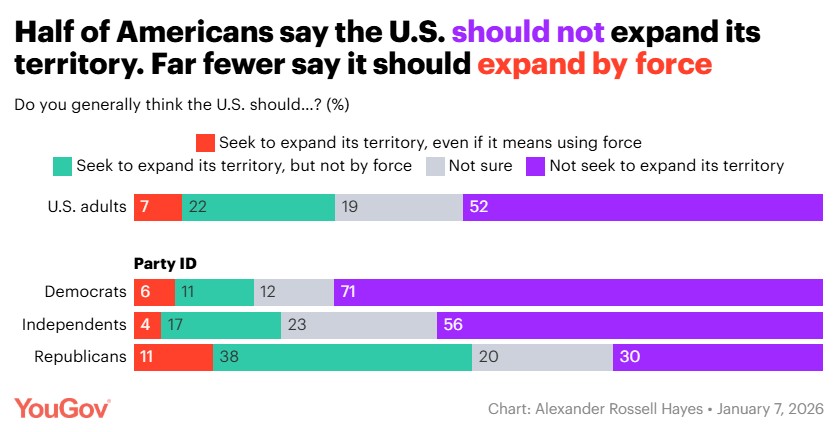
Public Opinion Opposed this invasion.
Take Action
Congress must act to block this madness. The American people must demand that our government respect international law and our treaty obligations. Our allies must know that America still honors its commitments.
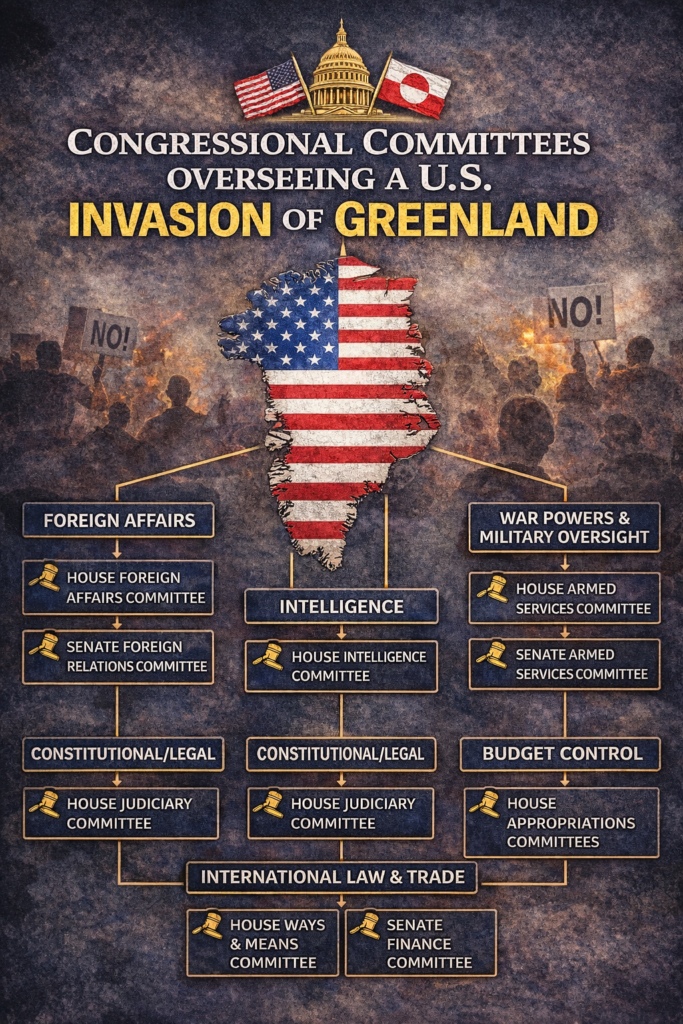
I. Core Committees With Primary Jurisdiction
1. House Committee on Foreign Affairs
Jurisdiction:
- Relations with foreign nations
- Treaties and international agreements
- Use of force against foreign states
- NATO obligations and alliance relations
Why it matters here:
- Greenland is part of Denmark, a NATO ally
- Any invasion would violate international law and treaty commitments
- This committee would hold hearings on diplomatic fallout, legality, and alliance consequences
2. Senate Committee on Foreign Relations
Jurisdiction:
- War authorization
- Treaties (including NATO)
- U.S. obligations under international law
- Diplomatic relations with Denmark and allies
Why it matters:
- The Senate must approve treaties and authorizations for use of military force (AUMFs)
- Would examine whether the president exceeded constitutional authority
- Central to any impeachment-related inquiry tied to foreign aggression
II. War Powers and Military Oversight
3. House Armed Services Committee
Jurisdiction:
- Department of Defense
- Military operations and planning
- Use of armed forces
Why it matters:
- Would oversee military orders, planning, and rules of engagement
- Would scrutinize whether the military was unlawfully directed
- Key venue for testimony from Pentagon leadership
4. Senate Armed Services Committee
Jurisdiction:
- Military command authority
- Defense readiness and legality of operations
- Civilian control of the military
Why it matters:
- Would examine whether orders were lawful
- Could investigate refusal or compliance by military officers
- Central to questions of the constitutional chain of command
III. Intelligence and National Security Oversight
5. House Permanent Select Committee on Intelligence (HPSCI)
Jurisdiction:
- Intelligence assessments
- Covert action
- National security decision-making
Why it matters:
- Would assess intelligence justifications (if any) for action
- Investigate misuse or manipulation of intelligence
- Examine whether intelligence agencies were pressured or bypassed
6. Senate Select Committee on Intelligence (SSCI)
Jurisdiction:
- Intelligence community oversight
- National security threats
- Foreign influence and disinformation
Why it matters:
- Would evaluate whether claims about Greenland posed a national security threat
- Could investigate foreign influence or conflicts of interest motivating action
IV. Constitutional, Legal, and Accountability Committees
7. House Judiciary Committee
Jurisdiction:
- Constitutional authority
- Impeachment
- Abuse of executive power
Why it matters:
-
Central Committee for determining whether an invasion constitutes:
- Abuse of power
- Violation of the War Powers Resolution
- High crimes and misdemeanors
8. Senate Judiciary Committee
Jurisdiction:
- Constitutional interpretation
- Executive authority limits
- National security law
Why it matters:
- Would assess the legality of executive actions
- Relevant to impeachment trial preparation or statutory reform
Trump’s bizarre letter to Norway
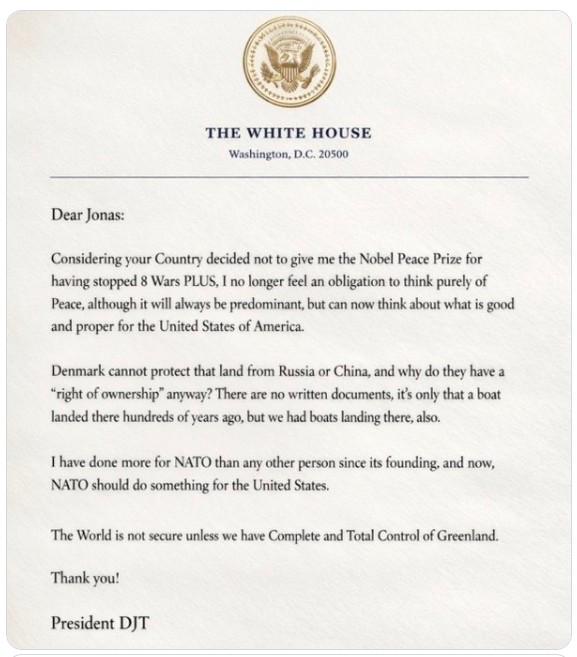
Note: The Nobel Committee, not the government of Norway, awards the Nobel Prizes.