Who are Unauthorized Immigrants?
Key Points:
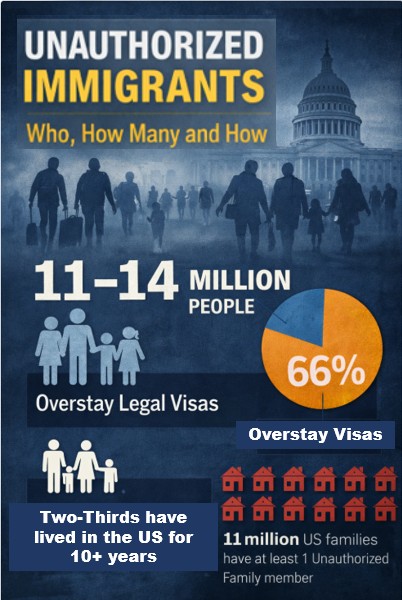
- There are 11 and 14 million unauthorized immigrants in the US.
- There is no evidence that countries are emptying their prisons and mental health hospitals to send them to the U.S.
- The primary way people have become unauthorized immigrants in the United States is by overstaying legal visas.
- Nearly eight in ten, of unauthorized immigrants have resided in the US for at least 15 years.
What is an Unauthorized Immigrant?
An undocumented immigrant, also called an unauthorized immigrant, is someone living in the United States who is not a lawful permanent resident, not a refugee, not granted asylum, and not here on a legal temporary visa like a student or worker visa.
That’s it. That’s the definition. They lack legal authorization to be in the country permanently.
But here’s what’s crucial to understand: how someone becomes undocumented is far more complicated than most people realize. And that leads us to the first major misconception we need to address.
How many unauthorized Immigrants are there in the US?
According to Pew Research Center’s most recent comprehensive analysis published in August 2025, there were 14 million unauthorized immigrants living in the United States as of July 2023. That’s a record high, representing about 3.3% of the total U.S. population.
The Department of Homeland Security estimates roughly 11 million.
The Migration Policy Institute estimates 13.7 million.
The Center for Migration Studies puts it at 12.2 million for 2023.
Why the variation? Because we’re estimating a population that by definition doesn’t want to be counted. Researchers use what’s called the “residual method“; they take Census Bureau data on all foreign-born people, subtract the number of people who are here legally, and the remainder is the estimated undocumented population.
So when you hear different numbers, understand that these are estimates based on sophisticated statistical modeling, not exact counts. But they all point to the same reality: between 11 and 14 million people, roughly one in every twenty-five to thirty people you pass on the street.
How do they enter the US?
Now here’s where it gets really interesting, because the conventional wisdom about how people become undocumented is almost entirely wrong.
When most Americans think about undocumented immigration, they picture someone sneaking across the border in the dead of night, crossing the Rio Grande. Evading border patrol. What immigration officials call “entry without inspection” or EWI.
That happens. But it’s not the majority.
From 2007 to the present, the primary way people have become undocumented in the United States is by overstaying legal visas.
Let me give you the numbers from the Center for Migration Studies. In 2014, a typical year, 66% of people who became newly undocumented had entered the country legally with valid temporary visas and then stayed after those visas expired. Only 34% crossed the border illegally.
By 2016, the Center found that 320,000 people overstayed their visas while 190,000 entered illegally. In 2019, for the seventh consecutive year, visa overstays outnumbered illegal border crossings. From 2016 to 2017, people who overstayed their visas accounted for 62% of the newly undocumented.
Pew Research found that as much as 45% of the total unauthorized immigrant population, not just new arrivals, but the entire population, entered the country legally through airports or border crossing points where they were inspected by immigration officials.
Think about what this means. Nearly half of undocumented immigrants didn’t sneak across a desert. They walked through customs. They showed passports. They were screened by immigration officers. They entered as tourists, students, temporary workers, or business visitors. And then they stayed.
According to the Department of Homeland Security, between fiscal year 2016 and fiscal year 2022, an average of 650,000 to 850,000 people overstayed their visas each year. That’s between 1% and 2% of all non-immigrant admissions annually.
Are they being dumped here by other countries?
“They’re emptying out their prisons. They’re emptying out their mental institutions and insane asylums into the U.S., and we’re not a dumping ground.”
When PolitiFact investigated the claim in June 2024, Trump’s campaign again provided no evidence. When FactCheck.org investigated, the same result. When multiple journalists asked for the source of Trump’s story about a South American doctor who claimed all his mental health patients had been sent to the United States, the campaign couldn’t produce it. The doctor doesn’t exist. The story doesn’t exist.
Dr. Pierluigi Mancini, an Atlanta-based expert on immigrant behavioral health, told fact-checkers in 2024, and confirmed again in January 2025, that there is “no evidence that countries are emptying their prisons and mental health hospitals to send them to the U.S.”
His reasoning is simple: the journey to the U.S. is extremely difficult, particularly given the “Remain in Mexico” policy that requires immigrants to reside at the Mexican side of the U.S. It’s also expensive; migrants often pay smugglers thousands of dollars. And it requires physical fortitude that someone with a serious mental illness may be unable to sustain.
Who are they, and how long have they been here?
Here’s another critical fact that challenges the narrative: the vast majority of undocumented immigrants are not recent arrivals.
According to a 2024 Department of Homeland Security report, 79%, nearly eight in ten, of unauthorized immigrants have resided in the United States since before 2010. That means they’ve been here for at least 14 years.
Pew Research found that as of 2017, the median undocumented immigrant had lived in the United States for 15 years. Two-thirds had been here for more than a decade.
These are not people who just crossed the border last month. These are long-term residents. They’ve raised children here: 11 million U.S. citizens live with at least one undocumented family member. They’ve built businesses, paid taxes through Individual Tax Identification Numbers, and become integrated into American communities.
As for where they’re from: as of 2022, 37% of unauthorized immigrants were from Mexico, the smallest share on record. El Salvador, India, Guatemala, and Honduras were the next four largest countries of origin. The population is becoming more diverse, with significant numbers now coming from Asia, Central America, South America, and the Caribbean.
The pathway to becoming unauthorized.
Let’s break down the specific ways people become undocumented, because it’s more varied than you might think.
Visa overstays are the largest category. Someone enters on a tourist visa valid for six months, gets a job, decides to stay, and becomes undocumented when that visa expires. Or a student finishes their degree, but their work visa application gets denied, and they stay anyway.
Entry without inspection, the traditional border crossing, still happens, particularly along the southern border. In 2022-2023, we saw unprecedented numbers of people fleeing violence and economic collapse in Venezuela, Haiti, Cuba, Nicaragua, and Central America. Many crossed illegally. Many others presented themselves at ports of entry to seek asylum.
Border Crossing Card violations: Some Mexican nationals enter legally using cards that authorize short visits to the border region, then violate the terms by traveling deeper into the U.S. or staying longer than permitted. Pew estimates between 250,000 and 500,000 people became undocumented this way.
Failed asylum claims: Some people enter legally, request asylum, have their cases denied by immigration judges, receive deportation orders, and remain in the country anyway.
Children brought by parents: An estimated 1.6 million people entered as children and have grown up undocumented, many protected temporarily by the Deferred Action for Childhood Arrivals program.
Why this matters.
Let’s bring this together. What is an unauthorized immigrant?
It’s someone who lacks legal authorization to be in the United States permanently. But that single category includes an extraordinarily diverse population: people who entered legally and overstayed, people who crossed borders illegally, people who’ve been here for decades, people who arrived last year, people from over 150 different countries.
How did they get here? Contrary to popular belief, the majority in recent decades entered legally and then overstayed their visas. Nearly half of all undocumented immigrants came through official ports of entry, not across unguarded borders.
Why does this matter? Because if you don’t understand how people actually become undocumented, you can’t design effective policy. Building a 2,000-mile wall doesn’t address visa overstays. Increasing border patrol doesn’t catch someone who flew into JFK Airport on a valid visa and stayed after it expired.
The immigration debate is filled with rhetoric and emotion. Here are the facts. What you do with those facts is up to you. But at least now you’re working with accurate information about what undocumented immigration actually is, who these people are, and how they got here.
That’s the foundation for any honest conversation about what we should do next.
KEY SOURCES CITED:
- Pew Research Center (August 2025): 14 million unauthorized immigrants as of July 2023
- Department of Homeland Security: 11 million estimate; 79% residing since before 2010
- Center for Migration Studies: Visa overstays outnumbering illegal border crossings since 2007
- Migration Policy Institute: 13.7 million estimate; demographic breakdowns
- Congressional Research Service: 650,000-850,000 annual visa overstays (FY2016-FY2022)