Trumps Deportation Machine
Deportations in Trump’s ICE age
EXECUTIVE SUMMARY
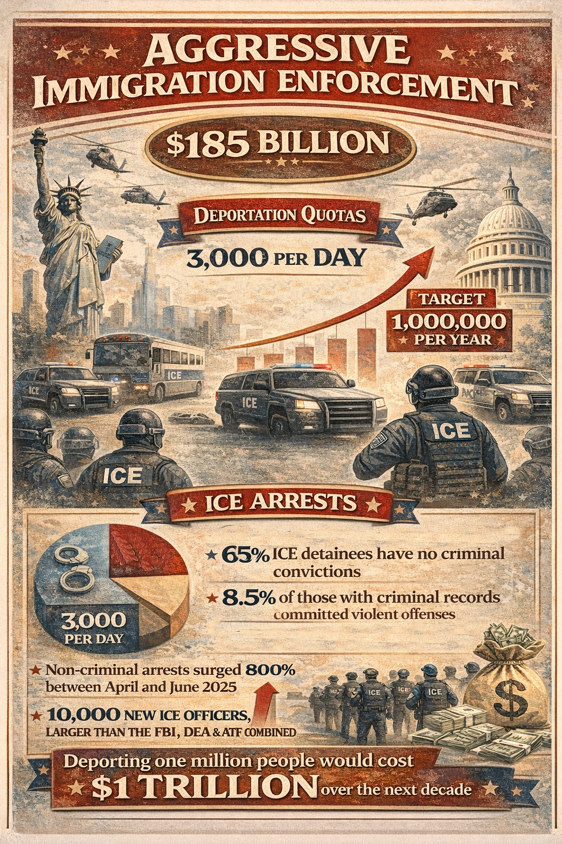
Ten months into President Donald Trump’s second term, the United States has undergone the most dramatic restructuring of immigration enforcement in modern American history. What emerged from the ashes of the Biden administration’s approach is not merely a policy shift. At its core is the construction of an unprecedented deportation apparatus, fueled by nearly $200 billion in federal funding and backed by a political mandate to remove one million people annually.
The Trump administration has transformed Immigration and Customs Enforcement (ICE) from a relatively modest federal agency into the most well-funded law enforcement operation in the country, surpassing even the FBI’s budget.
I. THE FUNDING REVOLUTION
From $10 Billion to $75 Billion: ICE’s Budget Explosion
On July 4, 2025, President Trump signed the ‘One Big Beautiful Bill Act’ (OBBBA), unleashing an unprecedented financial windfall for immigration enforcement. The legislation allocated $75 billion to ICE alone through fiscal year 2029—a staggering increase that transforms the agency’s annual operating budget from approximately $10 billion to a projected $30 billion in FY 2026.
This represents a 200% increase in a single fiscal year, making ICE’s budget larger than Poland’s entire military expenditure. When combined with the $65 billion allocated to Customs and Border Protection and additional homeland security funds, total immigration enforcement spending reaches approximately $185 billion—80 times more than federal labor standards enforcement receives annually.
The Breakdown: Where the Money Goes
The OBBBA funding is strategically distributed across three core functions:
- $45 billion for detention infrastructure – expanding capacity from 50,000 to over 100,000 beds, with plans to reach 107,000 by January 2026. This represents a 400% increase in the detention budget, exceeding the entire federal prison system’s budget.
- $30 billion for personnel and operations – hiring 10,000 new ICE officers (doubling enforcement staff), purchasing vehicles, technology, and modernizing the deportation fleet, including military transport aircraft.
- $47 billion for border wall construction – dwarfing the $15 billion spent during Trump’s first term, with CBP receiving an additional $18 billion for surveillance technology and hiring. NOTE: We have about 1,000 miles of border that could still be fenced at a cost of about $12 million/mile. At $12 billion total, that falls far short of the $47 billion requested.
Regarding specific Homeland Security departments-
The law’s allocations reach nearly every DHS component:
- Immigration and Customs Enforcement: $74.9 billion, focused on detention facilities, workforce growth, and training.
- Customs and Border Protection: $66.8 billion, for barrier construction, surveillance systems, and AI/ML-driven inspection.
- U.S. Coast Guard: $24.2 billion, supporting cutters, aircraft, and shore-facility modernization.
- Federal Emergency Management Agency: $2.9 billion, emphasizing event security, counter-UAS, and local preparedness.
- Secret Service: $1.2 billion, for personnel and training.
- Federal Law Enforcement Training Centers: $750 million, for facility and curriculum expansion.
- DHS-wide funds: $20 billion, split evenly between a State Border Security Reinforcement Fund and border-operations reimbursements.
A particularly concerning provision allocates $10 billion to a discretionary DHS fund with minimal oversight requirements. Critics describe this as a ‘slush fund’ that enables the administration to rapidly scale operations without Congressional scrutiny, redirecting resources to enforcement priorities as they emerge.
Personal diversions
Immigration and Customs Enforcement (ICE) is diverting criminal law enforcement agents away from their investigations and enforcement responsibilities to conduct civil immigration enforcement operations on a massive scale.
This diversion is not a small part of many of these agencies. It includes
- one in five US marshals (650 of 3,892),
- one in five FBI agents (2,840 of 13,700),
- half of DEA agents (2,181 of 4,620),
- over two-thirds of the ATF (1,778 of 2,572), and
- Nearly 90 percent of Homeland Security Investigations (6,198 of 7,100)
The Biden Comparison: A Study in Contrasts
Under President Biden, immigration policy was defined by competing priorities. While the administration conducted 605 immigration-related executive actions—more than Trump’s first term—enforcement focused primarily on border management rather than interior removals. ICE’s annual budget hovered around $8-10 billion, with deportations averaging 68,000 annually from the interior of the United States.
The Biden administration deported 271,000 people in FY 2024, a 10-year high that exceeded Trump’s first-term peak. However, the overwhelming majority were ‘voluntary returns’ at the border rather than formal removals from communities. Biden prioritized prosecutorial discretion, directing ICE to focus on individuals with serious criminal convictions and recent border arrivals, while largely leaving long-term undocumented residents untouched.
II. THE QUOTA SYSTEM: 3,000 ARRESTS A DAY
Inside the Pressure Campaign
On May 20, 2025, White House Deputy Chief of Staff Stephen Miller convened a closed-door meeting with senior ICE officials at DHS headquarters. The message was unequivocal: the administration demanded one million deportations in Trump’s first year, requiring ICE to triple its arrest efforts to 3,000 per day.
This quota system, while officially denied by the Department of Justice in court filings, has fundamentally reshaped how ICE operates. Field agents describe an environment of relentless pressure to meet numerical targets, with performance evaluations increasingly tied to arrest statistics rather than community safety outcomes.
‘We used to prioritize dangerous criminals,’ one ICE officer told investigators on condition of anonymity. ‘Now it’s about numbers. If you’re at a house looking for someone on the target list and there are others present, you’re encouraged to make collateral arrests. Everyone counts toward the quota.’
The Reality: Falling Short Despite Expansion
Despite the intense political pressure and massive resource infusion, ICE has struggled to meet its targets. According to data from the Deportation Data Project and Freedom of Information Act requests, daily arrests have averaged:
- January 20 – May 20, 2025: 778 arrests per day (2% higher than late Biden era)
- May 21 – October 15, 2025: 1,100 arrests per day (after Miller’s quota meeting)
- November – December 2025: Estimated 1,300-1,800 arrests per day (DHS claims higher)
The 3,000-per-day target remains elusive, a testament to both logistical constraints and resistance from sanctuary jurisdictions. As of late October, the administration reported approximately 527,000 formal removals since inauguration—less than half the one-million goal, though officials claim an additional 1.6 million ‘self-deportations.’
Who Gets Arrested: The Expanding Dragnet
The quota system’s most controversial aspect is its impact on whom ICE targets. Contrary to administration rhetoric about prioritizing ‘criminal aliens,’ data reveals a different story:
- 65% of ICE detainees have no criminal convictions (Cato Institute, June 2025)
- Only 30% of those in detention have criminal convictions
- Just 8.5% of those with criminal records committed violent offenses
- Non-criminal arrests surged 800% between April and June 2025
The elimination of ‘sensitive locations’ policies allows ICE to conduct arrests at schools, churches, and hospitals. High-profile cases include Marcelo Gomes Da Silva, an 18-year-old high school student arrested on his way to volleyball practice, Rümeysa Öztürk, detained in front of cameras while walking to class, whose case sparked international condemnation, and college student Mohsen Mahdawi, arrested at an appointment for his naturalization interview.
III. ICE’S TRANSFORMATION: AMERICA’S LARGEST POLICE FORCE
From 8,000 to 18,000 Officers
The OBBBA mandates hiring at least 10,000 new ICE officers, more than doubling the Enforcement and Removal Operations (ERO) workforce. This expansion makes ICE larger than the FBI, DEA, and ATF combined.
The hiring spree includes aggressive recruitment bonuses, expedited training programs, and partnerships with military veterans. Critics warn that rapid expansion without adequate vetting or cultural training risks creating an enforcement culture prioritizing speed over due process.
The Detention-Industrial Complex
ICE’s detention network has exploded to accommodate the deportation surge. As of November 2025, approximately 65,000 people are held in immigration detention—a 67% increase since January 2025 and the highest number in American history.
Nearly 90% of ICE detainees are held in private, for-profit facilities, making the detention expansion a windfall for corporations like CoreCivic and GEO Group. These companies, which donated heavily to Trump’s 2024 campaign, have secured multi-billion-dollar contracts to build and operate new facilities.
Louisiana has emerged as the nation’s ‘deportation hub,’ with eight ICE facilities holding an average of 7,500 people daily. The state’s criminal justice reforms left prisons with excess capacity, creating a lucrative opportunity to repurpose facilities for immigration detention. Alexandria’s airport facility processed over 40,000 deportees between January and July 2025 alone.
Conditions and Concerns
Reports from detention facilities paint a troubling picture. Detainees describe:
- Spoiled food and non-potable water
- Severe overcrowding, with facilities operating beyond capacity
- Limited access to showers, clean clothes, and basic hygiene
- Harsh lighting 24 hours a day, preventing sleep
- Restricted access to legal counsel and family communication
At least 23 deaths occurred in ICE custody during FY 2025—nearly matching the 24 deaths over the previous four years combined. DHS categorically denies allegations of substandard conditions, insisting detention standards are being met.
Deputizing Local Law Enforcement
A critical component of ICE’s expansion is the aggressive use of Section 287(g) agreements, which deputize local police to perform immigration enforcement functions. States like Tennessee, Texas, and Florida have eagerly embraced these partnerships, conducting massive traffic-stop sweeps that yielded hundreds of arrests.
In early May 2025, the Tennessee Highway Patrol coordinated with ICE in an operation that arrested nearly 100 people during routine traffic stops. Legal challenges argue that this transforms local police into immigration agents, eroding community trust and leading to racial profiling.
IV. LEGAL BATTLES AND CONSTITUTIONAL CONCERNS
Warrantless Arrests and Due Process Violations
Federal courts have emerged as the primary check on the administration’s enforcement tactics. In Chicago, a judge ordered the release of 600 people arrested without warrants, ruling that ICE violated Fourth Amendment protections. Similar rulings in Washington, D.C., Los Angeles, and other cities have temporarily halted operations or forced procedural changes.
The administration’s use of the 1798 Alien Enemies Act to expedite deportations without hearings has drawn particular scrutiny. In one notorious case, over 200 migrants—allegedly gang members—were flown directly to El Salvador’s CECOT megaprison without judicial review. Multiple courts, including those with conservative judges, ruled these deportations violated due process.
The Birthright Citizenship Executive Order
On his first day in office, President Trump signed an executive order attempting to end birthright citizenship for children born to undocumented or temporary visa holders. Legal experts near-unanimously condemned the order as unconstitutional, directly contradicting the Fourteenth Amendment‘s guarantee that ‘all persons born…in the United States…are citizens.’
Multiple lawsuits immediately challenged the order, with preliminary injunctions blocking implementation. The case is expected to reach the Supreme Court by 2026.
Remain in Mexico and Asylum Restrictions
The reinstated Migrant Protection Protocols force asylum seekers to wait in Mexico during their proceedings, often in dangerous border cities with limited access to legal counsel. A July 2025 ruling by Judge Randolph D. Moss declared the program illegal, stating the president lacked authority to ‘adopt an alternative immigration system’ that supplants Congressional statutes.
The administration appealed, and the program continues under a 14-day suspension of the ruling. Meanwhile, new restrictions deny asylum based on gender-based violence or gang threats, and require migrants to first seek protection in countries they passed through—effectively closing asylum access for Central Americans.
V. THE ECONOMIC AND HUMAN COST
The Price Tag: Nearly $1 Trillion
The American Immigration Council estimated that deporting one million people would cost $967.9 billion over a decade. Each deportation flight aboard military aircraft costs approximately $850,000, with about 80 people per flight—roughly $10,625 per deportee before accounting for detention, legal processing, and administrative overhead.
The Cato Institute projects that if the OBBBA funding is spent as rapidly as the administration desires, annual deportation costs could exceed initial Congressional Budget Office estimates by hundreds of billions. Mass deportation would account for nearly a quarter of the bill’s total fiscal impact.
Labor Market Disruption
Economists warn that removing millions of workers will devastate critical sectors:
- Agriculture: Immigrant workers comprise over 50% of the agricultural labor force. Mass deportations threaten food supply chains and increase prices.
- Construction: Nearly one-quarter of construction workers are foreign-born. Housing shortages will intensify as labor becomes scarce.
- Service industries: Restaurants, hospitality, and childcare rely heavily on immigrant labor. Businesses report difficulty filling positions.
- Healthcare: Immigrant workers provide essential home health and eldercare services. Removing them strains an already fragile system.
Goldman Sachs research found that immigration drove net population growth to its highest level in two decades, supporting economic expansion. Mass deportation reverses this trend, potentially triggering a recession in affected regions.
Human Stories: Families Torn Apart
Behind the statistics are millions of families facing impossible choices. Consider:
- Ximena Arias Cristobal, a 19-year-old Georgia college student arrested during a traffic stop for turning right on red. Shackled at her wrists, waist, and ankles, she spent weeks in detention before release.
- Any Lucia Lopez Belloza, detained while flying to visit family for Thanksgiving. Despite an emergency federal court order prohibiting her deportation, she was sent to Honduras. Federal agents later appeared at her family’s Texas home.
- A detained 46-year-old double amputee with a pending permanent residence petition, taken into custody for a teenage burglary conviction pardoned in 2010. His attorney predicts thousands of similar cases.
An estimated 5.5 million U.S. citizen children live in mixed-status families. Deportations force families to choose between separation and leaving the only country their children have known.
The Political Calculus
President Trump views immigration enforcement as fulfillment of his core campaign promise. At his November 5, 2025, one-year election anniversary speech, he declared deportations and border security as signature achievements, claiming ‘promises made, promises kept.’
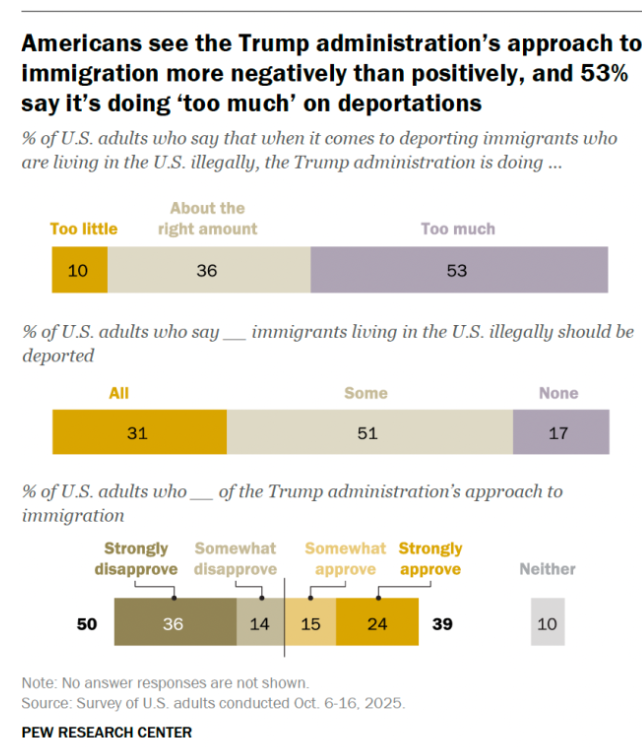
Public opinion remains divided. While immigration topped voter concerns in 2024, polls show Americans are conflicted about mass deportation. Many support border security but oppose separating families or deporting long-term residents. The humanitarian cost may ultimately test the political sustainability of these policies.
CONCLUSION
The transformation of American immigration enforcement under Trump‘s second term represents a fundamental restructuring of federal priorities. With nearly $200 billion in funding, 18,000 ICE officers, and detention capacity exceeding 100,000 beds, the infrastructure for mass deportation is becoming permanent.
What began as a campaign promise has evolved into a bureaucratic machine that will outlast any single administration. The legal framework established, the facilities built, and the workforce hired create institutional momentum that future presidents may struggle to reverse.
The comparison to Biden-era policy reveals not incremental change but categorical transformation. Where Biden balanced enforcement with humanitarian protections, Trump has eliminated that balance. Where Biden focused on recent arrivals and serious criminals, Trump’s dragnet captures students, workers, and families embedded in American communities for decades.
As legal challenges mount and economic consequences emerge, the fundamental question remains: At what cost? The financial expense approaches $1 trillion. The human cost, families separated, communities destabilized, and industries disrupted, may prove incalculable.
History will judge whether this unprecedented deportation apparatus made America safer or simply created a machinery of suffering operating at an industrial scale. For now, the machine runs on, fed by quotas, funded by billions, justified by promises to a fractured electorate.
The deportation machine is not slowing down. It is only accelerating.
Contact Congress
House of Representatives
1. House Committee on the Judiciary
-
The primary legislative committee for immigration reform legislation in the House.
-
Its Subcommittee on Immigration Integrity, Security, and Enforcement handles most immigration policy specifics, including naturalization, border security, refugee admissions, and enforcement frameworks.
2. House Committee on Homeland Security
-
Has jurisdiction over immigration enforcement and border security, including oversight of the Department of Homeland Security (DHS) and agencies such as U.S. Customs and Border Protection (CBP), ICE, and USCIS.
3. House Committee on Oversight and Accountability (formerly Oversight and Government Reform)
-
Conducts broader oversight of federal operations, including immigration enforcement and border policies, through relevant subcommittees.
4. House Appropriations Committee
-
Controls funding for federal agencies and programs that implement immigration policy, especially via its Subcommittee on Homeland Security.
Note: Other House committees (e.g., Ways and Means, Foreign Affairs) may occasionally consider immigration–related provisions when they intersect with trade, visas, labor, or international agreements, but they are not primary policy committees for immigration reform.
Senate
1. Senate Committee on the Judiciary
-
The primary Senate committee on immigration reform legislation.
-
Its Subcommittee on Border Security and Immigration focuses on immigration law, citizenship rules, refugee policy, and oversight of federal agencies involved in immigration functions.
2. Senate Committee on Homeland Security and Governmental Affairs (HSGAC)
-
Provides broad oversight of DHS operations, including immigration enforcement components like CBP and ICE. It reviews effectiveness and government operations relating to border security and immigration policy implementation.
3. Senate Appropriations Committee
-
Determines funding levels for immigration and border security enforcement through its Subcommittee on Homeland Security
Context on Roles and Interaction
-
Judiciary Committees (House and Senate) are traditionally the primary legislative authors and gatekeepers for comprehensive immigration reform bills, shaping substantive policy and legal changes.
-
Homeland Security Committees focus on enforcement, border operations, and agency oversight, making them central in debates over border security, detention policy, and enforcement resources.
-
Appropriations Committees do not craft immigration policy directly, but they shape the practical implementation by setting funding levels for immigration agencies and programs.