Trump’s Abuse of Power
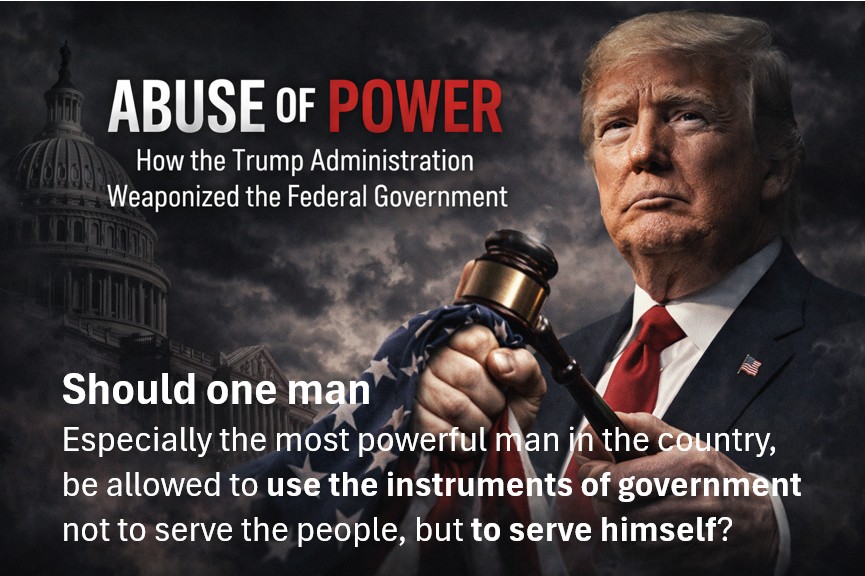
Trump’s Abuse of Power:
A Top-Line Summary
During his second term, President Trump systematically converted the institutions of the federal government into instruments of personal and political power.
The Department of Justice, currently headed by Trump’s former personal lawyer, was historically independent of White House political direction, was now transformed into a vehicle for rewarding allies and punishing enemies. Investigations were launched against Trump’s political opponents, including state attorneys general and sitting U.S. senators who had played roles in his impeachment.
The administration created a formal Interagency Weaponization Working Group, drawing officials from across the CIA, FBI, IRS, Homeland Security, and the FCC to pursue the president’s perceived adversaries.
Trump simultaneously filed an $10 Billion unprecedented suit and a $230 million personal claim against his own Justice Department, with his former personal defense attorney positioned to approve the payout. This is an arrangement legal scholars described as a constitutional conflict without historical parallel.
The retributive campaign extended far beyond the DOJ. Trump signed executive orders targeting prominent law firms that had represented his political opponents, stripping security clearances, canceling federal contracts, and coercing the legal profession into silence. Federal courts that were appointed by presidents of both parties struck every one of these orders down as unconstitutional violations of the First, Fifth, and Sixth Amendments, with judges calling them an “unprecedented attack” on the legal system and the product of a “personal vendetta.” Nine major law firms nonetheless capitulated, providing an estimated $700 million in free legal services under threat of further retaliation.
The IRS was simultaneously prepared as a weapon against Democratic donors and nonprofits, with a senior official compiling target lists that included major opposition figures. This echoes the Nixon-era abuses that the post-Watergate reforms were specifically designed to prevent.
Trump’s use of presidential pardon power completed the picture of an administration that placed loyalty above law and politics above justice. On his first day in office, Trump pardoned approximately 1,500 January 6 Capitol attackers, which instantly erased over $2.6 million in court-ordered restitution owed to victims.
Across all his clemency grants, a House Judiciary Committee report found that more than $1.3 billion in legally mandated restitution owed to crime victims and American taxpayers was wiped out.
Taken together, the record constitutes what legal scholars, federal judges, and bipartisan critics have described as the most serious and sustained assault on the rule of law in American history.
The Weaponization of the Dept of Justice.
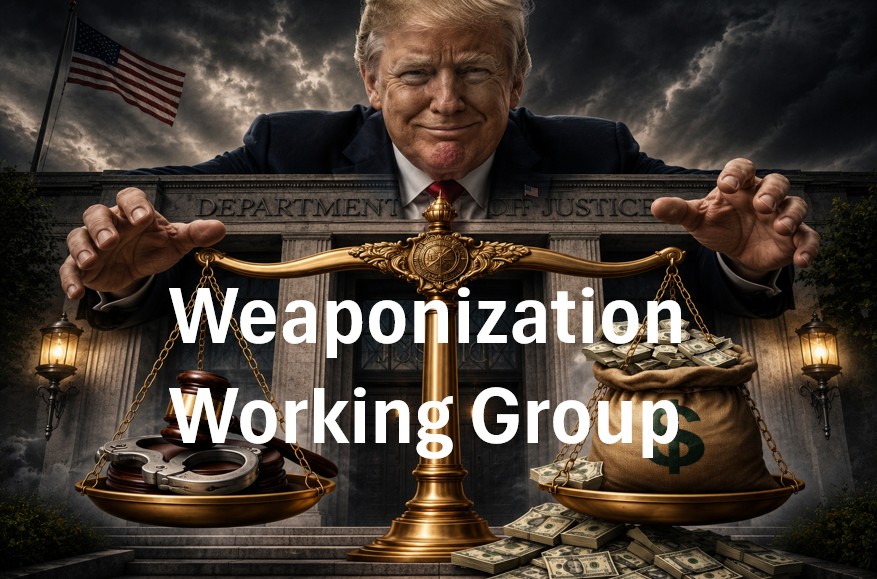
The weaponization of the Department of Justice and other federal agencies to reward allies and punish opponents.
In February 2025, Attorney General Bondi formally established what the administration called the ‘Weaponization Working Group,’ ostensibly to review alleged abuses by prior administrations against conservatives and Trump specifically. In practice, the group functioned as an institutional mechanism for pursuing retribution. It was directed to produce quarterly reports for the White House on its findings.
By October 2025, reporting by Reuters revealed the existence of the broader ‘Interagency Weaponization Working Group‘ (IWWG), a multi-agency body drawing officials from the White House, the Office of the Director of National Intelligence, the CIA, the Justice and Defense Departments, the FBI, the Department of Homeland Security, the IRS, and the Federal Communications Commission. This interagency apparatus was, in the words of a government source, ‘basically to go after the Deep State‘, a term the administration used to describe anyone who had investigated or opposed Trump during his first term or in the intervening years.
Career federal prosecutors who observed the working group’s operations were clear-eyed about its nature. As one Justice Department veteran with experience under both Republican and Democratic presidents noted, the group was using ‘the powers of the Justice Department to create flashy headlines and launch shaky investigations for political purposes.’
Legally, the group had ‘not clocked any wins’. Its chilling effect on potential witnesses, political opponents, and anyone who might challenge the administration was profound.
Misuse of Executive Orders.
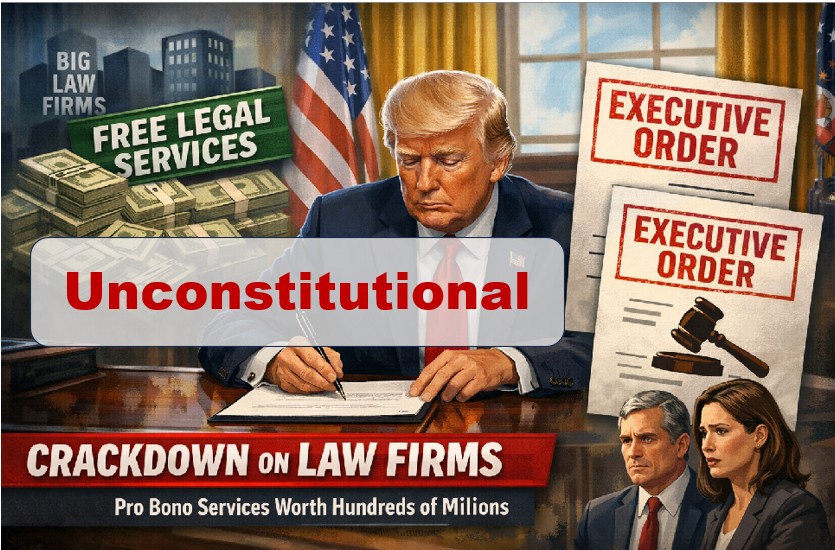
The use of executive orders and government offices to target individuals, organizations, and law firms perceived as adversaries.
Among the most constitutionally alarming of Trump’s retributive actions was his campaign against prominent law firms that had represented his political opponents or employed individuals involved in investigating him. Beginning in March 2025, Trump issued a series of executive orders targeting law firms that had worked against his interests.
The order suspended security clearances for firm employees, restricted their access to federal buildings, directed federal agencies to terminate contracts with the firm, and prohibited the government from hiring the firm’s attorneys.
The constitutional infirmity of these orders was pronounced and quickly recognized by the courts. U.S. District Judge Beryl Howell, called it ‘an unprecedented attack’ on the legal system and found that it violated the First, Fifth, and Sixth Amendments to the Constitution.
Another judge found that the government ‘sought to use its immense power to dictate the positions that law firms may or may not take.’ Yet another judge characterized the Susman Godfrey order as the result of a ‘personal vendetta.‘
The chilling effect of these orders was immediate and severe. While four firms filed suit and ultimately prevailed in court, at least nine other prominent law firms chose to capitulate rather than fight. In total, the administration extracted hundreds of millions of dollars’ worth of legal services through what amounts to extortion, threatening legally unjustifiable punishment unless firms agreed to provide services of the administration’s choosing.
Commentators across the political spectrum, including the editorial board of The Wall Street Journal, recognized that Trump’s campaign against law firms ‘breaks a cornerstone principle of American justice‘, the principle that lawyers must be free to represent unpopular clients without fear of governmental retaliation
Abuse of the Pardon Powers.
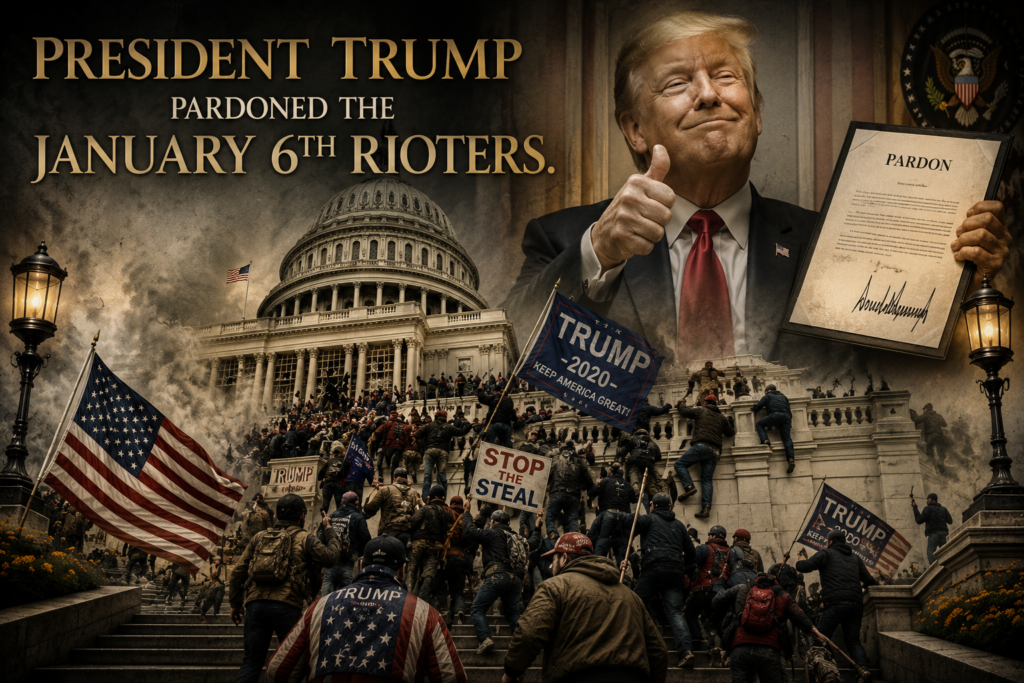
The unprecedented and ethically compromised use of presidential pardon power to benefit political allies, forgive billions in legally mandated restitution, and shield criminals from accountability.
From his first day in office, Trump deployed his pardon power with a speed, breadth, and apparent disregard for victims that set a historical record. By June 2025, he had issued pardons for roughly 1,600 convicted criminals, the vast majority of whom were participants in the January 6, 2021 Capitol attack. The House Judiciary Committee’s Democratic members issued a report concluding that these pardons had allowed recipients to avoid more than $1.3 billion in legally mandated restitution and fines owed to victims and taxpayers.
The pardons were not merely voluminous and characterized by patterns that raised serious questions of corruption. They appeared to reward individuals with political connections to Trump, to flow to campaign donors and their relatives, and to be granted in ways that imposed substantial financial costs on innocent victims.
What can you do?
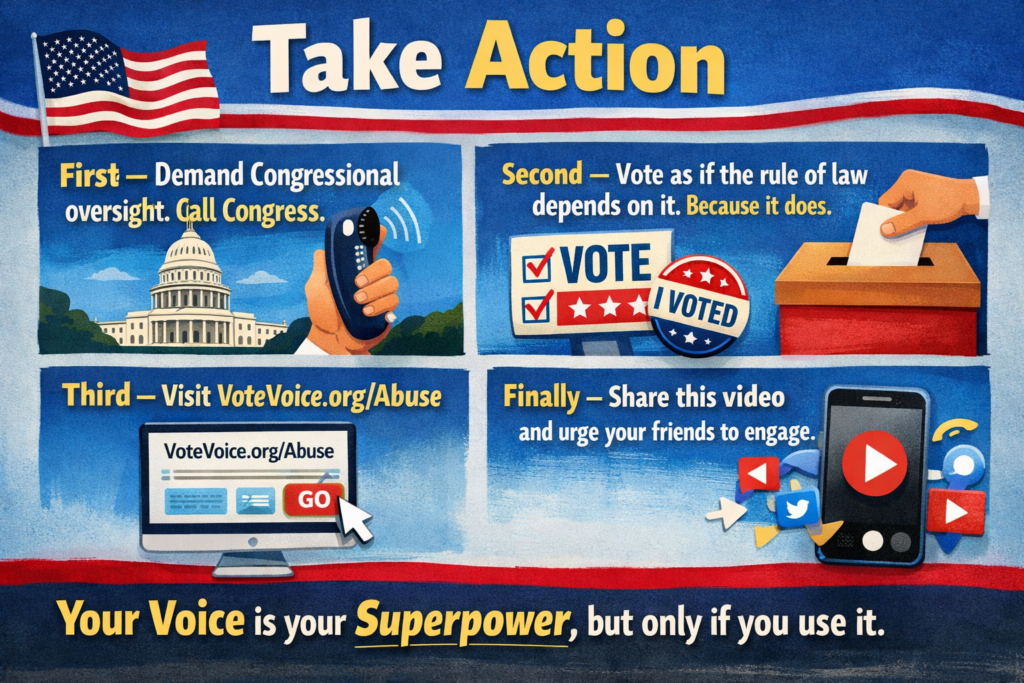
Ultimately, the preservation of the rule of law in a democracy depends on an informed and engaged citizenry. These abuses have been illuminated by persistent journalism, congressional oversight efforts, and the courage of career government officials who resigned or spoke out when directed to participate in conduct they recognized as unlawful. Informed public engagement with these issues is constitutionally essential.
Your Voice is your superpower… but only if you use it.
Contact Congress and share this page.
Senate
Senate Judiciary Committee
The primary Senate body overseeing the DOJ, FBI, and federal law enforcement
Senate Finance Committee
The primary Senate body overseeing the IRS and federal tax administration
Senate Homeland Security and Governmental Affairs Committee
The Senate’s chief oversight committee for federal government operations generally
House
House Judiciary Committee
The primary House body overseeing the DOJ, FBI, pardon power, and constitutional rights
House Committee on Oversight and Government Reform
The main investigative committee of the House; has the broadest general oversight authority
House Ways and Means Committee
The primary House body overseeing the IRS and federal tax policy
A Note on the Political Reality
Because Republicans hold the majority in both chambers, the chairs of all six committees are aligned with the Trump administration and are not initiating oversight investigations. The investigative pressure is coming almost entirely from ranking members who have the power to request hearings, demand documents, and issue minority reports, but cannot compel subpoenas without a majority vote.
This means the most effective points of citizen pressure are:
- Republican members of these committees, particularly those with prior records of concern about rule-of-law issues (e.g., Sen. Grassley on DOJ independence, Sen. Cornyn on constitutional guardrails). A Republican-led hearing would carry far more institutional weight.
- Ranking members and their minority staff, who are building the documentary record that future majorities, inspectors general, and courts will use.
- Inspectors General, the DOJ-IG, Treasury-IG (TIGTA), and DHS-IG have independent investigative authority and report to both the executive branch and Congress; they represent a parallel accountability mechanism not dependent on committee majorities.
Need help?