The SAVE America Act
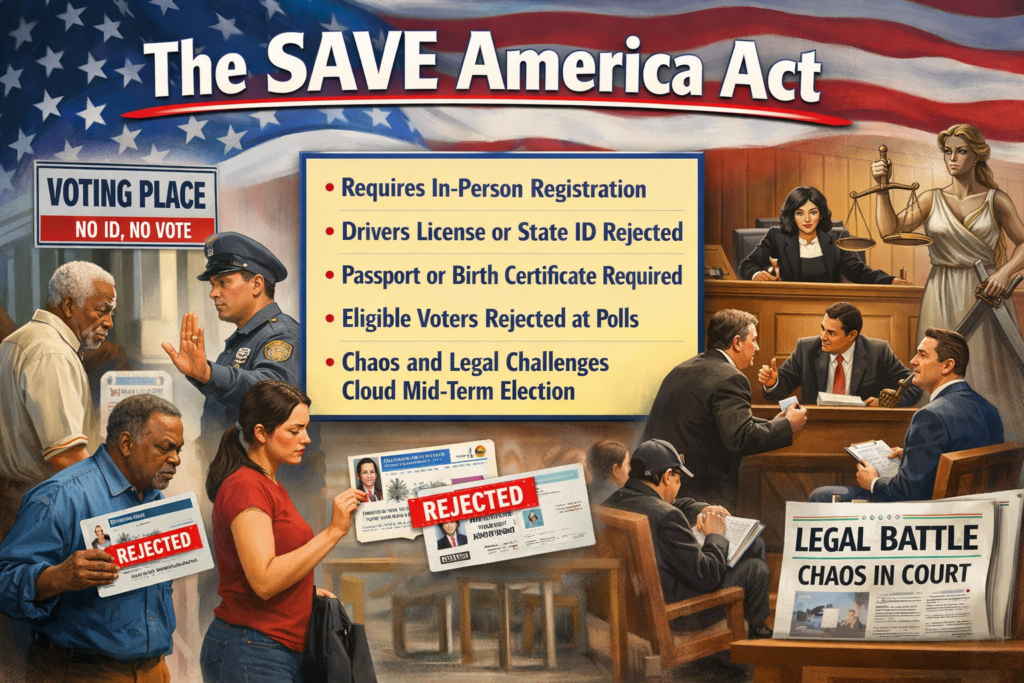
TOP LINE:
Non-citizen voting in US elections essentially does not happen.
The penalties for even registering to vote in a federal election by a non-citizen are felony imprisonment and possible deportation.
Currenlty voter registration laws carefully verify voter eligibility before the elections.
The conservative Heritage Foundation carefully scrutinized voting data and found only 68 cases of non-citizen voting since the 1980’s.
This act attacks a currently fully functioning system.
The SAVE America Act invalidates the most common forms of ID used at the polling place and requires proof of citizenship, something that many Americans do not readily have.
This law would cause confusion and chaos at the polling place and introduce multiple ways to challenge valid votes after the midterm elections, calling them into question, and possibly delaying the election certification.
THE SAVE AMERICA ACT (H.R. 7296)
How a ‘Safeguard’ Becomes a Barrier: The Systematic Disenfranchisement of American Voters
What Is the SAVE America Act?
The Safeguard American Voter Eligibility (SAVE) America Act (H.R. 7296) passed the U.S. House of Representatives on February 11, 2026, along near-party-line lines. Framed by its sponsors as a common-sense election-integrity measure, the legislation amends the National Voter Registration Act of 1993 to impose two sweeping new requirements on all federal elections: documentary proof of U.S. citizenship to register to vote and photo identification to cast a ballot.
The bill also mandates that all 50 states submit their voter rolls to the Department of Homeland Security for ongoing cross-referencing.
Make no mistake: beneath its patriotic title lies legislation that, if enacted, would constitute one of the most significant rollbacks of voting access in modern American history.
Here is a brief video of the impact of this proposed law
Key Provisions at a Glance
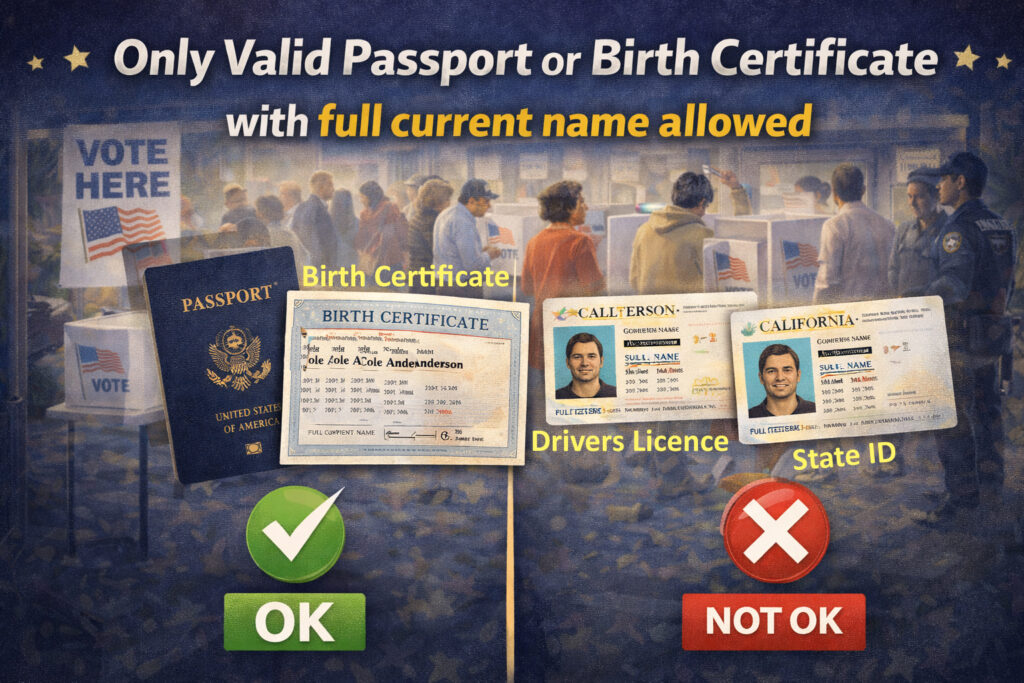
- Registration: Proof of citizenship is required at registration and at the voting station. A valid passport or a birth certificate with the current surname are among the few forms of ID allowed.
- REAL ID Rejection: Standard REAL ID driver’s licenses are explicitly insufficient as they do not indicate citizenship status.
- End of Remote Registration: Mail-in and online registration are effectively eliminated because citizenship documents must be delivered in person to an elections office.
- Restrictive Voting ID: Photo ID would be required at the polls, even though the current registration process certifies voter eligibility.
- Federal Data Surveillance: Mandatory voter-roll purges, with state data submitted to DHS, with no restrictions on federal use of that data.
- Criminalizes Election Officials: Criminal penalties of up to 5 years in prison for election officials who register a voter without complete documentation, regardless of thier legal right to vote.
How the SAVE America Act Makes Voting Harder for Most Americans
Supporters insist the bill simply requires voters to confirm what the current citizenship law already demands.
This argument collapses on contact with reality. Citizenship is already verified under penalty of perjury when Americans register to vote.
This bill creates documentation theater that millions of citizens simply cannot perform.
The Document Gap: 21 Million Americans Left Behind
The Brennan Center for Justice estimates that more than 21 million American citizens lack ready access to a passport or birth certificate, which are the primary documents required under this bill.
They are disproportionately elderly Americans whose birth records were never formally filed, low-income citizens who cannot afford a U.S. passport ($165 application fee), and rural residents for whom obtaining a birth certificate requires navigating distant county offices.
Requiring these documents is a financial barrier that functions, in practice, as a modern-day poll tax.
The Destruction of Mail and Online Registration
In 2022 alone, over 7 million Americans registered by mail and nearly 11 million registered online. The SAVE America Act guts both pathways. Under the bill, mail registrants must still appear in person to show physical citizenship documents, which renders the entire point of mail registration moot.
Online registration is left in legal limbo, with no clear statutory guidance for how digital citizenship documents may be submitted, virtually guaranteeing inconsistent implementation across jurisdictions.
Only 6% of voters currently register in person at an elections office. This bill demands that the other 94% conform to a process they have never used.
The REAL ID Trap
The legislation largely rejects REAL ID-compliant identification, because standard REAL IDs do not indicate US Citizenship. Only Enhanced Driver’s Licenses (EDLs), issued by just five states bordering Canada, would likely qualify. This leaves residents of 45 states without a viable everyday document.
Re-Registration Traps for Existing Voters
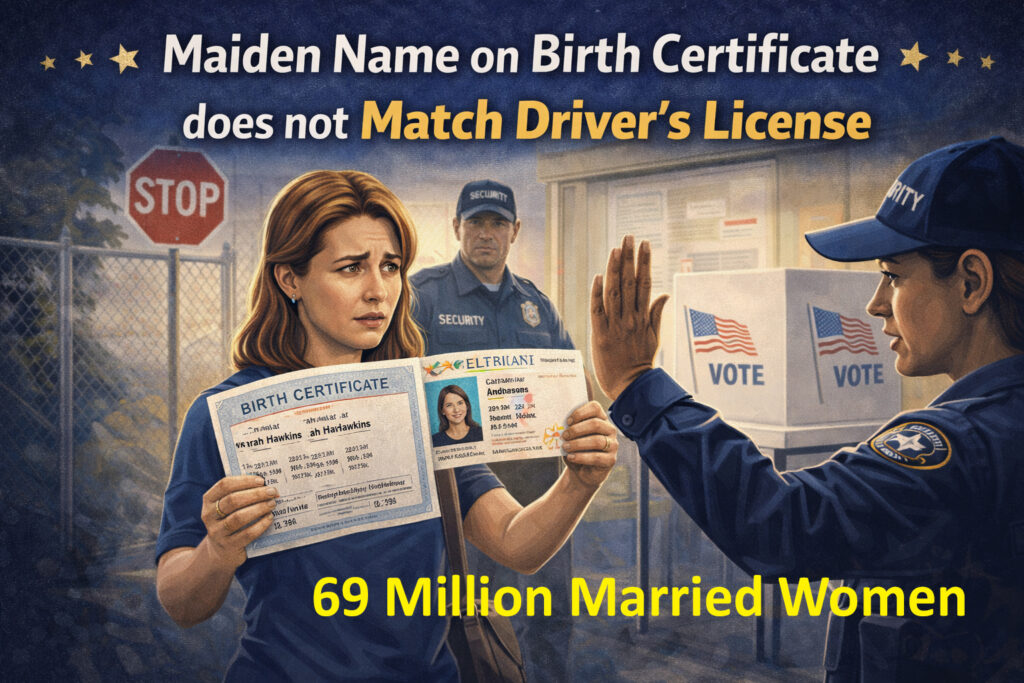
The burden does not end at initial registration. Under the SAVE America Act, any update to a voter registration record, for example, a change of address, or a name change after marriage, automatically triggers the documentary proof requirement again.
For the estimated 9% of Americans who move within a state each year, and for millions of women who change their names, this creates a recurring bureaucratic gauntlet.
The legislation also mandates frequent voter roll purges, raising the well-documented risk of erroneously removing legitimate citizens. This is a practice with a long and troubling track record in American electoral history.
Setting the Stage for Midterm Confusion and Legal Challenges
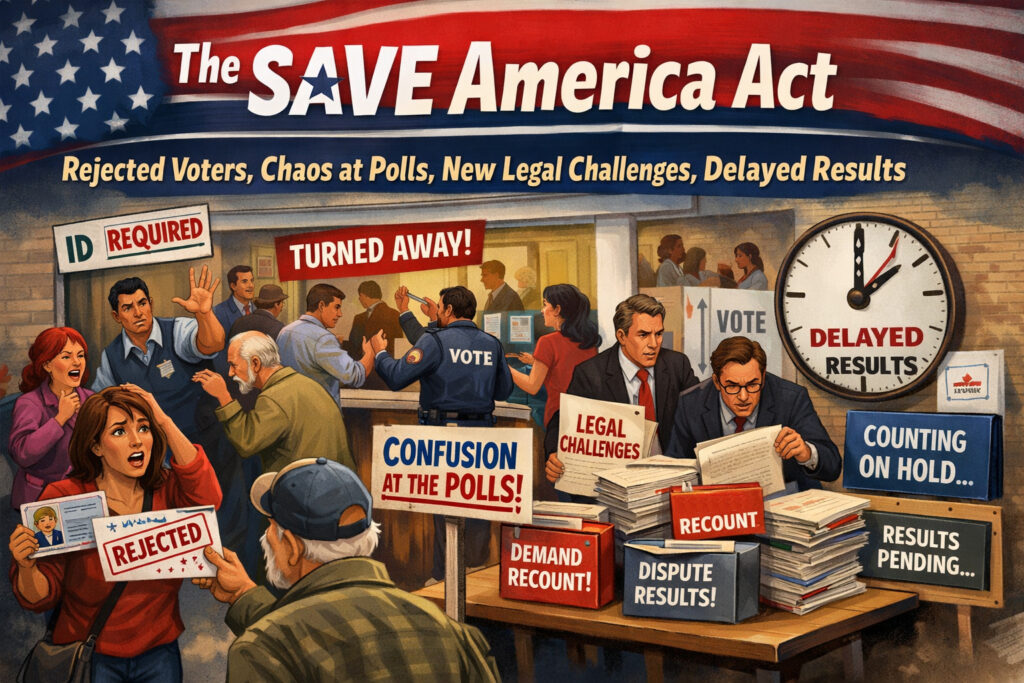
Even setting aside the merits, the implementation timeline alone is a recipe for electoral chaos. The SAVE America Act, if signed into law, would take effect immediately upon enactment.
With the 2026 midterm elections approaching, election administrators across the country would face the near-impossible task of retooling voter registration systems, retraining staff, updating public communications, and processing a surge of re-registrations, all while operating under threat of criminal prosecution if they make honest mistakes.
Legal Challenges Are Inevitable
Civil rights organizations, including the Brennan Center for Justice, the Campaign Legal Center, and the NAACP Legal Defense Fund, have signaled robust legal opposition to both the SAVE Act and its successor. Constitutional challenges under the 14th Amendment, the National Voter Registration Act, and the Voting Rights Act are already being prepared.
Federal courts have previously blocked related executive action, including President Trump’s March 2025 executive order requiring proof of citizenship, which courts struck down as unconstitutional. Multiple simultaneous legal battles during a federal election cycle create precisely the uncertainty that undermines public confidence in electoral outcomes.
DHS Data Sharing: An Unprecedented Federal Intrusion
Perhaps the most underexamined provision is the mandatory submission of all state voter rolls to the Department of Homeland Security. The bill places no restrictions on what DHS may do with this data once received, and no safeguards against using it to compel additional purges or challenge election results.
Earlier this year, the Trump administration’s DOGE team came under scrutiny for attempting to access Social Security Administration voter roll data for an outside group seeking to ‘find evidence of voter fraud and overturn election results.’ The SAVE America Act would place this data pipeline on a statutory footing, with no congressional guardrails.
Criminalizing the People Who Run Elections
Under the bill, election officials face up to five years in federal prison for registering a voter who fails to present complete documentation, even if that voter is, in fact, a U.S. citizen.
In a rushed implementation environment, with ambiguous online registration rules and an unfamiliar documentary standard, honest mistakes are a certainty.
The predictable result: election officials will err heavily toward rejection, and eligible citizens will lose their votes. This is not a bug in the legislation’s design. For those who crafted it, it may well be the feature.
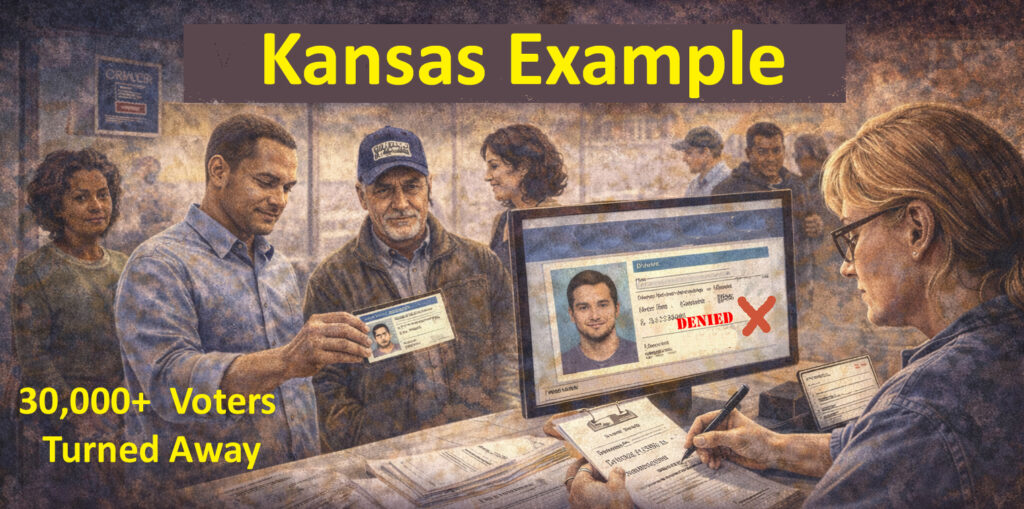
The Kansas example –
We have a real-world example from Kansas that implemented a strict Voter ID law.
In 2011, Kansas passed a documentary proof of citizenship requirement for voter registration, which took effect in 2013. Within the first years of the law’s operation, more than 31,000 eligible citizens were prevented from completing voter registration because they could not produce the required documents.
Courts ultimately declared the Kansas law unconstitutional.
Bottom Line:The SAVE America Act creates new problems where they did not previously exist. Verified noncitizen voting accounts for a statistically negligible fraction of ballots cast. This bill creates massive, documented barriers for tens of millions of eligible American citizens. It guts the most widely used voter registration methods, sets a documentary standard that the majority of Americans cannot readily meet, criminalizes the officials tasked with implementation, and hands the federal government unprecedented, unchecked access to state voter data. Heading into a midterm election year, the legislation is not just a voting rights concern. It is an invitation to legal gridlock, voter tabulation chaos, administrative failure, and a crisis of democratic legitimacy. |
Sources: Congressional Research Service (H.R. 7296 Summary) • Brennan Center for Justice • Campaign Legal Center • Center for American Progress • Bipartisan Policy Center • NAACP Legal Defense Fund • National Public Radio • American Postal Workers Union
This bill has already passed the House, so it’s time to contact your Senators.
Click here for advice on how to contact your member of Congress.
Key Senate Committees for the SAVE America Act
Senate Committee on Rules and Administration, Primary & Most Critical
This is the gatekeeper committee. The Senate version of the SAVE America Act (S.3752) was read twice and formally referred to the Committee on Rules and Administration on January 29, 2026.
This committee has jurisdiction over federal election laws, voter registration, and the administration of the Senate itself. Any markup, amendment, or formal advancement of the bill would originate here. The chair holds significant power to schedule (or delay) hearings and votes.
Current Chair: Sen. Mitch McConnell (R-KY) is the Chairman; Republicans hold the gavel under the 119th Congress majority.
Senate Judiciary Committee, Substantively Important
Because the SAVE America Act amends the National Voter Registration Act of 1993 and involves federal civil rights, criminal penalties for election officials, and constitutional questions about voting rights, the Senate Judiciary Committee is directly involved.
Sen. Mike Lee (R-UT), the bill’s Senate sponsor, sits on this committee and has engaged it in related oversight. This Judiciary Committee would be the venue for any constitutional challenges or companion legislation.
Senate Homeland Security & Governmental Affairs Committee, Key Role
The bill’s requirement that every state submit its voter registration list to the Department of Homeland Security for comparison through the SAVE (Systematic Alien Verification for Entitlements) program falls squarely within this committee’s oversight purview. DHS operations, data-sharing between federal and state governments, and the integrity of federal databases are all within its jurisdiction.
Sen. Rand Paul (R – KY) is the current chairman of this committee.