Federal Shutdown
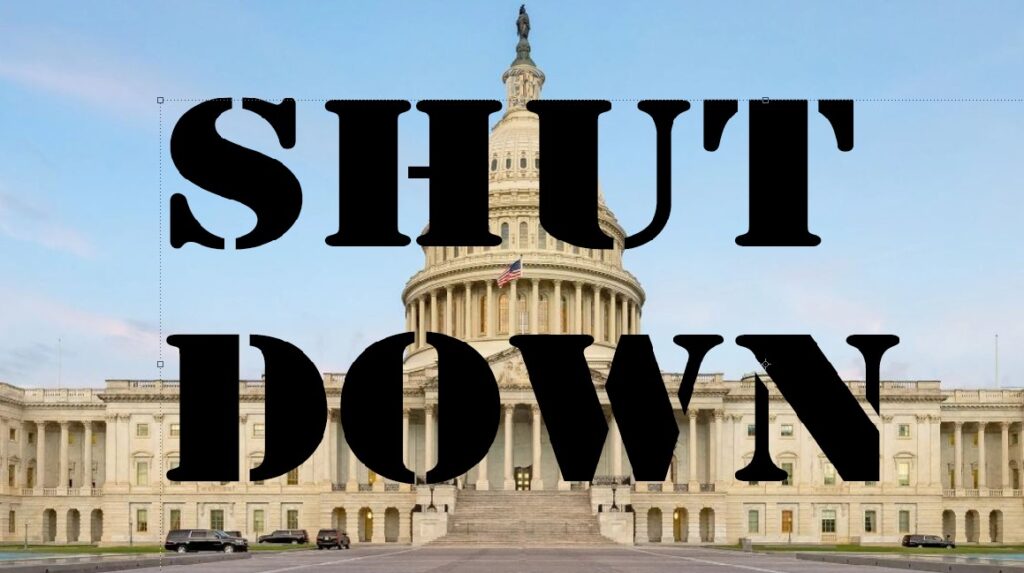
On November 9th, several Democratic members of the Senate and one Independent agreed to begin the process of ending the shutdown. Two key points kept both sides apart
- Extension of the ACA tax credits, which the GOP opposed
- Payments to fund food assistance for needy people (SNAP), which the GOP opposed.
The concessions made by this group were
- Extend government funding through January 30, 2026, and include full-year appropriations bills (including for agriculture) through September 30, 2026, including SNAP payments.
- Fund military construction, veterans’ affairs, the Department of Agriculture and the legislative branch through Sept. 30 of 2026.
- Retain more than 4,000 federal workers targeted for layoffs during the shutdown
- Prevent the Trump administration from firing additional federal workers through reductions in force (RIFs) for the length of the newly drafted continuing resolution, until Jan. 30.
- A promise for a Senate vote in December on a Democratic proposal to extend expiring Affordable Care Act (ACA) subsidies by one year.
Full Bill here
The concessions did not include an extension of the ACA health care subsidies, which were a key focus of the Democrats’ opposition.
The legislation still needs a final vote in the Senate before it goes to the GOP-controlled House, which at the time of the vote was still out of session.
Indivisible.org’s comments on the concessions.
“Chuck Schumer and a critical mass of Senate Democrats surrendered. For nearly six weeks, Republicans held the government hostage while threatening health care, food assistance, and basic services for millions of Americans.
In these six weeks of the shutdown, Democrats had their best election night in over a decade, polls showed Republicans were losing this shutdown fight, and their base turned out for the largest protest in modern U.S. history with a resounding rejection of Trump and Republicans,” said Ezra Levin, co-founder and co-executive director of Indivisible. “Instead of standing with that energy, Senate Democrats surrendered – yet again. That’s why Indivisible is launching our largest primary program yet.
“This is no longer about them – it’s about us. We’re done waiting for Democrats to find their spine. We can’t afford a weak and cowardly Democratic Party while the authoritarians invade our cities, terrorize our communities, and threaten our democracy. We get the party we demand, and we intend to demand a Democratic Party that fights.”
Senator Chris Murphy (D-CT) posted a video on social media warning: “Bullies gain power when righteous people yield to the face of their wrongdoing. I didn’t want this shutdown. I want it to end, but not at any cost. And of course, I wish that there was a path to saving this democracy and saving people’s health care that didn’t involve pain. This shutdown hurt. It did. But unfortunately, I don’t think there is a way to save this country, to save our democracy, without there being some difficult, hard moments along the way…. [T]here’s no way to defend this,” he said. “And you are right to be angry about it. I’m angry about it.”
Call to Action:
Contact your member of Congress to be heard on the Federal Shutdown.
These coalition Senators voted to end the shutdown. None are up for reelection in 2026.
Jeanne Shaheen (D- New Hampshire) Retiring (202) 224-2841
https://www.shaheen.senate.gov/contact/contact-jeanne
Maggie Hassan (D-New Hampshire) (202) 224-3324
https://www.hassan.senate.gov/contact/email
Catherine Cortez Masto (D-Nevada) (202) 224-3542
https://www.cortezmasto.senate.gov/contact/connect/
Tim Kaine (D-Virginia) (202) 224-4024
https://www.kaine.senate.gov/contact/share-your-opinion
Dick Durbin (D-Illinois), Retiring (202) 224-2152
https://www.durbin.senate.gov/contact/email
John Fetterman (D-Pennsylvania) (202) 224-4254
https://www.fetterman.senate.gov/contact/
Maggie Hassan (D-New Hampshire) (202) 224-3324
https://www.hassan.senate.gov/contact/email
The 3 most vulnerable Republican senators up for reelection in 2026 are
- Susan Collins (R-Maine) (202) 224-2523
- https://www.collins.senate.gov/contact/email-senator-collins
- Jon Husted (R-Ohio) (202) 224-3353
- https://www.husted.senate.gov/contact/
- John Cornyn (R-Texas) (202) 224-2934
- https://www.cornyn.senate.gov/share-opinion/
Democratic Minority Leader
Chuck Schumer (D-New York) (202) 224-2854
https://www.schumer.senate.gov/contact/message-chuck
A contact list of all democratic Senators here.
https://www.democrats.senate.gov/about-senate-dems/our-caucus
REMEMBER: A US senator is only interested in the opinions of the constituents from his/her state. The contact form will ask for an address or zip code to verify that you are from that state.
If you can’t remember your exact address in that state, some people use sources like Zillow or Realtor to identify their address in the Senator’s state, by selecting a major city and identifying a specific address, preferably from a large multi-dwelling unit.
The impact of ending the ACA subsidies
What the subsidies do
Under the ACA, many individuals who purchase coverage through the health insurance marketplaces receive “premium tax credits” (subsidies) that reduce their monthly premiums. The subsidies were enhanced under the American Rescue Plan Act of 2021 and extended via the Inflation Reduction Act, making insurance much more affordable for many people.
These enhancements:
-
lowered the share of income that people pay for benchmark plans.
-
expanded eligibility beyond the previous cap of 400 % of the federal poverty level (FPL)
-
significantly cut premiums for many marketplace enrollees.
How many people would be affected?
-
In 2024, about 21.3 million people selected marketplace plans.
-
Nearly 20.1 million of them received enhanced subsidies.
-
According to analysts, if the enhanced subsidies expire, ~4.0 million people could become uninsured in 2026 due to cost increases and drop‐off of coverage.
-
Some projections also suggest up to ~5 million people losing coverage in 2026.
Financial impact on individuals
-
With the subsidy enhancements in place, the average annual premium payment (after subsidies) was about $888 in recent years.
-
If subsidies expire, that average could rise to about $1,904 in 2026, a more than 100 % increase (an increase of about $1,016 annually).
-
In concrete terms, for someone earning around $28,000, premium payments could rise from $325 annually to $1,562 annually.
-
For higher‐income households (above 400 % FPL) currently benefiting, one example shows a couple earning US$85,000 could see their premium payment rise by over $22,600 in 2026 (if the benchmark plan remains and they lose subsidies).
-
Additionally, premiums themselves are projected to rise (independent of subsidy changes) — insurers are requesting large rate increases.
Broader consequences
-
Rising premiums and loss of subsidies would likely prompt some people to drop or forego marketplace coverage, increasing the uninsured population.
-
With fewer healthy people enrolling, insurers warn that premiums could rise further (adverse selection).
-
The economic ripple effects are large: one study estimated that eliminating the enhanced premium tax credits could contribute to 340,000 job losses in 2026.
What this means for Americans
-
Middle-income households that do not qualify for other assistance and are just above subsidy thresholds will be hit hardest. Many will face large premium hikes or lose access to subsidies entirely.
-
People currently covered via the marketplaces may see a sharp increase in out-of-pocket premium costs, making insurance less affordable.
-
Some may choose to forgo insurance or be priced out, increasing the risk of being uninsured or under-insured.
-
The gains in coverage achieved under the ACA could be partially reversed, with implications for health outcomes and financial stability.
Bottom line
If the ACA’s enhanced subsidies are eliminated or not extended, tens of millions of Americans receiving marketplace coverage would face large premium increases (on average doubling), and several million could lose coverage entirely. The financial burden would fall especially on those in the non-elderly marketplace population, especially in the middle‐income bracket, reducing the affordability of insurance and increasing the uninsured rate.
Background on the Shutdown:
- Expiration of funding: The shutdown began when federal funding lapsed at midnight on October 1, 2025, after Congress failed to pass a new spending bill or continuing resolution to keep agencies funded beyond the prior budget’s expiry. Under the U.S. system, both chambers of Congress must approve appropriations that the President signs into law; failure to do so triggers a partial shutdown of unfunded agencies.
- Political impasse: Republicans and Democrats remained deadlocked over the scope and terms of funding. Reporting indicates disagreements included broader questions about spending levels and policy riders, with dynamics shaped by party control and priorities; multiple attempts to advance stopgap measures in the Senate failed prior to a late-breaking procedural vote in early November.
- Historic duration: By early November, the shutdown had surpassed the 2018–2019 record (35 days) and crossed the 40-day mark, making it the longest in U.S. history. Around 900,000 to 1.4 million federal workers have been furloughed or are working without pay during the closure, reflecting the breadth of the disruption across the federal apparatus.
Departments and Agencies Most Affected
Classification of Federal Employees
During a shutdown, federal employees generally fall into three categories: those whose salaries are financed through means other than annual appropriations and who continue to work and be paid; those who are furloughed; and those who continue to work without pay, also known as “excepted” employees.
High-Impact Agencies (Over 85% Furloughed)
Environmental Protection Agency (EPA) Over 85% of employees at the Environmental Protection Agency are furloughed. This significantly impacts environmental monitoring, enforcement of pollution regulations, and review of environmental permits.
Department of Education Over 85% of employees at the Department of Education are furloughed. Multiple union members confirmed that at least two offices would be affected by RIFs: the Office of Communications and Outreach as well as the Office of Elementary and Secondary Education.
Moderate-Impact Agencies
Department of Defense The Defense Department would send home around 45% of its 741,000 civilian employees. All military personnel continue in their duties as usual, but servicemembers do not receive pay during a government shutdown.
Department of Homeland Security DHS would send home less than 15% of its employees, but critical border security and immigration enforcement operations continue with staff working without pay.
General Services Administration The General Services Administration is furloughing employees who are typically “exempt” from a government shutdown because much of the agency isn’t funded through congressional appropriations, with GSA’s Federal Acquisition Service and Public Buildings Service given a number to hit in terms of furloughs.
Department of Commerce Commerce Department employees were placed in furlough status effective October 31, 2025, with the furlough not expected to exceed 30 days, expiring on November 29, 2025.
Department of Justice The Department of Justice sent out emails to employees detailing the extension of furloughs.
NASA NASA sent out notices about extended furloughs, affecting space exploration programs and research activities.
Low-Impact Agencies (Less Than 15% Furloughed)
Department of Veterans Affairs Most employees at the Department of Veterans Affairs are funded by a source other than annual appropriations and keep working with pay during a shutdown. Veterans Health Administration facilities are not seriously impacted, and almost all employees are expected to remain on the job, with access to benefits under the Veterans Benefits Administration continuing.
Department of Treasury The Department of the Treasury would furlough less than 5% of employees. The entire Internal Revenue Service continues working using funds provided in the 2022 Inflation Reduction Act.
Social Security Administration The Social Security Administration would send home less than 15% of employees. A shutdown does not impact Social Security benefit payments, though new benefit verification and the issuing of new cards pause during a shutdown.
Department of Health and Human Services HHS employees across multiple divisions received reduction-in-force notices, with all HHS employees receiving notices designated non-essential by their respective divisions.
Centers for Disease Control and Prevention More than half of the 1,300 CDC employees who received layoff notices subsequently had those notices reversed over the weekend due to data discrepancies and processing errors, with RIF notices erroneously issued to nearly 800 HHS employees.
Critical Infrastructure
Federal Aviation Administration 42 reports of staffing shortages at Federal Aviation Administration air traffic control facilities across the US contributed to increased delays. Working to comply with the Federal Aviation Administration mandate to cut 4% of flights at 40 major airports across the country, major US carriers had to cancel over 600 flights.
National Nuclear Security Administration On October 20, 2025, NNSA furloughed 1,400 employees—the majority of its workforce and the first time it has ever done so during a shutdown, leaving less than a quarter of the agency’s full staff to advance NNSA’s mission.
Impact on Federal Workers
Workforce Numbers In total, the Congressional Budget Office estimates that as many as 750,000 workers may be furloughed at a cost of $400 million per day in missed pay.
Financial Hardship If the shutdown lasts through December 1, federal agency workers will collectively miss about 4.5 million paychecks, or $21 billion in total federal wages, with the average federal paycheck approximately $4,700 in fiscal year 2025.
Uncertainty Over Back Pay In January 2019, Trump signed into law the Government Employee Fair Treatment Act to guarantee retroactive pay for both furloughed workers and excepted employees who continued to work during that shutdown and future lapses, but White House press secretary Karoline Leavitt declined to confirm that furloughed federal employees will receive back pay. A draft legal opinion from OMB argued that whatever funding legislation Congress ultimately passes to end the current shutdown must explicitly include appropriations to provide back pay for furloughed federal employees, and if it’s not expressly written in the spending legislation, furloughed workers cannot receive any retroactive compensation.
Unprecedented Layoffs During Shutdown. Trump blamed Democrats for the shutdown and claimed that his administration had no choice but to permanently cut some federal jobs due to the lapse in congressional appropriations, a radical departure from past shutdowns in which the government has only temporarily furloughed employees. The unions accuse the Trump administration of using federal employees as pawns to impose political pressure on the Administration’s perceived opponents in Congress.
Military Personnel 1.3 million active-duty personnel and over 750,000 National Guard and reserve personnel are also required to serve, potentially without pay, with November 14 possibly being the first time in history that members of all military branches will miss a paycheck due to a government shutdown.
Impact on Public Services
Aviation Disruptions More than 5,000 flights were delayed primarily due to a combination of staffing issues and flight cuts caused by the government shutdown, with some busy airports like Nashville International Airport, Newark Liberty International Airport and Houston William P Hobby seeing temporary ground stops.
Food Assistance Programs Current SNAP recipients may continue to use any remaining benefits on their EBT cards following November 1, but will not receive new benefit payments until the federal government shutdown ends. October 2025 SNAP benefits were issued according to the usual schedule, and SNAP applications and recertifications continue to be processed, but if the shutdown lasts for more than a month, federal employees without pay may need help, and SNAP and WIC recipients will need help as well.
In August 2025, 867,162 Arizonans received SNAP benefits, meaning thousands of neighbors visiting food banks for basic necessities, some of whom will be doing so for the first time. As the federal government shutdown drags on, tens of millions of people are at risk of losing food and nutrition aid as a result.
Tourism and Recreation All tours of the U.S. Capitol, White House, and FBI Building are canceled during a shutdown, and all Smithsonian museums, the National Zoo, the National Gallery of Art, and most other public government properties are now closed to the public until the government reopens. Some parks are open and operating at a limited capacity, while others are entirely closed, with limited emergency rescue services and safety updates not being published.
Healthcare Services Medicare and Medicaid continue during a federal shutdown, but communications from the agencies or reaching out for assistance may be difficult or impossible due to the temporary staff furloughs, with messages, updates, or support stalled or outdated.
Economic Consequences
Consumer Spending Impact: The delay in federal compensation reduced consumer spending, especially among federal workers who missed paychecks, with the disruption reducing GDP.
Tourism Industry: The U.S. tourism economy is already under pressure in 2025 due to reduced inbound international travel and uneven domestic demand, with a shutdown only deepening the divide, hurting lower-income households, small businesses dependent on tourism, and delaying growth opportunities across the travel sector.
Infrastructure and Construction: Prolonged disruptions in federal operations threaten critical infrastructure projects, delay permitting, and create uncertainty across the cement and concrete value chain.
Aerospace and Defense Industry: A prolonged shutdown has serious implications that will reverberate throughout the aerospace and defense supply chain, with significant disruptions to government services that underpin the economy, national security, and workforce.
Hospitality Sector: The hotel and lodging industry supports 2.1 million direct jobs—one out of every 25 in the U.S. economy—and nearly nine million total jobs nationwide, generating more than $894 billion in GDP annually and contributing $85 billion in state, local, and federal taxes combined.
National Security Implications
Nuclear Security: NNSA furloughed the majority of its workforce, leaving less than a quarter of the agency’s full staff to advance NNSA’s mission of ensuring the safety and reliability of the nuclear stockpile.
Defense Readiness: The Department of Defense continues defending the nation and all military personnel continue in their duties as usual, but servicemembers do not receive pay during a government shutdown.
Long-Term Workforce Implications
The shutdown may have lasting effects on the government’s ability to attract talent, as many federal workers could be making more in the private sector but choose to do the work they do because of a sense of mission or purpose, but how federal workers are treated really matters for the ability to attract quality federal workers in the long term.