What Does the US Government Do?
TOp
TOP LINE:
Americans as a whole are not satisfied with their federal government. There is a significant partisan divide in their attitudes toward government. Still, most Americans don’t want the federal government to reduce services like Medicare, Social Security or affordable health care.
Much of Americans’ dislike of the federal government is based on political issues rather than public services themselves. Many people are surprised to see where the majority of the federal labor force works and the services they provide.
How happy are Americans with the federal government?
A majority of Americans say they feel frustrated – rather than angry or content – with the federal government. This has been the dominant emotion for much of the last several decades – with the sole exception being the period shortly after Sept. 11, 2001.
Today, six-in-ten Americans say they feel frustration toward the federal government, while 21% say they feel anger and 18% say they feel basically content.
Do Americans Trust their government?
Roughly two-in-ten Americans (22%) say they trust the government in Washington to do what is right just about always or most of the time.
A majority of Americans say they trust the federal government “only some of the time” (59%), while 17% say they never trust it.
Americans tend to trust the federal government more when the party they associate with holds the White House. Today, 35% of Democrats and Democratic-leaning independents say they trust the government almost always or most of the time, a somewhat larger share than in recent years. As has been the case since the beginning of Joe Biden’s administration, only about one-in-ten Republicans and Republican leaners say they trust the government to do what is right.
How do Americans view the efficiency of government?
In assessments of the efficiency of the government, a majority of Americans (56%) find it to be “almost always wasteful and inefficient.” A smaller share (42%) say government “often does a better job than people give it credit for.”
Among partisans, a majority of Democrats (63%) say the government often does a better job than people give it credit for, while a large majority of Republicans (77%) say government is often wasteful and inefficient.
Views on the government’s regulation of business
On the topic of government regulation of business, about six-in-ten Americans (58%) say that government regulation of business is necessary to protect the public interest. Four-in-ten, however, say government regulation of business usually does more harm than good.
- About two-thirds of Republicans (65%) say government regulation does more harm than good.
- Roughly eight-in-ten Democrats (82%) say government regulation is necessary to protect the public interest.
Confidence in the nation’s ability to solve problems
Americans are divided in their views on the country’s ability to solve important problems. About half (52%) of Americans say “this country can’t solve many of its important problems,” while 47% say that “as Americans, we can always find ways to solve our problems and get what we want.”
Majorities of Americans see a role for government on several safety net issues.
- 65% say the government has a responsibility to ensure all Americans have health care coverage.
- 55% say government aid to the poor does more good than harm.
- 79% say Social Security benefits should not be reduced in any way.
Views on government’s role in health care
About two-thirds of Americans (65%) say it is the federal government’s responsibility to make sure all Americans have health care coverage, while roughly a third (34%) say it does not.
- Four-in-ten Republicans and Republican-leaning independents now say it is the government’s responsibility to ensure health care coverage for all, up from 32% who said this in 2022. Six-in-ten say it is not the government’s responsibility, down from 68% who said the same three years ago.
- Democrats and Democratic leaners overwhelmingly hold the view that the government has a responsibility to ensure health care coverage: 88% say this. Democrats’ views on this question are largely unchanged in recent years.
Among Republicans, there are differences within income groups on whether government is responsible for ensuring all Americans have health care coverage:
- 56% of lower-income Republicans say it is the government’s responsibility to make sure all Americans have health care coverage, including about a quarter (24%) who say this should be done through a single national government program.
- Middle-income (36%) and upper-income Republicans (29%) are far less likely to say the government has a responsibility to ensure people have health care coverage. Majorities in both of these groups say it is not the government’s responsibility.
By comparison, more than eight-in-ten Democrats across all income levels say the government is responsible for ensuring all Americans have health care coverage.
- Overall, about half of Democrats (53%) say this should be done through a single national government program. About six-in-ten upper-income (57%) and middle-income (58%) Democrats say this, compared with about four-in-ten lower-income Democrats (43%).
Views on government’s role in health care
Wide majorities of both Republicans and Democrats do not support Social Security benefit reductions: 77% of Republicans and 83% of Democrats say Social Security benefits should not be reduced in any way.
However, Democrats (51%) are more likely than Republicans (29%) to say Social Security should be expanded.
Let’s take a look at the federal workforce.
How many people work for the Federal Government?
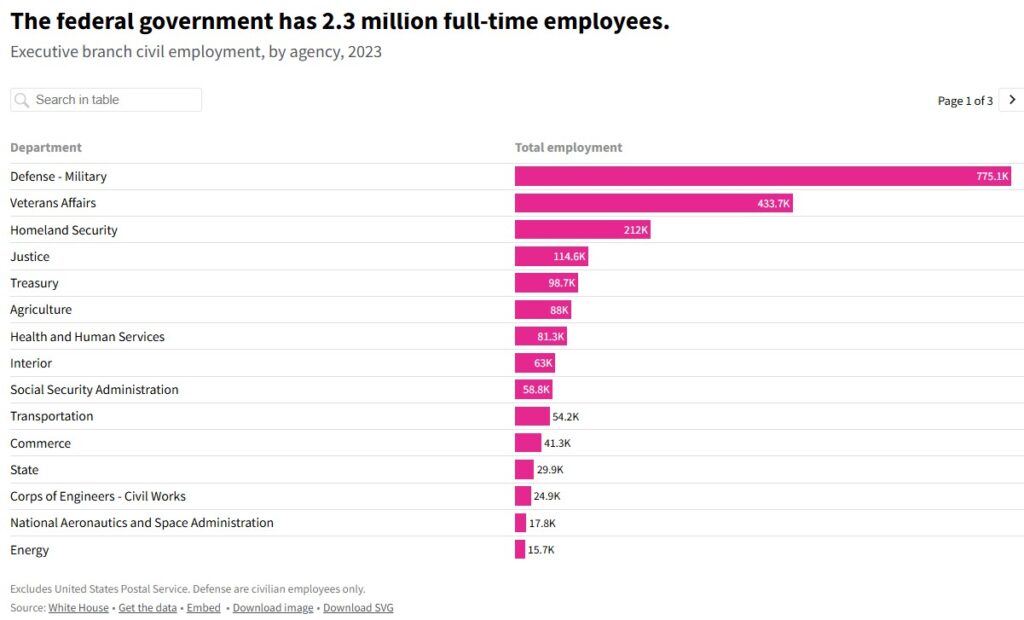
The Federal government has 2.3 MIllion Full-time employees, of that number 1.4 Million (61%) work in the Military, Veterans Affairs or Homeland Security departments.
The size of the federal workforce is comparable to the information industry (publishing, broadcasting, telecommunications), which employs just over 3 million people. Size-wise, the next-closest industry is education services (schools, colleges, universities, and training centers), with approximately 3.8 million workers.
The federal workforce is relatively small compared to the nation’s largest workforce: professional and business services which includes scientific and technical services (including legal, accounting, advertising, and consulting), corporate management, administrative and support services, and waste management, employs 22.8 million people.
SOURCE: https://usafacts.org/articles/how-many-people-work-for-the-federal-government/
https://www.pewresearch.org/short-reads/2025/01/07/what-the-data-says-about-federal-workers/