Build and Care Initiative
Overview > Key Actions > Program 2: American Dream
PROGRAM 2: AMERICAN DREAM
| Why voters want this
• Voters under 30 swung about 17 points toward Democrats compared with 2024 and are angry about the country’s direction. • Households earning under $50,000 report the most financial strain. • Pew found 62% of voters rate education very important; it lands best when tied to jobs and wages. |
What the program does
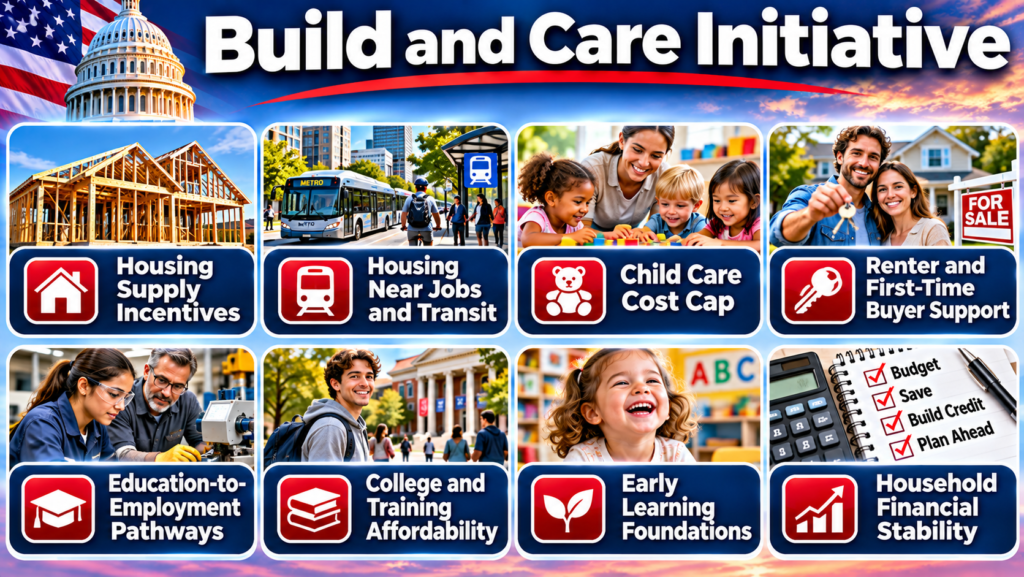
1. Housing supply incentives
Tie part of federal transportation and community development grants to local zoning reforms that allow more homes: smaller lots, accessory units and conversions of commercial buildings. Expand the low-income housing tax credit and add a starter-home construction credit.
2. Housing near jobs and transit
Support more homes near jobs and transit, streamline permitting without weakening health and safety standards, and use targeted vouchers and rental assistance for households in acute hardship.
3. Child care cost cap
Set a target that families pay no more than a fixed share of income for licensed care, funded through block grants to states that expand supply and raise provider pay. Expand the dependent care tax credit as a faster first step.
4. Renter and first-time buyer support
Down payment help for first-generation buyers, and emergency rental assistance for households hit by energy price shocks.
5. Education-to-employment pathways
Paid apprenticeships and employer partnerships in health care, construction, manufacturing, energy and skilled trades; career and technical education matched to verified regional demand; short-term credentials that transfer. Tie public money to completion, job placement and wage gains.
6. College and training affordability
Simplify aid applications, show total costs and expected debt up front, and tie public support to completion and employment results without penalizing public-service fields or programs that serve disadvantaged students.
7. Early learning foundations
Strengthen early literacy, numeracy and tutoring with evidence-based methods, and report progress and achievement gaps publicly.
8. Household financial stability
Stronger protections against predatory lending and abusive fees, plus emergency savings tools and financial counseling.
Design options
| Option | What it means | Trade-off |
| Child care as a tax credit | Families receive a larger dependent care credit. | Favored by conservatives; simpler, but does less to expand supply. |
| Child care as provider funding | Block grants to states that raise provider pay and open new slots. | Favored by progressives; builds supply, costs more. |
| Hybrid (recommended) | A credit now, with provider grants phased in. | Best odds of passage; visible help in year one. |
| Housing: carrots or conditions | Bonus funding for reforming jurisdictions, or grant conditions on all. | Bonuses avoid backlash; conditions move faster but draw local resistance. |
Success metrics
| Measure | Baseline | Target |
| Housing permits in participating areas | Below demand | Up year over year |
| Child care cost as a share of family income | High | Falling in participating states |
| Apprenticeship completion, placement and wage gains | Not tracked jointly | Published by program |
| Rent burden and homelessness | Rising | Declining, by income and region |
| Literacy and numeracy proficiency | Baseline in 2027 | Measurable gains |
Explore the other key actions
Previous: Program 1: Affordability: Kitchen Table Relief Package
Next: Program 3: Health Care: Health Cost Guarantee
Sources for this page
- AP Voter Poll: How key demographic groups voted in the 2026 midterms (AP via PBS News, November 3, 2026)
- Economy Ranks as Top Issue in Midterms for All Voters (Pew Research Center, October 8, 2026)
- AP Voter Poll 2026: how voters shifted since 2024 (secondary analysis of AP data)
- How Trump and Republicans lost the 2026 midterm elections, according to AP Voter Poll (AP via PBS News, November 4, 2026)
The 2026 Midterms: What Comes Next. Analysis updated November 8, 2026. Figures from election-day and pre-election surveys; projections may change as counting finishes.