Messaging and Implementation
Overview > Messaging and Implementation
Voters rewarded candidates who talked about prices in concrete terms and punished those who seemed distracted or self-serving. This page applies that lesson to governing.
| Lead line: Lower costs, cleaner government.
• Two ideas, both top voter concerns, each reinforcing the other. • Corruption is one reason costs are high: tariffs imposed without a vote, data centers passing costs to families, insiders trading on information. |
Message principles
- Proof points over promises. Cite a specific dollar figure, bill or date every time.
- Name the household, not the program. “A family in Ohio pays $X less for insulin this month” beats a program name.
- Do not claim credit for prices you did not move. Global energy prices and interest rates are outside any program’s reach.
Words to use and avoid
| Use | Avoid | Why |
| Lower your bills, cost of living, prices | Economic jargon (GDP, CPI, soft landing) | Voters judge the economy by receipts, not indicators |
| Accountability, checks and balances, no one above the rules | Purely partisan attacks on the president | About 4 in 10 Republicans want stronger checks |
| Secure and fair, orderly | Open borders or enforcement-only language | 57% say enforcement went too far, yet Republicans lead on trust |
| Make big tech pay its fair share | Anti-technology rhetoric | Voters fear AI harm but value growth |
| Change, results, delivered | Victory laps | The mandate is conditional |
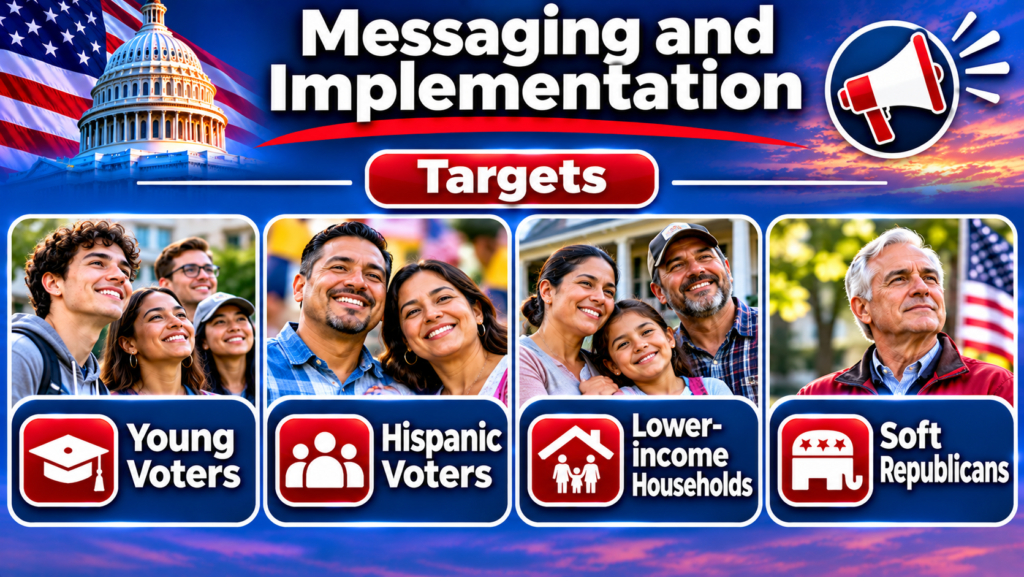
Who to reach, and with what
| Audience | Lead topics | Approach |
| Independents and moderates | Ethics reform, drug price caps, ratepayer protection, border capacity | High-agreement, low-partisanship topics |
| Young voters | Housing, child care, AI worker protections | Digital channels; show results quickly |
| Hispanic voters | Prices and wages, then immigration as order plus fairness | About 7 in 10 blame current policy for the economy |
| Lower-income households | Utility bill relief, grocery competition | Trusted local messengers |
| Soft Republicans | Corruption, congressional authority, data center costs, public safety | Stress fiscal responsibility |
Implementation
First 100 days of the new Congress
Pass the stock trading ban and at least one cost measure with a visible effect, such as a drug cap expansion or tariff relief on staples. Two early wins establish credibility.
A 100-day policy development plan
Days 1 to 30 Set up a cross-functional policy team, test national findings against state and district evidence, publish a baseline dashboard and fix existing programs before creating new ones.
Days 31 to 60 Draft legislative concepts with legal reviews, cost estimates and analysis of who benefits; consult state and local officials, providers, employers and experts.
Days 61 to 100 Release draft proposals with timelines, agency owners, cost ranges, beneficiaries, risks and outcome measures; take public comment and revise.
Delivery standards
- Delivery unit: a leadership-level team tracks each program and publishes a public scorecard every quarter, including failures.
- Budget discipline: name a funding source, give 5- and 10-year cost estimates, separate gross from net cost and avoid double-counting savings.
- State partnerships: work with new governors and legislatures on grocery tax cuts, data center ratepayer rules and zoning reform.
- Sequencing: start with clear legal authority; use pilots only with sunset or review dates; require inspector general review for large programs.
Risks to manage
| Risk | How to manage it |
| Overreach: only about half view the winning party favorably | Lead with high-agreement measures; save divisive items for later |
| Veto and gridlock | Use must-pass bills, bipartisan coalitions and state action; make vetoes of popular bills a visible choice |
| New spending fuels inflation | Favor supply-side measures and pay for new spending |
| Oversight seen as revenge | Tie every oversight effort to costs, waste or safety |
| External shocks from the Iran war and energy markets | Build energy price contingency plans and war powers oversight into the agenda |
Timeline
December 2026 Pick the two first-100-day priorities; estimate costs for all seven programs; commission district polling; begin message testing.
January 2027 Introduce the Clean Government and Accountability Act and the first cost-of-living bill.
First quarter 2027 Launch the delivery unit and public scorecard; convene governors on the state partner track.
Mid 2027 Attach health, housing, immigration and public safety pieces to spending and reauthorization bills.
2028 Campaign on a record of measurable delivery.
Design options
| Option | What it means | Trade-off |
| Speed over scale (recommended) | Smaller, targeted bills that pass in 2027. | Visible wins before 2028; some goals deferred. |
| Scale over speed | Larger packages that address problems fully. | More impact if passed; may stall until 2029. |
| Oversight intensity | Targeted, cost-linked oversight versus aggressive investigation. | Targeted oversight keeps persuadable voters; aggressive oversight energizes the base but risks the margin. |
Success metrics
| Measure | Baseline | Target |
| Messages tested with each target audience | None | All five audiences by early 2027 |
| Early wins passed in the first 100 days | None | At least two |
| Quarterly scorecard released on time | None | Every quarter |
| Proposals with full cost and funding estimates | None | All seven programs |
| District polling and listening sessions completed | None | Before final adoption |
Sources for this page
- AP Voter Poll: The economy and the state of democracy are voters’ top issues (AP via PBS News, November 3, 2026)
- How Trump and Republicans lost the 2026 midterm elections, according to AP Voter Poll (AP via PBS News, November 4, 2026)
- Fox News Voter Poll: 2026 midterm elections usher in a blue wave (Fox News, November 4, 2026)
- Health Care in the 2026 Midterm Election (KFF, updated November 4 to 5, 2026)