Messaging and Implementation
Overview > Messaging
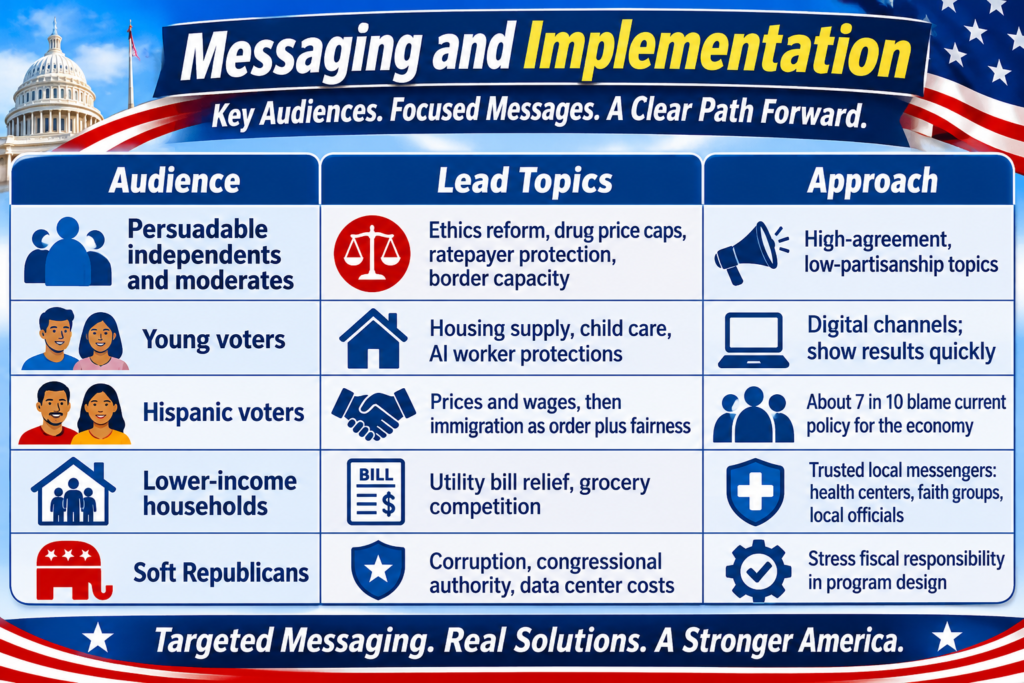
Voters rewarded candidates who talked about prices in concrete terms and punished those who seemed distracted or self-serving. This guide applies that lesson to governing.

Message principles
- Proof points over promises. Every speech and ad should cite a specific dollar figure, bill or date. Voters who trust neither party respond to evidence of delivery.
- Name the household, not the program. “A family in Ohio pays $X less for insulin this month” beats “the Health Cost Guarantee.”
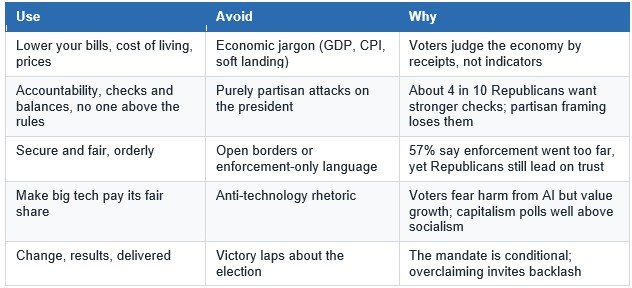
Words to use and avoid
Delivery plan
- First 100 days: pass the stock trading ban and at least one cost measure with a visible effect, such as a drug cap expansion or tariff relief on staples.
- Delivery unit: a leadership-level team tracks each program against its success measure and publishes a public scorecard every quarter.
- State partnerships: work with newly elected governors and legislatures on grocery tax cuts, data center ratepayer rules and zoning reform, which can show results even if federal bills stall.
- Oversight with a purpose: hold hearings tied directly to costs, such as tariff impacts, price gouging and data center utility bills.Sources for this page
Risks, Trade-offs and Next Steps
The largest risk is misreading the result: treating a vote against the status quo as a vote for a full partisan agenda. The second is delivering too slowly for voters who are already angry.
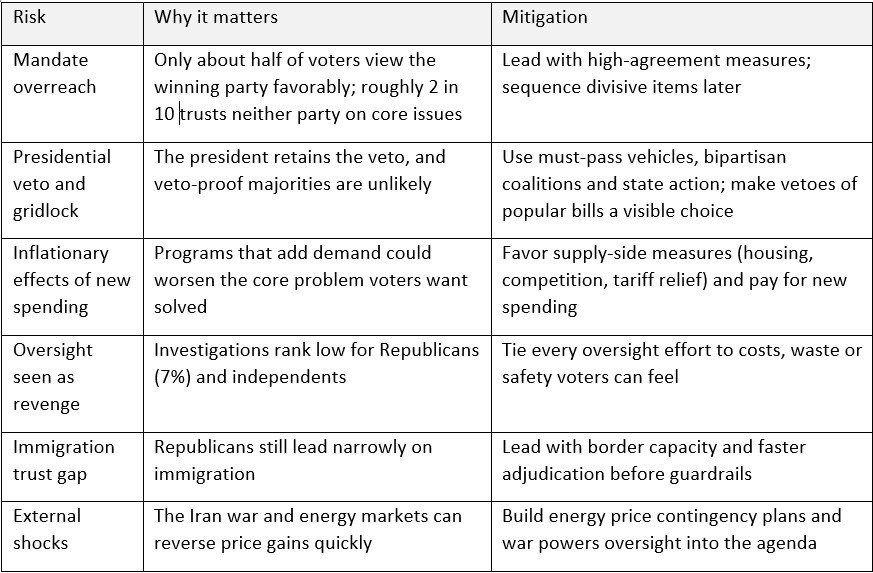
Trade-offs to decide now
- Speed versus scale. Smaller bills that pass in 2027 may beat larger packages that stall until 2029. This paper recommends speed.
- Relief versus structure. Rebates and caps help immediately; zoning and competition reforms take years. A credible agenda needs both, with relief front-loaded.
- Oversight intensity. Aggressive oversight energizes the base but risks alienating the persuadable voters who supplied the margin. The recommended posture is targeted, cost-linked oversight.
Next steps
- By December 2026: leadership selects the two first-100-day priorities; budget staff produces cost estimates for all six programs; message testing begins with the target audiences in Section 6.
- January 2027: introduce the Clean Government and Accountability Act and the first cost-of-living bill on the opening days of the new Congress.
- First quarter 2027: launch the delivery unit and public scorecard; convene governors on the state partner track.
- Mid 2027: attach health, housing and immigration elements to appropriations and reauthorization bills.
- 2028: campaign on a record of measurable delivery, using the success metrics defined in Section 5.
Open questions: Which audience is the priority for 2028 (holding new swing voters or expanding further)? What fiscal constraints will leadership impose on new spending? Which governors are ready to move first on the state partner track?
Sources
- AP Voter Poll: The economy and the state of democracy are voters’ top issues (AP via PBS News, November 3, 2026)
- How Trump and Republicans lost the 2026 midterm elections, according to AP Voter Poll (AP via PBS News, November 4, 2026)
- AP Voter Poll: How key demographic groups voted in the 2026 midterms (AP via PBS News, November 3, 2026)
- The Issues Voters Say Matter Most This Midterm (Gallup, October 29, 2026)
- Economy Ranks as Top Issue in Midterms for All Voters (Pew Research Center, October 8, 2026)
- Many voters saw midterm election as a rebuke of Trump, NBC News Exit Poll shows (NBC News, November 4, 2026; figures taken from search summary)
- See CBS News exit poll results for the 2026 midterm elections (CBS News)
- Ahead of the midterms, most voters cite the economy and cost of living as top issues (AP-NORC, October 2026)
- 2026 midterm election updates (CBS News, seat projections)
- 2026 midterm election results: Who won the key House and Senate races? (Northeastern Global News, November 5, 2026)
- Inflation, tariffs and a voter revolt: The midterm verdict on Trump’s economy (AP report, November 5, 2026)
- Voters Put Affordability First (Forbes, November 4, 2026)
- AP Voter Poll 2026: how voters shifted since 2024 (secondary analysis of AP data)
- Fox News Voter Poll: 2026 midterm elections usher in a blue wave (Fox News, November 4, 2026)
- Following Callais: Views on Supreme Court Remain Mixed But Reforms Are Popular (Navigator Research, May 21, 2026)
- Majorities of Americans say Donald Trump gives out too many pardons and want to limit pardon power (Economist/YouGov, December 2025)
What Voters Want 2026. Working analysis, November 2026. Figures from election-day and pre-election surveys; projections may change as counting finishes.