The Mood of the Voters
Overview > Mood of the Voters
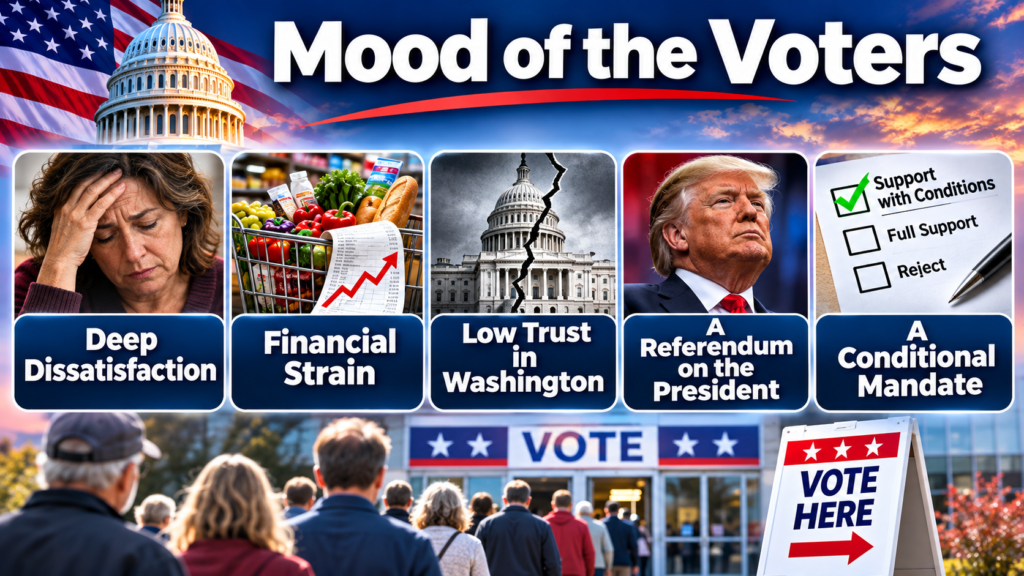
The 2026 electorate was angry at the status quo, not enthusiastic about the winners.
That mood is both the new majority’s opening and its biggest risk.
3 in 4Felt angry or dissatisfied with the country’s direction |
3 in 4Rated the economy not so good or poor |
14%Approved of Congress before the election |
About three-quarters of voters felt angry or dissatisfied with the direction of the country.
Only about one-quarter felt satisfied or enthusiastic. Dissatisfaction reached majorities even in deep-red states.

About three-quarters rated the economy “not so good” or “poor.”
Voters were more than twice as likely to say their finances had worsened as improved, and among voters earning under $50,000, about 6 in 10 said they were worse off than two years ago.
Before the election, Gallup found only 15% of Americans said most members of Congress deserve reelection, a record low before a midterm.
Asked to name the nation’s top problem, more Americans named “the government” (26%) than anything else.
About 6 in 10 voters disapproved of President Trump’s job performance. About 4 in 10 said their House vote was meant to oppose him, just under 2 in 10 to support him, and about 4 in 10 said he was not a factor.
Only about half of voters view the Democratic Party favorably, compared with about 4 in 10 for Republicans, and about 2 in 10 Democratic voters hold a negative view of the party they supported.
On the economy, health care, taxes, foreign policy and immigration, roughly 2 in 10 said neither party would do better; the share was higher on corruption and AI.
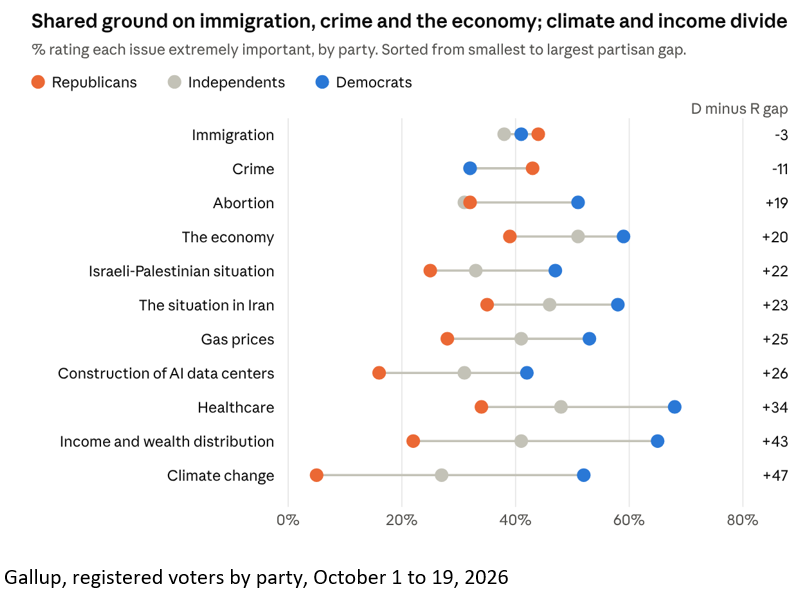
Interests vary by party affiliation
Design options
How leaders respond to this mood matters as much as what they propose.
| Option | What it means | Trade-off |
| Humility and results (recommended) | Acknowledge the anger, avoid victory laps, and point to specific deliverables. | Matches the conditional mandate; less rallying for the base. |
| Mandate claim | Treat the result as approval of the full platform. | Energizes supporters; invites backlash from voters who only wanted change. |
| Shared frustration | Speak to anger at Washington across party lines, including on ethics and checks on power. | Reaches independents and soft Republicans; must be backed by reforms that bind the majority itself. |
Success metrics
| Measure | Baseline | Target |
| Voters satisfied with the country’s direction | About 1 in 4 | Rising |
| Voters rating the economy positively | About 1 in 4 | Rising |
| Voters saying finances worsened versus improved | More than 2 to 1 | Narrowing |
| Favorable view of the majority party | About half | Held or rising |
| Voters trusting neither party | About 2 in 10 | Falling |
Sources for this page
- AP Voter Poll: The economy and the state of democracy are voters’ top issues (AP via PBS News, November 3, 2026)
- How Trump and Republicans lost the 2026 midterm elections, according to AP Voter Poll (AP via PBS News, November 4, 2026)
- AP Voter Poll: How key demographic groups voted in the 2026 midterms (AP via PBS News, November 3, 2026)
- The Issues Voters Say Matter Most This Midterm (Gallup, October 29, 2026)
- Inflation, tariffs and a voter revolt: The midterm verdict on Trump’s economy (AP report, November 5, 2026)