Priorities
Overview > Priorities
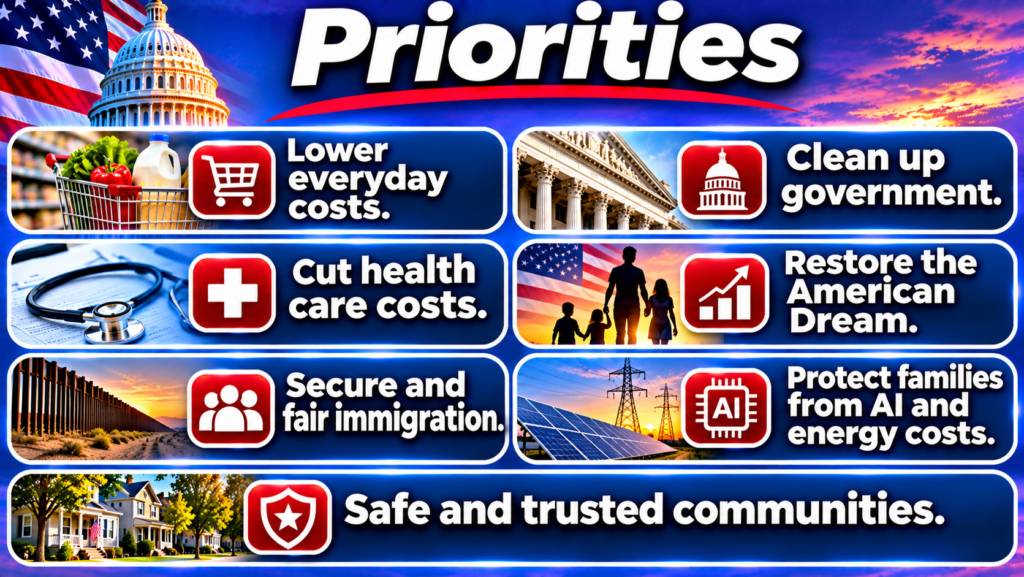
Not every concern can come first. These priorities rank what to act on by how many voters care, how much shared ground exists and how fast results can show.
Ranked priorities
1 Lower everyday costs. The top concern for voters of every party. Tariff relief on staples and fee transparency can move first.
2 Clean up government. Corruption was crucial for more than half of voters. A stock trading ban is popular in both parties and can pass in 100 days.
3 Cut health care costs. Half of the voters rate health care as extremely important, and voters trust Democrats on it by 20 points.
4 Restore the American Dream. Housing, child care, and skills matter most to the young and lower-income voters who swung hardest.
5 Secure and fair immigration. The one issue where Republicans hold a trust edge; a balanced approach can close it.
6 Protect families from AI and energy costs. Open ground where many voters trust neither party.
7 Safe and trusted communities. Crime matters most to Republican voters, making it a bridge to voters the majority does not yet hold.
Where the parties agree and differ
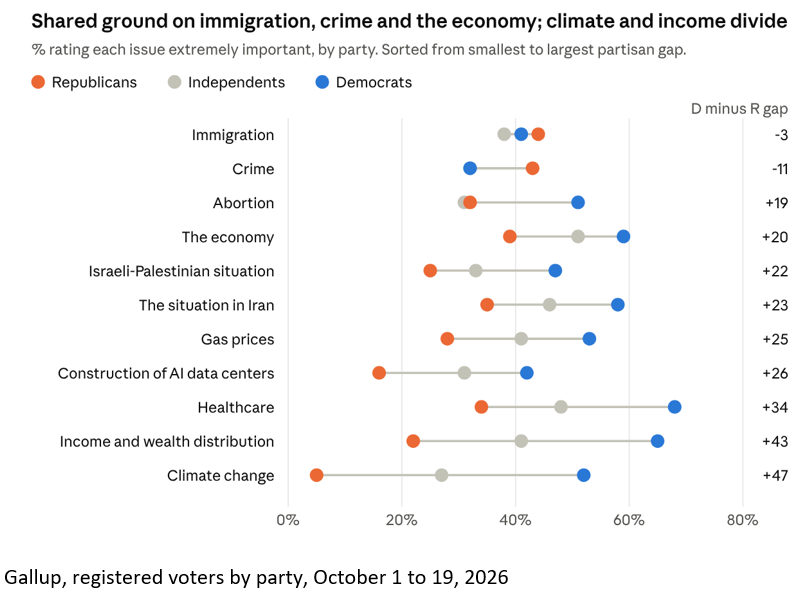
To persuade, lead with low-gap issues: immigration, crime and the economy, which 82% of Republican and 88% of Democratic supporters rate very important (Pew).
- To mobilize, use high-gap issues: climate, income distribution and health care.
- Frame in cost terms: health care as a monthly bill reaches Republicans and independents better than health care as coverage policy.
Groups that moved, and what they want
| Group | What happened | What they want |
| Voters under 30 (about 1 in 10 voters) | About 7 in 10 voted Democratic for the House, after splitting roughly evenly in 2024 | Housing, child care, AI and job security; fast results |
| Hispanic voters | About 6 in 10 voted Democratic; Republican share fell from about 4 in 10 to about one-third | Prices and wages first; enforcement guardrails with border credibility |
| Households under $50,000 (about 3 in 10 voters) | Swung away from Republicans | Visible relief on utilities, groceries and health care |
| Moderates and independents | Moved toward Democrats | Bipartisan framing, ethics reform, measurable cost results |
| Republican voters | Base held, but about 4 in 10 want more checks on the president | Corruption, data center costs, public safety, congressional authority |
Priorities have flipped since 2022
| Rated extremely important | 2022 | 2026 | Change |
| Democrats: the economy | 33% | 59% | +26 |
| Democrats: immigration | 22% | 41% | +19 |
| Republicans: the economy | 64% | 39% | -25 |
| Republicans: crime | 55% | 43% | -12 |
| Independents: the economy | 47% | 51% | +4 |
The new majority’s own voters now hold it to an economic standard, and opposition voters will re-engage on the economy as soon as the other party is in charge of it.
Design options
| Option | What it means | Trade-off |
| Persuasion first | Sequence low-gap priorities (costs, ethics, immigration, crime) ahead of others. | Wins independents and some Republicans; base may grow impatient. |
| Mobilization first | Lead with high-gap priorities that energize the base. | Holds the coalition; does little to widen it. |
| Balanced sequence (recommended) | Pair one persuasion priority with one base priority in each phase. | Keeps both groups engaged; requires discipline about timing. |
Success metrics
| Measure | Baseline | Target |
| House vote share among voters under 30 | About 7 in 10 | Held in 2028 |
| Hispanic vote share | About 6 in 10 | Held or rising |
| Independents trusting neither party | Over 4 in 10 on health care | Falling |
| Republicans backing at least one majority bill | None yet | Bipartisan votes on two or more priorities |
Sources for this page
- The Issues Voters Say Matter Most This Midterm (Gallup, October 29, 2026)
- Economy Ranks as Top Issue in Midterms for All Voters (Pew Research Center, October 8, 2026)
- AP Voter Poll: How key demographic groups voted in the 2026 midterms (AP via PBS News, November 3, 2026)
- AP Voter Poll 2026: how voters shifted since 2024 (secondary analysis of AP data)
- Health Care in the 2026 Midterm Election (KFF, updated November 4 to 5, 2026)