Health Cost Guarantee
Overview > Key Actions > Program 3: Health Care
PROGRAM 3: HEALTH CARE
| Why voters want this
• Half of voters rate health care extremely important, tying Gallup’s 2010 high. • KFF found about 6 in 10 voters very concerned about health care costs, on par with gas and groceries, and 55% said federal policy made their own costs worse. • Voters trust Democrats over Republicans on health care 50% to 30%; about 6 in 10 want a bigger federal role in helping people get care. |
What the program does
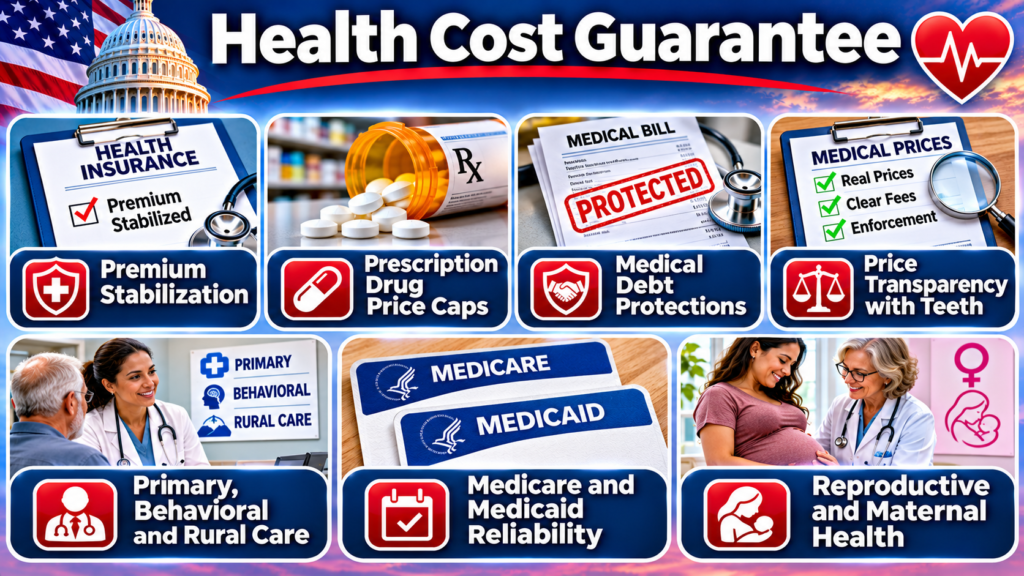
1. Premium stabilization
Protect and, where needed, restore marketplace premium help so no family pays more than a fixed share of income for benchmark coverage.
2. Prescription drug price caps
Extend monthly out-of-pocket caps, like the insulin cap, to more drugs for chronic disease, and expand the number of drugs covered by federal price negotiation.
3. Medical debt protections
Keep medical debt off credit reports, cap interest on it, and require nonprofit hospitals to screen patients for charity care before collections.
4. Price transparency with teeth
Enforce hospital and insurer price disclosure with real penalties, a measure with Republican roots.
5. Primary, behavioral and rural care
Expand community health centers, rural clinics and telehealth where clinically appropriate, with mental health and substance use treatment built in.
6. Medicare and Medicaid reliability
Protect continuity of coverage for older adults, people with disabilities, children and low-income families; cut paperwork churn with data matching, renewal reminders and enrollment help.
7. Reproductive and maternal health
Clarify federal protections for emergency care, including pregnancy complications; protect the privacy of reproductive health records; improve access to contraception, prenatal and postpartum care; support rural maternity services. State laws differ, so each proposal should state which level of government holds authority.
Questions to answer before introduction
- What is the expected effect on premiums, deductibles, taxes and federal deficits?
- Will rural hospitals, independent practices and safety-net providers stay financially viable?
- How will people with employer coverage, marketplace plans, Medicare and Medicaid be affected differently?
- What safeguards prevent cost shifting, narrower networks or delayed care?
Design options
| Option | What it means | Trade-off |
| Bipartisan first | Lead with drug caps, price transparency and medical debt protections. | Can pass now; leaves premium costs unresolved. |
| Coverage first | Lead with premium assistance and Medicaid continuity. | Biggest effect on household bills; more partisan and may need a future spending vehicle. |
| Sequenced (recommended) | Pass the bipartisan pieces in 2027 while building the case for premium help. | Shows early results and keeps the larger goal in view. |
Success metrics
| Measure | Baseline | Target |
| Average out-of-pocket health spending | Rising | Lower by 2028 |
| Adults skipping care because of cost | Baseline in 2027 | Declining |
| Voters very concerned about health costs | About 6 in 10 | Declining |
| Medical debt on credit reports | Present | Removed |
| Rural provider closures and maternal outcomes | Baseline in 2027 | Published on a public dashboard |
Explore the other key actions
Previous: Program 2: American Dream: Build and Care Initiative
Next: Program 4: Corruption and Accountability: Clean Government and Accountability Act
Sources for this page
- The Issues Voters Say Matter Most This Midterm (Gallup, October 29, 2026)
- Health Care in the 2026 Midterm Election (KFF, updated November 4 to 5, 2026)
- Economy Ranks as Top Issue in Midterms for All Voters (Pew Research Center, October 8, 2026)
- AP Voter Poll: The economy and the state of democracy are voters’ top issues (AP via PBS News, November 3, 2026)
The 2026 Midterms: What Comes Next. Analysis updated November 8, 2026. Figures from election-day and pre-election surveys; projections may change as counting finishes.