Fair Share Grid and Worker Shield
Overview > Key Actions > Program 6: AI Issues
PROGRAM 6: AI ISSUES
| Why voters want this
• 57% of voters expect AI to do more harm than good for society. • 61% dislike leaders who back data centers near them; only 8% like it. • Pew found 54% rate energy policy very important; large shares trust neither party on AI, so the issue is open ground. |
What the program does
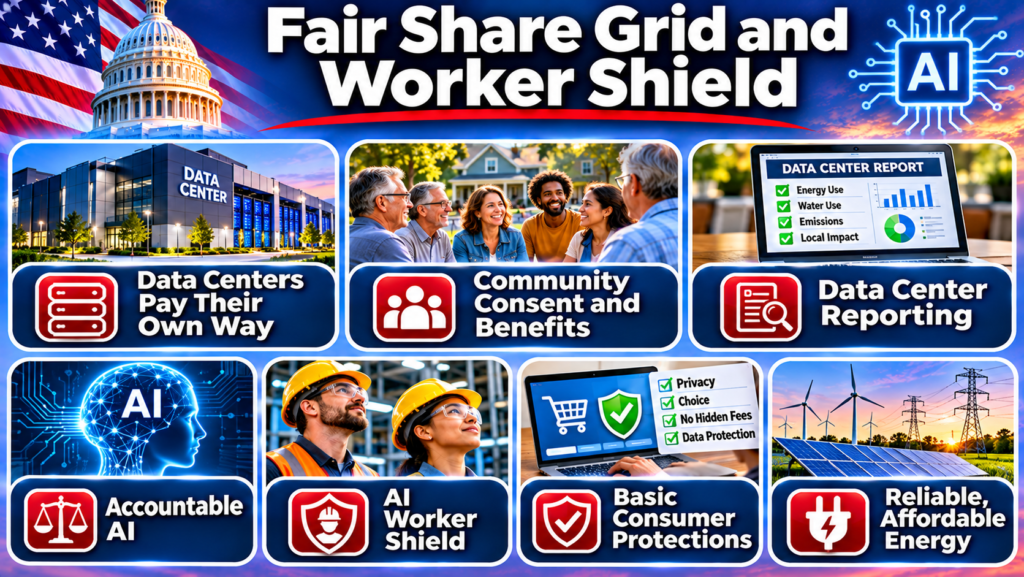
1. Data centers pay their own way
Grid upgrades and new power built for large data centers are paid for by those facilities, not by household ratepayers.
2. Community consent and benefits
Local hearings, disclosure of water use, and binding community benefit agreements covering local hiring, tax payments and environmental safeguards.
3. Data center reporting
Public reporting of projected electricity and water demand, grid impacts and community benefits, with the same rules for every company.
4. Accountable AI
Risk-based testing, documentation and incident reporting for high-impact AI used in employment, credit, health care and public services; meaningful human review of major automated decisions; stronger protection of personal data.
5. AI Worker Shield
Advance notice of mass layoffs driven by AI, portable training accounts and wage insurance for displaced workers.
6. Basic consumer protections
Disclosure when AI is used in decisions about hiring, lending, insurance and health care, and protections against deceptive AI-generated content, especially for children.
7. Reliable, affordable energy
Modernize transmission to cut outages and congestion; speed permitting while keeping real environmental review; use competitive procurement and a diversified mix judged on cost, reliability and emissions.
8. Disaster readiness
Fund flood, wildfire, heat and water system resilience, with each project publishing expected risk reduction and lifetime costs.
Design options
| Option | What it means | Trade-off |
| Ratepayer first | Lead with data centers paying their own grid costs and local consent. | Strong rural and Republican appeal; ties directly to utility bills. |
| Worker first | Lead with layoff notice, wage insurance and training accounts. | Appeals to labor and younger voters; more contested by industry. |
| Framing choice | Present the program as fairness, not as opposition to technology. | Voters fear harm from AI but value growth; anti-technology framing loses them. |
Success metrics
| Measure | Baseline | Target |
| Residential rate increases caused by data center demand | Rising in some states | None in participating states |
| Household energy burden and outage duration | Baseline in 2027 | Lower |
| Documented high-risk AI incidents and complaint resolution time | Not reported | Reported and falling |
| Voters who trust the sponsoring party on AI | Large share trust neither | Rising |
Explore the other key actions
Previous: Program 5: Immigration: Secure and Fair Border Compact
Next: Program 7: Public Safety: Safe and Trusted Communities
Sources for this page
- Many voters saw midterm election as a rebuke of Trump, NBC News Exit Poll shows (NBC News, November 4, 2026)
- Economy Ranks as Top Issue in Midterms for All Voters (Pew Research Center, October 8, 2026)
- The Issues Voters Say Matter Most This Midterm (Gallup, October 29, 2026)
- How Trump and Republicans lost the 2026 midterm elections, according to AP Voter Poll (AP via PBS News, November 4, 2026)
The 2026 Midterms: What Comes Next. Analysis updated November 8, 2026. Figures from election-day and pre-election surveys; projections may change as counting finishes.