Key Actions
Overview > Key Actions
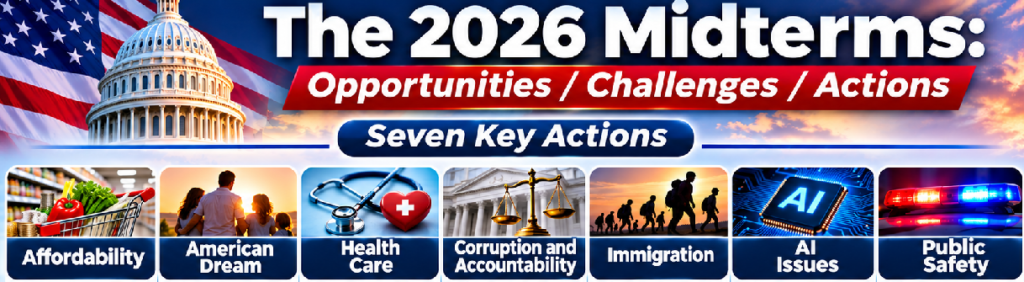
Seven programs answer what voters asked for. Each is built to produce something people can see, name and feel before the 2028 cycle begins.
The seven programs
Program 1: Affordability: Kitchen Table Relief Package
Tariff relief on everyday goods, lower utility bills, competition enforcement and honest pricing: a cost-of-living package built on what 2026 voters said.
Program 2: American Dream: Build and Care Initiative
More homes, affordable child care and paths from school to good jobs: a plan to put the American Dream back in reach for young and working families.
Program 3: Health Care: Health Cost Guarantee
Stable premiums, capped drug costs, protection from medical debt and better access to care, built around voters’ top health worry: cost.
Program 4: Corruption and Accountability: Clean Government and Accountability Act
A stock trading ban, ethics rules, pardon reform, lobbying disclosure and restored congressional checks, matched to voters’ concern about corruption.
Program 5: Immigration: Secure and Fair Border Compact
Border capacity paired with enforcement guardrails, detention standards and legal work pathways: a balanced plan matched to how voters see immigration.
Program 6: AI Issues: Fair Share Grid and Worker Shield
Make data centers pay their own grid costs, require community consent, hold high-risk AI to account and protect workers, while keeping energy reliable and affordable.
Program 7: Public Safety: Safe and Trusted Communities
Focused violence reduction, more serious crimes solved, professional policing, and prevention that works: public safety policy that earns trust.
Three principles behind every program
- Visible over clever. A line on a utility bill or a lower pharmacy receipt beats a complex tax provision voters never notice.
- Prices first, then structure. Short-term relief buys time; structural reforms such as housing supply and competition prevent the next squeeze.
- Pass what can pass. Each program includes bipartisan pieces, pieces that can ride must-pass bills, and pieces states can enact on their own.
Programs at a glance
| Program | Cost tier | Bipartisan potential | Best legislative vehicle |
| Affordability | Medium | High on tariffs, competition and fee transparency | Standalone bills; spending bill riders |
| American Dream | High | High on zoning and apprenticeships; medium on child care | Transportation, workforce and tax legislation |
| Health Care | Medium to high | High on drug caps and transparency; low on reproductive health | Health extenders package; spending bills |
| Corruption and Accountability | Low | High on stock ban and disclosure; medium on executive ethics | Standalone; rules package; defense bill for war powers |
| Immigration | Medium | Medium | Homeland security spending bill |
| AI Issues | Low to medium | High on ratepayer protection and grid reliability | Energy and permitting legislation; state action |
| Public Safety | Medium | High on clearance rates; medium on policing standards | Justice spending and grant programs |
Cost tiers are planning estimates, not scored figures, and should be checked with budget staff and the Congressional Budget Office.
Design options
| Option | What it means | Trade-off |
| One omnibus package | Combine all seven programs in a single bill. | One big moment; one veto ends everything. |
| Seven standalone bills | Move each program separately. | Each can succeed or fail alone; harder to tell one story. |
| Phased waves (recommended) | Ethics and affordability first, then health and housing, then immigration, AI and public safety, riding must-pass bills where possible. | Early wins build credibility for the harder fights. |
Success metrics
| Measure | Baseline | Target |
| Programs with at least one component enacted | 0 of 7 | 5 of 7 by end of 2027 |
| Components enacted by states through the partner track | None | Grocery tax, ratepayer and zoning reforms in multiple states |
| Quarterly public scorecard | None | Published on schedule with results and failures |
Related pages
The 2026 Midterms: What Comes Next. Analysis updated November 8, 2026. Figures from election-day and pre-election surveys; projections may change as counting finishes.